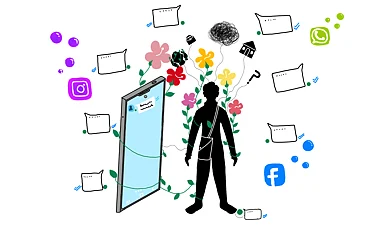
*What physical play produces in terms of spontaneity, balance and control cannot be replicated on an already pre-coded virtual screen.
*A puppy chasing its own tail, children playing tag, a child playing dress-up are all forms of play.
*Are we willing, as a collective society, to build the physical, social and structural conditions in which children actually have something worth putting devices down for?
Every evening, many children play in the lobby of my building. Most of them are under ten, each with a tablet in hand. They sit side by side, very absorbed and very present, perhaps playing. But are they really playing? Something is missing from this frame. Even though they are together, it does not feel that way. Barely moving in the embodied sense that characterises traditional play, the negotiations in real time, the unannounced invented rule, a scraped knee, the squabbles and other tangible evidence of play are largely absent. What we see here is a distinction between playing together virtually and playing together physically.
Child development research has long established that play is not simply recreation, a reward at the end of a school day, or a scheduled activity on a learning app. It is the primary way children make sense of the world. Play, then, is not just the pushing and pulling, the pointless fighting and reconciliation, the losing and winning and the learning that comes from all of this. Play is primal; it escapes definition. A puppy chasing its own tail, children playing tag, a young child playing dress-up are all forms of play. In this sense, play is an unstructured activity that children manifest through their own agency and imagination. In doing so they undertake some of the most cognitively and socially complex work of their lives.



What physical play produces in terms of spontaneity, balance and control cannot be replicated on an already pre-coded virtual screen, because these qualities depend on something fundamentally irreplaceable: the friction of being physically present with other children who have their own will, moods and ideas. Today, children are not only playing less physically, many seem to have lost the instinct for it. Intolerant of boredom and unsure of what to do with unstructured time as they are, what would happen if unstructured play were given back to them, if it is given back to them at all?
This is why Article 31 of the UN Convention on the Rights of the Child matters beyond its symbolic weight in today’s context. It is a way to recognise every child's right to rest, leisure and play as a right intrinsic to their childhood. But in order to take Article 31 seriously a few uncomfortable questions need to be raised across the spectrum. Are the existing conditions of contemporary childhood: that of urban design, school schedules, parenting culture and digital infrastructure actually compatible with this right? In most cases, the honest answer is that they are not. Unstructured play has been losing ground to structured activity for decades now. This process began with rapid urbanisation long before the smartphone; screens have since accelerated a disappearance already underway.
This erosion of play has many interrelated causes. Risk-averse parenting, shaped by genuine safety concerns in dense urban environments has reduced the freedom children once had to roam, explore and self-organise. Academic pressure and competitive parenting now arrive early in children’s lives and have claimed hours from their days that were once unscheduled. Public spaces designed for children have been shrinking in cities while weather conditions become increasingly hostile, making unstructured play less and less available to them. All these factors have fundamentally reshaped contemporary childhood.
Today, we are understandably anxious about the dangers of social media, excessive technology use and the ways in which they can hamper children’s holistic growth. Research shows how tech platforms exploit developing brains through addictive design and monetise children’s attention.
In the last couple of years, governments have begun responding to the digital dimension. Last year, Australia took a decisive step by banning social media access for children under 16 and so has Canada now. European policymakers are strengthening platform accountability. In India, Karnataka became the first state to formally propose restrictions on social media use for minors. The United Arab Emirates, too, has increasingly emphasised children’s online safety.
Regulation alone cannot restore what is gradually being lost and is at risk. Laws can restrict access but they cannot recreate the social, cultural and physical conditions that make play for children possible in the first place. Critical judgement, tolerance for boredom and real-world social skills only grow through the friction of face-to-face encounters. These cannot be legislated into existence. Moreover, tech-literate young people today are adept at navigating around age-verification systems in all kinds of creative ways, which means restriction alone may only displace risks rather than reduce them.

Framing the digital crisis purely as one of restriction risks ignores the deeper question of what children actually need to thrive, alongside what they need to be protected from. Children are rarely invited into conversations that are directly shaping their lives. True digital safety cannot be achieved by keeping children locked out of the rooms where their futures are being designed.
Then there is the rising wave of artificial intelligence (AI), the newest and perhaps least-examined presence in children’s lives yet. When AI becomes a trusted daily presence for a child, acting as a companion that always responds, never tires and never judges, the threat shifts from what the machine says to how the machine functions. It has the risk of reshaping the very nature of a child’s developmental environment. Children who turn habitually to AI for conversation, guidance and emotional processing are moving away from the healthy friction of human relationships. They bypass the waiting, the misunderstanding and the imperfect business of learning to trust another person. The looming harm is not only in what AI might say but in what it can permanently replace—the messy but real experience of human interactions. In this sense, children in such spaces are not explicitly isolated. They are together, but that togetherness is being mediated almost entirely through an algorithmic system. This shift risks creating a different kind of social self, one that lacks first-hand experience of the unpredictable yet rich possibilities of human encounters and lived reality. This is the biggest challenge perhaps, for all of us.

What would it mean to take International Day of Play seriously rather than as a sentimental or a tokenistic gesture? Taking play seriously means holding urban planners strictly accountable for building accessible outdoor spaces. It means restructuring school timetables around the understanding that unscheduled time is not wasted time. For the tech sector, it requires demanding safety by design and auditing whether digital products are systematically displacing the environments children need for healthy development.
And ultimately, this shift can make sense if it is mirrored by personal action. Parents must take daily responsibility for prioritising offline play against the constant encroachment of digital demands. At the same time, we need children to have these conversations as active agents who have something essential to say about their own lives.
The children in the lobby of my building with their tablets are not a lost generation, and this is not an argument for digital prohibition. The ultimate plea presented by this International Day of Play is not simply whether we have the will to take devices away. It is whether we are willing, as a collective society, to build the physical, social and structural conditions in which children actually have something worth putting devices down for.
(Dr. Sonia Ghalian is an interdisciplinary scholar working at the intersections of film, media, childhood and culture. Currently, she is affiliated with Rochester Institute of Technology, Dubai as adjunct assistant professor)