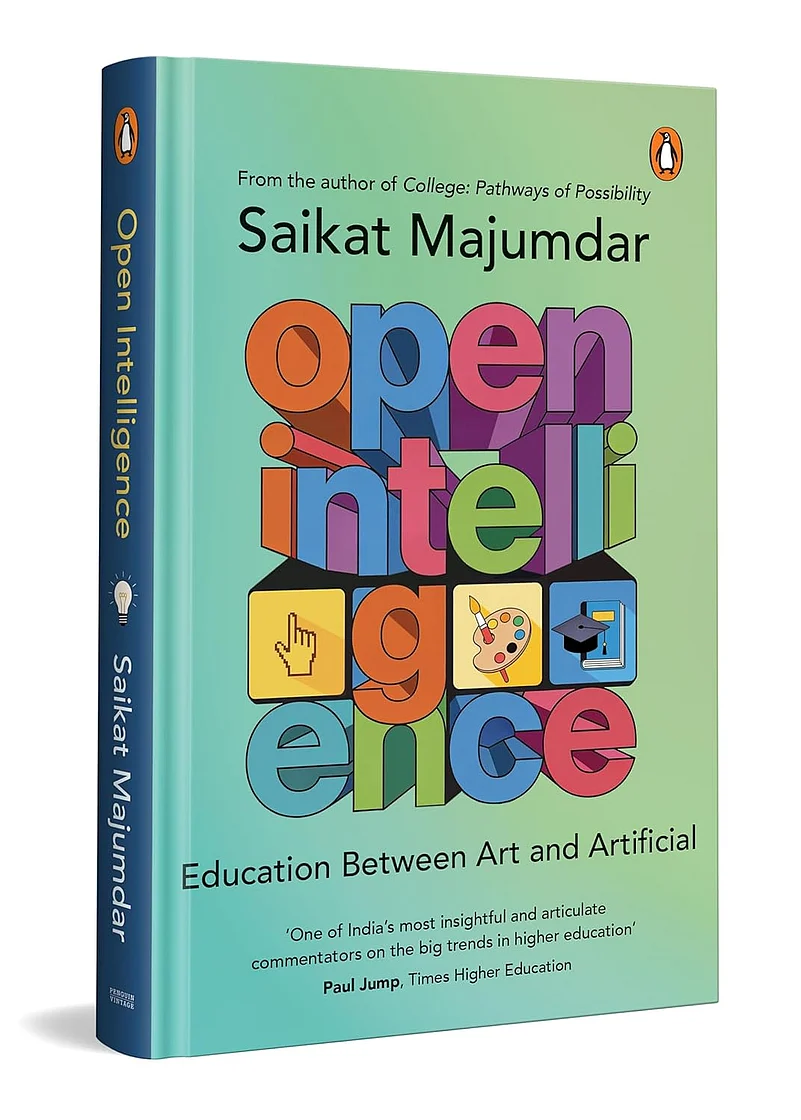
Open Intelligence makes a case for cultivating the interrelated family of personal, emotional, moral, narrative and ethical intelligences.
The ability to empathise is one of the core elements that Majumdar foregrounds as decisive in the age of artificial intelligence (AI)
He pushes past the ethical use of AI to a sharper question: what narratives are we feeding LLMs and how do we train them to read human subtlety as legitimate knowledge, rather than flatten it into categories of bias?
The ability to empathise is one of the core elements that Saikat Majumdar foregrounds as decisive in the age of artificial intelligence (AI) in his book Open Intelligence: Education Between Art and Artificial (Penguin Random House). Emotional, social and personal intelligences (inter- and intra-personal) are already familiar territory. By situating in the context of AI, Majumdar asserts two things. First, that humans are far more than AI’s flattened data. AI, he observes, is growing more sophisticated than humans at processing the patterns of data and text rooted in what Howard Gardner calls logical-mathematical and linguistic intelligences. These are the very faculties education has long prioritised to foster conceptual thinking, analytical reasoning, data interpretation and verbal ability. When these abilities are increasingly absorbed by AI and easily accessible online, what is left for humans?
It is the capacity to bring the vast data and text together, crafting and re-crafting pertinent narratives bound by questions of ethics and fairness, that is likely to remain the domain for human intervention, answers Majumdar. His reminder that AI learns from dominant socio-cultural, economic and political patterns that rapidly restructure opportunities, wealth and power within an already unequal social structure, is pointed. This is why he emphasises the role of ethical consciousness when handling narratives. He pushes past the ethical use of AI to a sharper question: what narratives are we feeding LLMs and how do we train them to read human subtlety as legitimate knowledge, rather than flatten it into categories of bias? His argument that education should urgently make way to “forms of memory that are deeply rooted in one’s emotions, sensibility, ethics and politics” promises a pathway.




Majumdar’s second claim adds more nuance: that humanity is idiosyncratic by virtue of biologically and psychologically inhabiting a range of intelligences that “melt the sensory, body, mind into each other in strange, beautiful and mysterious ways,” and by the capacity for subjective consciousness. This peculiar, and almost invisible integration, in his words, combined with lived experiences—the personal and shared histories of emotions, trauma, belonging—culminates in humanity’s uniqueness, from which the capacity for narrative intelligence emerges.
Still, the sheer volume of data AI processes is commendable, and something humans are incapable of matching. However, no volume of data carries the heavy breath of lived experiences. It is at this exact moment that Majumdar dispels the reader’s anxiety, helplessness and overwhelm surrounding AI-human interchangeability, as he artfully asserts the significance of humanity’s irreplaceable uniqueness ̶ whether in any form of art, education or career.
His empathetic prose and intellect tempered by sensitivity nudged me to ask: what’s the way to shape this creative agency systematically, rather than leaving it to individual efforts and resilience?
Answering this question in the final chapters, he writes of an educational atmosphere that collapses the mind-body hierarchy. Education today is designed to mostly foster conceptual and abstract thinking, training us to understand the world through symbols. Majumdar mentions that symbols are alphabets, numbers, notations in sciences and computer codes, that represent the world without an obvious physical or concrete resemblance. But what education has long excluded is bringing to the forefront the bodily, sensory and emotive forms of thinking that help us learn unexpected truths about living. He puts this mind-body collapse eloquently, “without the concrete, there is no experience, but without the abstract there is no understanding”.

Recently, I visited Vidya Vanam, a school for children from tribal and other communities, in Anaikati, Coimbatore. On its hilly campus stands a life-sized model of a traditional Irula house, built entirely by the Irula children studying there. Built of mud and bamboo, the house speaks in its intricacies, angles, space and history. It felt like a live moment of native intelligence. Those students have now graduated to become artisans. As Majumdar calls for an education that creates space for a learner’s idiosyncratic element, Vidya Vanam can certainly be considered a role model.
While we have long questioned the possibility of customised education given the scale of India’s population, the plea to evolve our educational methods—both for school and higher education—beyond fostering business or technical skills, is pressing. In Majumdar’s earlier book, College: Pathways of Possibility, he details the crux of liberal arts education that includes the wide spectrum of human potential. His idea of contra-disciplinarity—bringing together distinct worldviews—is a compelling lens for holding the abstract and the concrete together. Open Intelligence, its sequel, extends this into a case for cultivating the interrelated family of personal, emotional, moral, narrative and ethical intelligences. This is precisely because the narrow academic and professional aptitudes, as Majumdar observes and as we too can see, have already begun migrating from the domain of the human to the artificial.
One aspect that deeply disturbs me is the dichotomy and hush surrounding AI use. As a PhD scholar, I often feel pulled between collaborating with it ethically and the fear of being judged for using AI. I resist its use with anger and helplessness in equal measure. Open Intelligence has reframed my resistance as participation. Participation, not merely to ‘collaborate’ with AI but to ‘participate’ in the evolving effort to become more human even as we work alongside AI. When Majumdar writes, “Let the artificial optimise. That’s its job. Humanity, humanise thyself,” I cannot argue my way out.
(Swathi Priya is a Ph.D. scholar in Higher Education at O P Jindal Global University, Haryana)