How do you assess the political situation in Bangladesh today?
Bangladesh is passing through a grave political crisis. This is not simply about one government replacing another. It is about the character of the state itself. It is about democracy, the rule of law and the spirit of the Liberation War. When we were in government, we built Bangladesh as a secular, democratic, development-focused and secure country. Today, that Bangladesh is being replaced by fear, mob violence, revenge politics, attacks on minorities, economic instability and rising extremism. A Bangladesh that was moving steadily towards prosperity, confidence and global respect has now been dragged into an atmosphere of fear, uncertainty and darkness. This is not an accident. It is the consequence of the destructive politics of Muhammad Yunus, the former chief adviser of Bangladesh, and Tarique Rahman, the prime minister.
Rahman chose China for his first major bilateral visit rather than India.
Every government has the right to set its diplomatic priorities. But in a normal state, those priorities are guided by history, geography, national interest and the welfare of the people. Bangladesh’s foreign policy should never have sent the wrong message to its neighbours, especially India, our historic friend. The relationship between Bangladesh and India is not only between two governments, it was shaped by the Liberation War, a debt of blood, geography, security and the living bond between our people. Bangladesh should maintain balanced relations with all friendly countries. We should work with China, Japan, the US, Europe and others. But balance does not mean forgetting history. It does not mean creating uncertainty with a proven friend.


Bangladesh’s engagement with China appears to be expanding across infrastructure, investment and strategic cooperation. Do you believe Dhaka is maintaining a balanced foreign policy?
Our guiding principle has always been clear: friendship with all, malice toward none. There is nothing wrong with foreign partners taking part in development. But the real questions are simple: are decisions being made transparently? Are people’s interests being protected? Is Bangladesh in control of its decisions? Bangladesh needs development, but political dependence cannot be called true development.
India has treated me with the utmost respect, honour and dignity. I am grateful to the people and the Government of India. India stood beside us in a difficult time, just as it stood beside us in 1971.
How do you view the evolving relationship between Bangladesh and Pakistan on trade and defence?
Bangladesh was born after an intense struggle against Pakistan. The people of Bangladesh have not forgotten the genocide, rape, arson and destruction carried out by the Pakistani military and their local collaborators. So, any relationship with Pakistan must stand on the truth of history. But what we are seeing today is not just normal diplomacy. In the name of diplomatic warmth, there is an effort to weaken the spirit of the Liberation War, rehabilitate pro-Pakistan forces, increase Pakistan’s influence in the military and administrative spaces and push young people towards Pakistani institutions. That carries a deep political message. Those who want to take Bangladesh back under Pakistan’s shadow are playing a dangerous game.
Do you believe the gains that India and Bangladesh made during your tenure on security, connectivity and counterterrorism are at risk now?
There are forces in Bangladesh that have used India as a political weapon. Anti-India politics has always been one of their favourite tools. They use it not for national interest, but for narrow political gains. Our government signed many agreements—The Ganges Water Treaty, Land Boundary Agreement, maritime boundary settlement, regional transit and connectivity, power and energy cooperation, refugee repatriation and counterterrorism cooperation were not accidental achievements. But during the 18 months of the interim regime and under the current government, they have not been able to show even one such agreement. The people now understand this propaganda.
If extremism rises in Bangladesh, if minorities live in fear, if anti-India politics receives state patronage, then all these achievements will come under pressure. Delhi and Dhaka must look beyond short-term diplomatic convenience. They must think about long-term stability, democracy, security and public trust.
The current government in Bangladesh has reportedly discouraged domestic media from airing your speeches or interviews.
It is not only my voice that is being blocked. It is not only the Awami League that is being silenced. In Bangladesh today, anyone who speaks for the Liberation War, secular politics or progressive values is being pushed out of public life. Freedom of expression has been sent into exile. A rule of terror has taken its place. Teachers, journalists, intellectuals, artists and actresses are being jailed through false cases or attacked by extremist mobs in their workplaces.
You have repeatedly expressed your desire to return to Bangladesh. Under what circumstances do you believe that return is possible?
I have already said that I will return this year. I want to return because Bangladesh is not well and its people are suffering. The illegal interim government that seized power through an unconstitutional design and the current Bangladesh Nationalist Party [BNP] government, formed through a staged election, are pushing the country towards destruction. There is no rule of law. There is no freedom of expression. There is no real space for democratic rights. A culture of fear has been imposed on the people. At a time like this, I cannot stay away from my country. The people want me to return. They believe I can help rescue them from this painful situation. Standing beside them is my responsibility.
How will your party rebuild itself?
Every great political party passes through moments of testing. The Awami League is now going through such a moment, a process of natural purification. Those who came to this party for its ideals are standing even more firmly beside it in this difficult time. Those people who came only for personal benefit, privilege or power are exposing themselves by changing sides or falling silent. This has not weakened the Awami League. It has cleansed it.
I have always encouraged young leadership. Many young leaders are now holding the Awami League flag with courage, despite repression, torture and pressure from the state machinery. They are our future. When a democratic environment returns, the party will be reorganised through a new council. Talented, patriotic young people who believe in the spirit of the Liberation War will be brought into leadership. That plan has already been made.
You are currently staying in New Delhi. How has India treated you during this difficult period?
India has treated me with the utmost respect, honour and dignity. I stay in touch with my family, party leaders, workers and well-wishers. I am grateful to the people and the Government of India. India stood beside us in a difficult time, just as it stood beside us in 1971. Living in India reminds me even more deeply of that history. Whenever Bangladesh has faced danger, the bond between the people of India and Bangladesh has shown itself to be more than diplomacy. It is human. It is historical.
I will return to Bangladesh this year. I want to return because the country is not well and its people are suffering. the BNP government is pushing the country towards destruction.
Have you remained in touch with Indian leaders, including Prime Minister Narendra Modi or National Security Adviser Ajit Doval? How would you describe India’s approach towards developments in Bangladesh?
Not every diplomatic or personal contact can be discussed publicly. India is Bangladesh’s important neighbour and historic friend. Indian policymakers are surely watching Bangladesh’s situation very closely. I do not want to turn personal communication into headlines. But I believe Indian policymakers understand the connection between Bangladesh’s stability, India’s security and the wider regional interest.
Is there anything you would have done differently during your final years in office?
During our time, criticism was everywhere: newspapers, television, online platforms, talk shows and social media. People criticised me, my government and my party every day. I listened to criticism. Where correction was needed, I corrected. No one was declared an enemy of the state simply for criticising the government.
What kind of Bangladesh-India relationship do you believe is essential for regional stability?
A stable and friendly India-Bangladesh relationship is essential for the welfare of both countries for regional security. The trust we built with India rests on border security, counterterrorism cooperation, electricity, energy, connectivity, maritime boundary settlement, land boundary settlement and people-to-people relations. That is the kind of relationship neighbours need.
MORE FROM THIS ISSUE


Do you believe external powers played any role—directly or indirectly—in the political developments that led to your departure from office, or was it primarily a domestic political crisis?
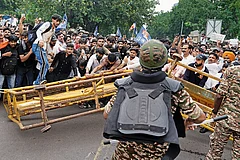
What happened in Bangladesh cannot be explained as only a domestic political crisis. It also cannot be described honestly as a spontaneous student movement. Anti-Bangladesh vested groups, extremist networks, organised elements of the BNP Jamaat alliance and opportunist circles were active from the beginning. At the same time, propaganda warfare, financing, international pressure and geopolitical interests cannot be ignored.
Yunus spoke at a Clinton Foundation programme in the US and described the movement as the result of a ‘meticulously designed’ process, guided by a ‘mastermind’. His own words reveal the character of what happened. If a movement is meticulously designed and guided by masterminds, then it is no longer a spontaneous student protest. It becomes a planned political operation. The quota movement of 2024 was used only as a cover. So, my answer is clear. Domestic conspirators were active, but they were supported by propaganda, financing, pressure and geopolitical calculations. This was a carefully prepared process of destabilisation.