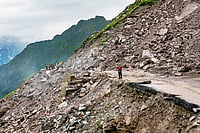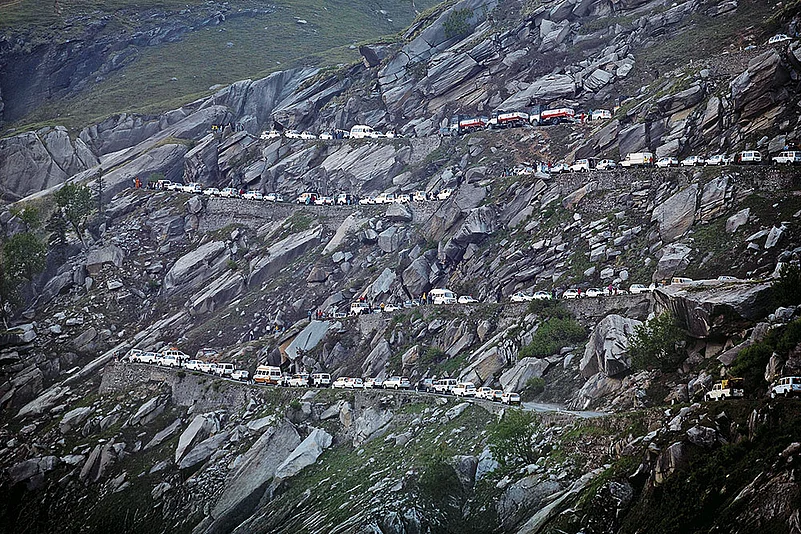
About a decade ago, Sheetal Sharma, a deputy registrar at the National Green Tribunal (NGT), visited Rohtang Pass in Himachal Pradesh, situated at 13,058 feet. Upon returning to Delhi, she submitted a 76-page report to the NGT, highlighting how massive environmental violations and unregulated tourism had reduced the ecologically sensitive destination into a polluted and overcrowded spot, strewn with garbage and animal waste. The report mentioned that there were 5,000 vehicles at the pass, much beyond the carrying capacity, and that vehicular emissions were leading to the “blackening of snow”.
The NGT intervened and restricted the number of vehicles, allowing only 1,200 tourist vehicles per day—800 petrol and 400 diesel. The cap on the number of tourists exists even today. Rohtang Pass, which is open to tourists from May to November, thus became a textbook example of how tourism can be balanced with environmental conservation in fragile mountain ecosystems.
Ten years down the line, the NGT and Himachal Pradesh are making headlines again. Recently, the tribunal expressed serious concern over solid and liquid waste management in the state. In a report submitted to the NGT, the government acknowledged that “littered waste continues to remain uncleared daily at several locations, including hill slopes, tourist destinations, vending zones and garbage hotspots”. One of the reasons attributed to garbage mismanagement is increased tourism activity in the state in recent years.
While there is a cap on the number of tourists visiting Rohtang Pass, the other popular destinations in the state are crumbling under the weight of incoming tourists. While videos of cars lined up for kilometres along the roads leading to Shimla, Manali, Dalhousie, Dharamshala or McLeod Ganj go viral every summer, people casually drive up to these destinations on long weekends as well.



Many spots have been out of bounds in winters, but erratic snowfall owing to climate change has changed the tourism pattern as well. The state can manage tourists if they arrive throughout the year; what has become unmanageable is the peak season madness.
“Our infrastructure is not fully equipped to meet the sheer volume of visitors arriving in the state. During peak season, issues like limited drinking water, overflowing sewer lines, waste management, choked roads and struggles for parking emerge,” says Ashok Thakur, a retired IAS officer who hails from Lahaul-Spiti and also served as principal secretary (tourism).
The Himachal Pradesh administration is dealing with a Catch-22 situation—while bumper tourism brings bumper revenue but it also brings along familiar chaos, resulting in infrastructural collapse and environmental damage.
Tourism is Crucial
The Himachal Pradesh government regards the tourism sector as a vital pillar of the state’s economy, constituting 7.8 per cent of the state’s gross domestic product (GDP). It also generates massive employment—both direct and indirect; estimated up to 15 per cent of the state’s total employment—supporting livelihoods and playing a catalytic role in infrastructure development.
While tourism is essential, the numbers present a scary picture. The state government’s annual Economic Survey report, tabled in the state assembly this year, says tourist arrivals have rebounded post-pandemic, with domestic tourists rising from 32.13 lakh in 2020 to 3.12 crore in 2025, which is far more than the state’s population of 75-76 lakh.
While nearly 15 lakh tourist vehicles arrived in Shimla in May-June, with almost 20,000 to 30,000 tourists checking in daily, the scale of tourist arrivals in Manali was equally unsustainable. Police data show about 66,600 vehicles from outside Himachal arrived in May alone—around 60 per cent more than the same month last year—more than 3,000 tourist vehicles were documented entering Manali every day during the peak summer season.
Manali, in fact, has been hosting record-breaking tourists ever since the Atal Tunnel—the world’s longest single-tube traffic tunnel at a height of above 10,000 feet, which connects Manali to Lahaul-Spiti Valley—was opened to tourists in 2020. The daily vehicular traffic at the Atal Tunnel exceeded its 4,500-vehicle designed capacity up to 11,000 vehicles per day. The Border Roads Organisation officials recall that tourist vehicles crossing the tunnel in May 2026 exceeded the 45,760-mark in just one week. Because of relatively easy accessibility, very remote locations in the Spiti Valley, like Keylong and Sissu village, are seeing an uptick in tourism.
“Online travel agencies and government-backed portals offer attractive packages. This compels the bulk of hoteliers, barring professional chains, to sell their rooms at throwaway prices because they have a limited business period. High-value tourism has got overshadowed by high-volume,” says Chander Mohan Parsheera, professor at the Institute of Vocational Studies (Tourism) in Himachal Pradesh University, Shimla. Adding that there are now more hotels than deodar trees in Manali, Parsheera says places like Palampur, known for its pleasant climate, the Dhauladhar range and sprawling tea gardens, are emerging as sought-after destinations for tourists visiting Shimla or Manali.
While tourists are a boon for the hotel industry, crumbling infrastructure and environmental degradation emerge as collateral damage. The Economic Survey report mentions that “to protect the state’s fragile ecosystem, it is essential to ensure this growth is sustainable in the long-term”.
Possible Solutions
Because ageing infrastructure is failing to cope with the influx of tourists, the administration is investing in the construction of highways and widening of roads.
Tikender Panwar, former Shimla deputy mayor and the member of a high-level committee set up by the Centre government in 2023 to evaluate the carrying capacity of 13 Himalayan states believes being an ecologically sensitive state facing multiple challenges due to climate-induced disasters, the need is to strike a balance.
“We can’t go on expanding the national highways, which involves massive cutting of the fragile mountains. This results in destabilisation of hills and illegal dumping of debris/muck that creates massive havoc during monsoon rains and flash floods. The mindless building of infrastructure also means felling of forests and displacements,” he points out, reminding about a recent Supreme Court warning in a case relating to a controversial tourism resort project at Taradevi Hills, near Shimla.
On July 28 last year, the apex court observed: “If things proceed the way they are, then the day is not far when the entire state of HP may vanish in thin air.”
Is capping the number of tourists a solution? Terming it an impractical suggestion, Sushil Kumar Singla, secretary (environment, science, and technology), says: “The tourism industry survives on a handful of peak-season days when there is a surge in visitors.” Talking about one of the possible solutions to help cut down vehicular pollution, Singla says the government is drafting an electric-vehicle policy, which is expected to be placed before the state Cabinet for approval soon.
Ashwani Sharma is a journalist with over 30 years of experience in reporting and analysis. He is based out of Shimla

MORE FROM THIS ISSUE




(This story appeared in Outlook magazine’s August 17 issue, 'Parliament on Street', which takes an incisive look at the student protests against recurring examination paper leaks, the zing of Gen-Z politics and the Jantar Mantar protest at Delhi which triggered a strong response all across India, sending out a clear reminder that while governments are formed in Parliament, democracies remain alive on the streets)