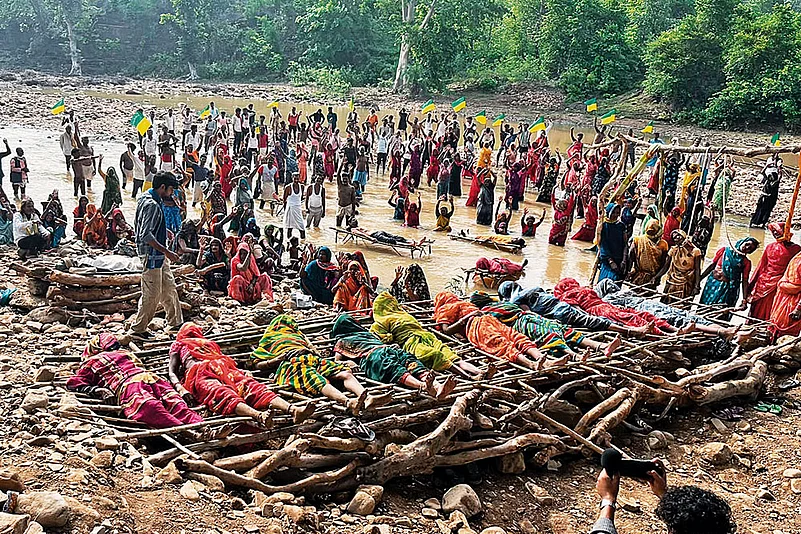
As bulldozers move deeper into the forests of the Panna landscape and villages brace for displacement, a different debate is quietly unfolding inside India’s water establishment.
Four decades after the Ken-Betwa River Linking Project was conceived, new hydrological evidence suggests that the assumptions underpinning India’s first inter-basin river transfer may deserve a fresh scientific review.
An unpublished basin reassessment reviewed by Outlook, drawing upon Central Water Commission (CWC) basin reassessment studies, India-Water Resources Information System datasets, hydrological modelling and Madhya Pradesh’s Climate Change Vulnerability Assessment, projects increasing flow variability and growing dry-season stress across the Ken, Betwa and Son basins. While the assessment does not predict an overall decline in Madhya Pradesh’s water availability, it warns that dependable lean-season flows in these basins are likely to become less reliable as climate change alters rainfall patterns and runoff behaviour.
The assessment appears to have entered official policy discussions. Rajesh Rajora, who until last week, was additional chief secretary, water resources, Madhya Pradesh, told a Hindi daily: “We are alert. Based on the CWC’s basin reassessment study, we are working on an action plan for the conservation of river catchment areas.” He was transferred to another department as part of a bureaucratic reshuffle on July 24.
For scientists, the question is no longer simply whether the Ken receives enough rainfall. It is whether a river long classified as “surplus” can continue to be treated as such if its flows become increasingly seasonal and less dependable.

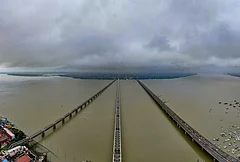

Climate Threat
The Ken-Betwa River Linking Project is the first project to enter implementation under India’s National Perspective Plan for interlinking rivers, conceived in 1980 to transfer water from so-called surplus basins to water-deficit regions. The Rs 45,000-crore project proposes to transfer water from the Ken River in Madhya Pradesh to the Betwa basin across Madhya Pradesh and Uttar Pradesh through the Daudhan Dam and a 221-km canal. Successive governments have described it as a lifeline for drought-prone Bundelkhand, promising irrigation, water and hydropower.
If the hydrological assumptions underlying this flagship project require reassessment, it will have an impact on how India plans long-lived water infrastructure in a changing climate.
The assessment study reviewed by Outlook mentions that the emerging water challenge in Madhya Pradesh is not one of overall water scarcity, but of increasing runoff concentration and seasonal imbalance. The document projects more intense monsoon rainfall, larger flood peaks and greater inter-annual variability across the state’s river basins. Western basins such as the Narmada, Tapi and Godavari are expected to benefit from increased runoff and groundwater recharge. The outlook for the Ken, Betwa and Son basins is markedly different. Among all the state’s major basins, the Ken is identified as the most vulnerable, with declining dependable flows and increasing seasonal water stress.
The human consequences of the Ken-Betwa project are becoming increasingly visible.
Yet the document occupies an unusual position within the bureaucracy. When Outlook contacted the Madhya Pradesh Water Resources Department, officials declined to acknowledge the assessment. A retired chief engineer, who now works as a consultant to the department, said the study had long been known within both the state Water Resources Department and the Department of River Development in the Union ministry of Jal Shakti, but added: “I don’t know its origin.”
The differing responses leave unanswered questions about the assessment’s provenance and official status. They do not, however, diminish the significance of the hydrological concerns it raises or the fact that a senior serving official has publicly referred to a “CWC basin reassessment study” while outlining the state’s catchment conservation strategy.
For hydrologists, dependable flow—not annual rainfall—is the critical parameter for assessing whether water can safely be transferred from one basin to another. This is not the first time the project’s hydrological foundations have been questioned. “Our analysis of the feasibility report in 2005 suggested that the assessment involved significant methodological issues. The Forest Advisory Committee, the National Board for Wildlife sub-committees and the Supreme Court’s Central Empowered Committee all sought an independent review of the project’s justification. That was never undertaken,” says Himanshu Thakkar, coordinator of the South Asia Network on Dams, Rivers and People. He believes the new assessment reinforces the need to revisit those assumptions.
One of the sharpest challenges to the project’s hydrological premise came before the Supreme Court’s Central Empowered Committee (CEC). Conservationist Debi Goenka, founder of Conservation Action Trust, recalls asking officials a question he says went unanswered. “I told the CEC to first address the question of water availability. All the irrigation engineers were present and I asked them how much surplus water was actually available for transfer, particularly during drought years or deficient monsoons. For them, it was like a surprise,” says Goenka.
Ecological Impact
The hydrological debate unfolds against one of India’s most sensitive ecological landscapes—the Panna Biosphere Reserve, designated by Unesco’s Man and the Biosphere Programme in 2020. It includes Panna Tiger Reserve and parts of Gangau Wildlife Sanctuary, renowned for successfully reviving its tiger population.
Shaped by the Ken River, the ecosystem features a diverse mix of plateaus, gorges, dry deciduous forests and marshy vegetation. It is a critical tiger habitat. The Daudhan Dam will submerge forests in a landscape that supports more than 100 tigers.
Scientists say these forests also function as natural hydrological infrastructure, slowing monsoon runoff, replenishing groundwater and sustaining environmental flows through the dry season. Large-scale deforestation, they warn, could alter these processes. “In the cacophony of arguments and counter-arguments, the likely impact of the felling of two million trees has gone unnoticed,” says a senior official.
Meanwhile, the human consequences of the project are becoming increasingly visible. Villagers have spent years protesting against displacement, alleging inadequate compensation and questioning rehabilitation plans. As construction advances, opposition continues.
Whether the latest hydrological assessment ultimately changes the course of the Ken-Betwa project remains uncertain. Construction has begun, thousands of trees have already been felled and villages are preparing for relocation. Yet the scientific question that has resurfaced is unlikely to disappear. If climate change is altering the behaviour of rivers once classified as “surplus”, India’s first river-linking project may become a test of whether water infrastructure planned in the 20th twentieth century can keep pace with the hydrological realities of the 21st.
Deshdeep Saxena is a Bhopal-based senior independent journalist covering politics, environment, climate change and public policy

MORE FROM THIS ISSUE




(This story appeared in Outlook magazine’s August 17 issue, 'Parliament on Street', which takes an incisive look at the student protests against recurring examination paper leaks, the zing of Gen-Z politics and the Jantar Mantar protest at Delhi which triggered a strong response all across India, sending out a clear reminder that while governments are formed in Parliament, democracies remain alive on the streets)