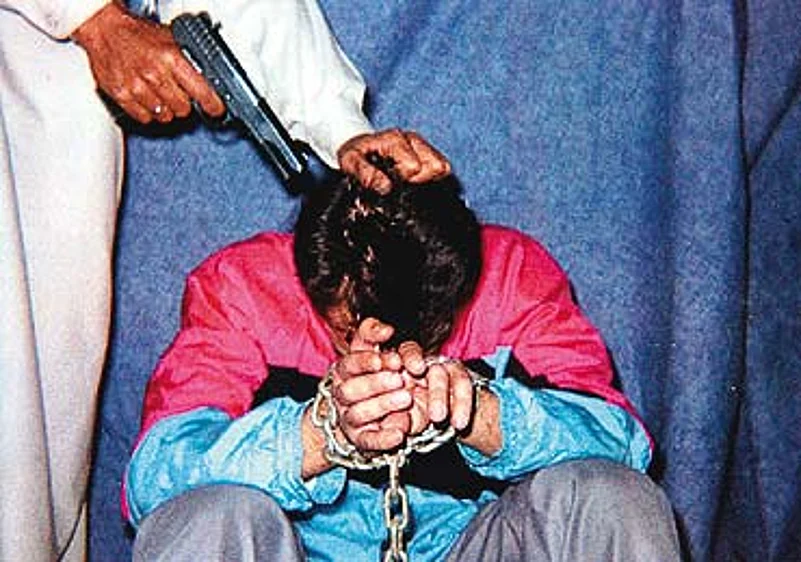

The documentary created a buzz in Washington, not only because it dealt with the hot subject of terrorism but also due to the authenticity with which the story of the two men comes alive. Sharma was honoured last year at the prestigious Council on Foreign Relations, which held a screening and a seminar followed by a black tie dinner for 500 people. What is also noteworthy is that it took an Indian and a Pakistani filmmaker pushing ahead to tell this story convincingly, while the resource-rich US television networks stayed away mainly due to security risks.
Yes, Hollywood has an offering on Pearl's life—A Mighty Heart—but it is based more on his wife Marianne's memoirs, and in the end it becomes a mighty Angelina Jolie film. Although it got good reviews in the US press, it was roundly criticised by Pearl's friend and colleague from the Wall Street Journal, Asra Nomani, who was with him and Marianne when he left for that meeting in Karachi, never to return. "For me, watching the movie was like having people enter my home, rearrange the furniture and reprogram my memory.... What I couldn't accept was that Danny himself had been cut from his own story," wrote Nomani, a US-settled Indian Muslim who herself is a target of conservative Muslims for her strong views on Islam and women.
But Sharma focuses largely on Pearl and Sheikh, with footage and photos from family archives and friends. The real-life Marianne and Nomani are there, recreating that awful day, and their struggles thereafter trying to find Daniel with the help of Pakistani police and the FBI. The film also includes embarrassing footage of Pakistan President Pervez Musharraf on a Washington visit saying Pearl was alive when he allegedly knew the journalist had been killed. His US visit would have drowned in a flood of public anger had he admitted the truth. Sharma has dealt with issues with finesse and subtlety, and not with a hammer. The narrator is CNN star Christiane Amanpour, whose otherwise confident manner is marred by her insistence on mispronouncing Muslim as Mozlem.
Given India's own experience with Pakistan-sponsored terrorist groups, Sharma had the difficult task of finding the key players in Pakistan without attracting too much attention. He decided to stay in the background, sending co-director Jamal to Pakistan six times with an all-Muslim crew to make it easier. The documentary has meaty interviews with FBI and CIA agents who probed the case and tried to track e-mails on Pearl's computer to Sheikh, in the hope of rescuing him. But they failed, and finally the video of his beheading was delivered to US officials. Jamal also managed some interviews with Pakistani police who seemed not to know about the ISI protection for Sheikh.
As the documentary moves on, retracing the lives of the two men, the portrait of Sheikh seems less complete, mainly because his family refused to cooperate. But Sharma did manage to find some of Sheikh's college friends and teachers. He turns out to be a keen arm-wrestler and a chess player, competitive and determined, but what really turned him into a cold and calculatingly brutal killer is not adequately explained. Bernard-Henri Levy, the French intellectual who wrote Who Killed Daniel Pearl?, tries to explain, but a few more voices would have helped. Because, without them the subtext becomes—Daniel Pearl was the best of the West and Omar Sheikh the worst of the East. The filmmakers have tried hard to be balanced, but it's ultimately a story about the clash of civilisations, with the middle ground between those who have rose-tinted glasses about terrorism and those who believe in Bush-style reductionism shrinking.