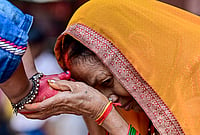
This Stained Dawn (2021) is a Pakistani documentary made by Anam Abbas.
It follows a few organisers of the ‘Aurat March’, mostly in Karachi, for a couple of weeks leading up to Women’s Day.
Besides external threats from right wing factions, who threaten the march with court petitions and accuse the organisers of blasphemy, they also face pressure from home.
Anam Abbas’s documentary This Stained Dawn (2021), which chronicles the multi-city women’s marches across Pakistan on March 8, 2020, centres on the two-steps-forward-and-one-step-back nature of a movement that, for as long as history remembers, has beset women worldwide. It is a struggle where fighting for women’s rights feels like pushing against a wall—inch by inch, generation after generation, with calcified rage. Resistance is pushing against a wall that pushes you back. The good news: there is always another generation ready to take your shift. The bad news, however, is that there is always someone on the other side of that wall.
Before we start asking, “So how does one win?” it may be worth pausing to wonder what winning actually looks like. In the grand scheme of things, do small victories—like a successful March 8 rally in Karachi just before the pandemic—count? Does the persistent resistance of a community living by the railroads, constantly threatened as their homes stand in the way of so-called progress, count? How about the image of a few women sitting around a table—discussing, negotiating, strategising and sharing thoughts? Maybe feminist solidarity looks like what Laila, one of the organisers, explains as an ever-expanding bubble. The idea is to include as many people as possible within the bubble until, one day, it becomes impossible to dismiss.




Abbas’s documentary follows a few organisers of the ‘Aurat March’, mostly in Karachi, for a couple of weeks leading up to Women’s Day. As March 8 draws closer, the pressure on them mounts, both from within the organisation and from outside. The film closely examines how mobilising and organising are complex tasks that require constant navigation of threats. Eminent writers and right-wing stakeholders begin labelling the movement “immodest”, framing slogans like “My body, my choice” as sexually aberrant or anti-Muslim. Cunningly, the slogan is interpreted by disruptors solely in terms of sexual freedom, rather than as a declaration of agency over one’s corporeal self—what one does with it, how it is perceived and whether it is controlled by others.

Besides external threats from factions of the right wing, who threaten the march with court petitions and accuse the organisers of blasphemy, they also face pressure from home. Many of their family members are unaware of their participation in the march, as they sneak out to rail against “pitrshahi” (patriarchy) in the streets. The girls put up street plays, spray-paint ‘Aurat March’ on city walls at night and show up in large numbers—fully aware of the stakes—to demand economic justice, environmental justice, freedom from violence, minority rights and reproductive health rights. They show up despite the threat of an acid attack at the march or even when a march gets actually attacked by a militant right-wing group, to push the wall, even if just by an inch. This persistence is what Abbas’s documentary captures with remarkable intimacy. The camera lingers not only on the march itself but on the painstaking work that makes it possible.

Another challenge women face while organising within democratic, neoliberal groups is the dilemma that arises when the scope of the march is broadened to include women from different organisations under one umbrella. Doing so means accommodating diverse ideals and manifestos. Liberation is not a monolith. Yet this broad coalition is essential; without it, the collective voice of women grows weaker. Finding a way for these groups to coexist, therefore, becomes a challenge in itself—but one that women take on with great spirit. They return to the drawing board again and again, debating, discussing and accommodating. They ask each other how the march can be improved. They also struggle with moments when the march must be led by commandos for protection. Accepting state protection while rallying against the state is an uneasy predicament. There is no single right way to act as a collective. The organisers show how much of organising involves strategic alertness.
Abbas’s lens follows them as they move between strategy sessions, rehearsals and the streets. Laila, Moneeza, Rayhan, Rashida and Ayesha are constantly calculating—who to bring into the fold, how to accommodate demands and when to push forward despite looming threats. The camera captures the meticulous labour behind each street play, each poster, each slogan. These acts—small on their own—catapult into a movement that stands its ground.

Abbas makes some striking creative choices, particularly in showing the organisers in their personal spaces as they prepare for the march. Laila, the president of the Women’s Democratic Front, juggles the financial and educational needs of her two younger sisters. In her small room, with a mattress on the floor, she beams with joy as she flips through a copy of Saba Ahmed’s Living a Feminist Life. Ayesha navigates life in Gharidabad, living under the constant threat of eviction, while Rayhan, who is treated differently at home than her brother, leads the biker contingent of the march with determination. Moneeza, a lawyer by profession, reveals how she manoeuvres through the “angry feminist” label that often follows her. Each individual carries the weight of both the personal and collective struggle in her own way. And yet, together, they form a force powerful enough to question the state.
They show that much of resistance is endurance and that every act of courage counts. In fact, if there is an imagination of a feminist utopia, it exists for now in women drawing posters with slogans like “I am marching for your right to read more than one book,” or rehearsing a street play on a rooftop at night. It is in the afternoons they spend debating, then unpacking the dabbas they have brought from home to share a meal. It is even in sloganeering, “Hai haq humari—Azaadi.” In the stained dawn, these women become part of a formation, taking two steps forward as they push the wall a few inches; for now, that is the feminist utopia they have achieved en route.
Sritama Bhattacharyya is a writer and teacher based in Washington.