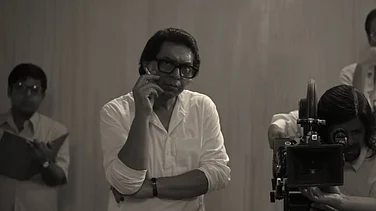
Mayasabha (2026) is written and directed by Rahi Anil Barve.
It features Jaaved Jaaferi, Mohammad Samad, Veena Jamkar and Deepak Damle.
The film is set around a crumbling theatre and follows a treasure hunt that exposes buried secrets and blurs reality with perception.
Director Rahi Anil Barve returns to the big screen with Mayasabha – The Hall of Illusion (2026), a film that dissects greed through a disillusioned lens, true to human nature. With such a legacy behind it, it is hard to avoid comparing the current film with its predecessor. While Tumbbad (2018) confines its generational curse to a haveli or ancestral home, here the “cursed space” is a crumbling film studio, where the entire story unfolds. The film stages a cat-and-mouse duel of intellects within these decaying walls.
Mirroring Tumbbad’s obsession with gold, it explores how far people will go to acquire material wealth, navigating human relationships, deception, power and trauma. Barve has long been one of the country’s sharpest storytellers, evident in his previous works but even in the conceptualisation of his shelved web series Gulkanda Tales (2022). In Mayasabha, his frustration as a filmmaker seeps through, reflecting his awareness of the industry and its limits. References to audiences and the act of filmmaking itself, all set against a studio in ruins, feel like a personal confession or a mirror to Barve’s own experience with the current state of Indian independent cinema.
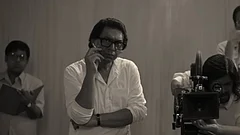


Where Tumbbad sprawled across myth and legend, Mayasabha is contained, deliberate and quietly unsettling. The film is dense, claustrophobic and murky, resisting the usual comforts of a cinematic experience. Make no assumptions, despite the gloomy descriptions, every frame of this film is meticulously lit and beautifully shot by Kuldeep Mamania and Nuthan Nagaraj. The stench of deception, decay and death saturates Mayasabha. Barve’s environment becomes a mysterious character in itself. Smoke drifts through fractured corners, dominant red hues and crumbling sets, catching shards of pale light—conjuring moral rot and unease.
The narrative unfolds on a storm-lashed night when Zeenat (Veena Jamkar) and her brother Ravrana (Deepak Damle) encounter Vasusen (Mohammad Samad), son of Parmeshwar Khanna (Jaaved Jaaferi). Samad, the unforgettable son from Tumbbad as the child of a greedy patriarch, now carries that shadow into adulthood, remaining part of a strained father-son axis. A careless act of revelation by Vasu triggers alarm in Zeenat and Ravrana, sparking a tense mind game aimed at outsmarting Parmeshwar. From that point, the film slowly builds a battle of wits, manipulation and intent.
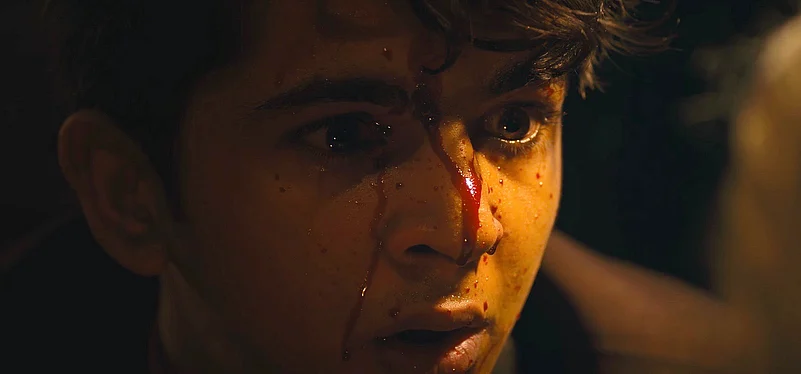
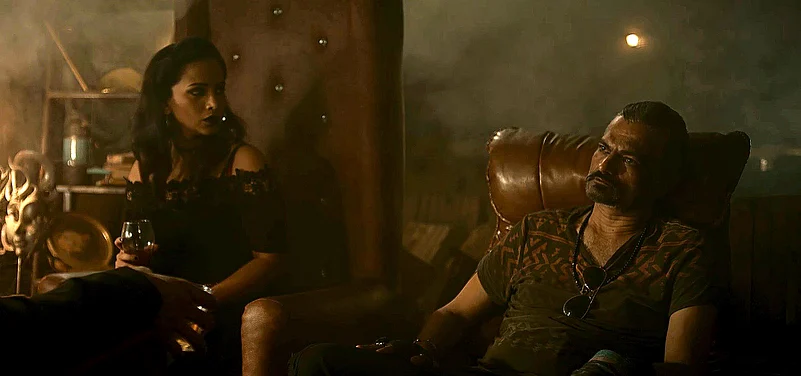
Parmeshwar’s story explores the world of his studio called “Mayasabha”, where he unpacks his past—his wife, his peak years and the specific triggers that push him into episodes of uncontrollable mania. Jaaferi dominates as producer Parmeshwar Khanna, ruling over the ruined space like a “ghost”, as his son Vasu calls him. Once a commanding and affluent film producer, he now lives in psychological distress. Memory intrudes into the present through unsettling patterns. The past refuses distance and also resists closure, keeping him suspended between denial and reluctant recognition.
His performance is gripping, theatrical and precise—grounding the story’s shifting psychological contours. Zeenat and Ravrana are outsiders drawn to this distorted universe, navigating his psyche through its shifting narratives and playful deceptions. This tightly paced film, with just four characters, unleashes a night-long, almost grotesque carnival of tension and manipulation.
Barve uses a minimal cast to explore close-knit suspicion, ambition, desperation, arrogance and fear. The story progresses sharply through dialogue, where each line acts as a strategic move in a psychological chess game. Every character seeks to outmaneuver the other, maintaining an edge-of-the-seat sense of rivalry.
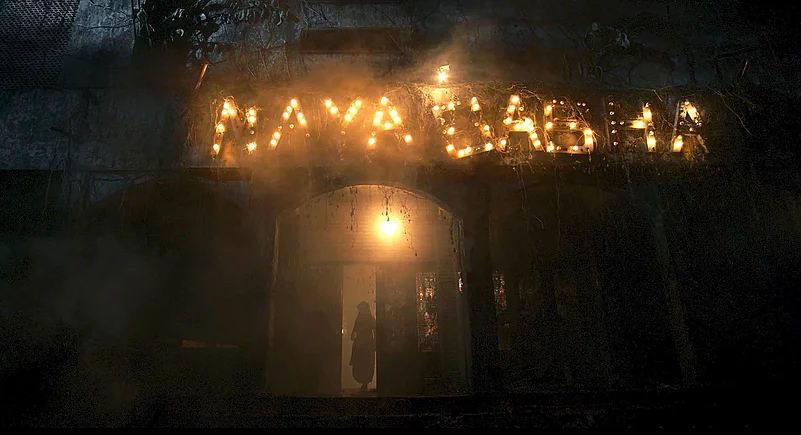
There are unresolved conflicts coexisting with sharp intimacy in the father-son dynamic between Parmeshwar and Vasu. Jamkar, as Zeenat, emerges as the shrewd manipulator within the story, whereas her brother Ravrana becomes her helping hand. The real centerpiece of this tense tale is the theatre itself, groaning with history and silently bearing the weight of forgotten stories. The characters, played with corrosive, electric energy feel like intruders in this dilapidated relic of light, sound and motion.
In a literal sense, Parmeshwar, Ravrana, Zeenat and Vasusen seem to operate as four inner dimensions that coexist within a single human being. Parmeshwar functions as the elder axis, tied to spiritual belief and moral inheritance. Zeenat channels the outward-facing self, rooted in allure, visibility and the discipline of performance. Ravrana occupies the civic register, driven by strategy and rational maneuvering. Vasusen, whose name signals wealth and privilege, recalls archetypes like Moses, where abandonment intersects with destiny and power along with an unresolved claim to royalty and inheritance.
A major portion of the film traps Parmeshwar and Zeenat in a tense tussle inside the dimly lit, dilapidated theatre—A battle of the troubled spiritual self and the manipulative performed self, if one can say. Their confrontation is staged like a skittish slasher with traces of tragic grandeur. Barve calls the film an experiment and the description fits its method. Viewers are invited to question motives and choices that feel incomplete at first contact. Certain moments ask for a second thought, while others demand acceptance in the way destiny operates within the narrative.
The outcome remains gripping and continuously involving. Barve’s script sustains attention from the opening beat, guiding the spectator through a dense structure that rewards return visits. Across the runtime, the spirit of risk-taking and the considered use of space and staging create an atmosphere that keeps unfolding through bursts of dark humour.
Every moment feels inevitable, calculated and charged with slow-burning menace (though grasping it all in the first watch feels difficult). Calling this intelligent filmmaking that rewards multiple viewings also raises the question of whether audiences will actually turn up. One hopes they do, because Mayasabha speaks to viewers who embrace layered, intricate narratives and can navigate gaps in context without feeling lost. The writing is strong, though it clearly has big shoes to fill, given Barve’s earlier film. Each film out of the two carries its own strengths and stands apart but Barve’s storytelling remains fearless, clever and deeply heartfelt, deserving the theatrical attention it earns after the filmmaker’s tumultuous journey to release it.
Read all the latest breaking news on Outlook India and stay updated with top stories from India, Entertainment, Education, and around the world.
Click/Scan to Subscribe

- Previous Story
 Welcome To The Jungle Review | Akshay Kumar-Led Loudest Comedy Is Equal Parts Funny and Frustrating
 - Next StoryPadatik Review | Chanchal Chowdhury Brings Mrinal Sen’s Restless Spirit Back To Life