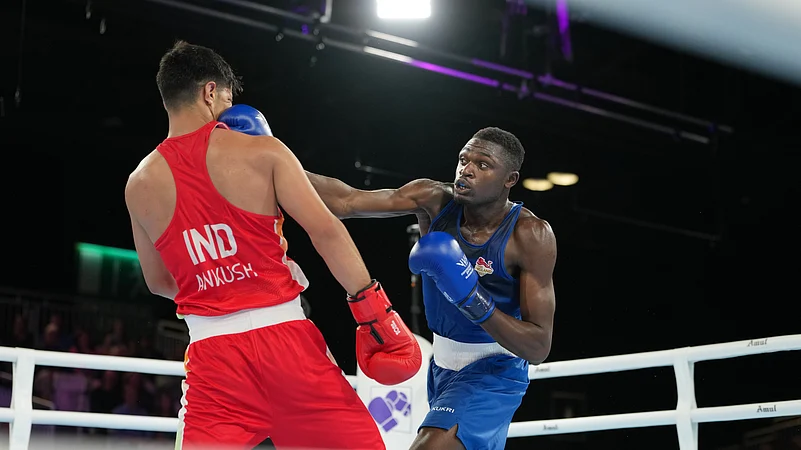
Dimeji Shittu loses controversial final to India’s Ankush Panghal after two point deductions
Richie Woodhall and TNT Sports pundits criticised the referee’s penalties and judges’ scoring
The result revives debate over AI-assisted judging in amateur boxing
A controversial judging decision in the men’s boxing competition at the Glasgow 2026 Commonwealth Games has reignited one of the sport’s oldest debates — whether amateur boxing should continue relying solely on human officials or move towards technology-assisted scoring.
England’s Dimeji Shittu was forced to settle for silver after losing to India’s Ankush Panghal in a bout that drew strong criticism from commentators and former fighters. The result quickly became one of the most discussed moments of the boxing competition.
Shittu started strongly and won the opening round on all five judges’ scorecards. He also appeared to trouble Panghal enough for the Indian boxer to receive a standing count during the contest.
The momentum shifted dramatically in the second round. Although many observers felt Shittu landed the cleaner punches, three judges awarded the round to Panghal. Matters became more complicated when the English boxer was penalised for repeatedly dipping his head too low, a foul under amateur boxing rules.
A second point deduction in the final round proved decisive. Even though Shittu seemed to hurt Panghal late in the contest, four of the five judges still scored the round in favour of the Indian boxer, meaning Panghal would have won even without the deductions.



Former world champion Richie Woodhall, speaking on TNT Sports, described the officiating as “shocking” and said he felt Shittu had been “totally robbed.” TNT commentator Dave Farrar also criticised the referee’s intervention, calling the decision “absolutely dreadful.”
Shittu Avoids Blaming Officials
Despite the controversy, Shittu avoided criticising the judges or referee after the fight. Speaking to BBC Sport, he accepted that the penalties were part of the rules and said the experience was something he had to learn from.
He acknowledged that some people might believe he deserved the decision, but stressed that focusing on officials would not help him improve as a boxer. His response was widely seen as a measured reaction to a highly emotional defeat.
AI Debate Returns To Amateur Boxing
The bout has also revived discussion about the possible use of artificial intelligence in boxing scoring.
England’s 2022 Commonwealth Games super-heavyweight champion Delicious Orie argued that technology could make scoring more objective. He suggested that if there were a clearly defined and transparent scoring framework, AI-assisted judging could reduce the influence of individual interpretation.
The idea is not entirely new. AI-based analysis was reportedly used in a behind-the-scenes capacity during Tyson Fury’s 2024 heavyweight fight against Oleksandr Usyk.
World Boxing, the international governing body that oversees amateur boxing, including Olympic and Commonwealth competition, has also been exploring whether such technology could assist judging in the future.
Under the leadership of former unified middleweight champion Gennadiy Golovkin, World Boxing has indicated an interest in investigating AI as a tool to improve transparency and confidence in officiating, although no immediate implementation has been announced.
Supporters of traditional judging argue that boxing is inherently subjective. Unlike sports where technology can determine clear factual outcomes, such as offside decisions in football, line calls in tennis, or edges in cricket, boxing scoring involves assessing the quality, effectiveness, and impact of punches.
Questions remain over whether AI could accurately evaluate punching power, ring control, defensive work, and the overall effectiveness of an attack. A punch that lands cleanly is not always equal in impact to another, making the creation of a fully objective scoring system extremely complex.
For now, Panghal leaves Glasgow with the gold medal, while Shittu’s defeat has become another reminder that judging controversies remain deeply embedded in amateur boxing. The debate over whether technology should play a greater role in deciding fights is unlikely to disappear any time soon.