
Mackay, a city in Queensland, is the sugar capital of Australia, informs Wikipedia with usual lack of fanfare. Twenty-two years ago, Indians and Sri Lankans landed there for a World Cup match. Only two deliveries were bowled before rain washed the game away.
Those of us who were there filed away a nugget for future trivia quizzes: Kapil Dev opened the batting for India, but didn’t get to face a ball.
But cricket wasn’t the highlight. The Indian team and the media had been in Australia for weeks by then following a Test series. And Mackay made the cardinal mistake of allowing free international calls from the phones (land lines) in the press box. Mackay’s sweetness was clearly not restricted to its sugar.
Long before the rain stopped, however, the kind offer was withdrawn. Cricketers from both sides, reporters and I suspect even casual passers-by kept the phones continuously engaged. I heard at least one player ask his wife what she intended to make for dinner. “We might have ruined Mackay’s economy in one afternoon,” a journalist commented drily.
Those were days of innocence. Players and newspapermen travelled together, often attended official functions together and whenever a free phone was offered, called wives (or girlfriends) back home.
Fast forward seven years. Another World Cup, this time in England. The game was in churning, although we’d know the full extent of it only much later. Everybody—players, reporters, hangers-on—had mobile phones. Not quite the sleek, shiny babies of today, but exciting nevertheless. Both the phones and their users had lost their innocence.




After news of the match-fixing scandal broke, I remembered that World Cup in England in 1999. Not for the cricket, but for the borrowed mobile phone. More than once, more than one player borrowed mine. “Local call, local call,” I was assured. Not that it mattered. It would have been churlish to refuse.
At least one senior player was later revealed as a fixer. Did he use my phone to make calls he didn’t want traced to himself? I don’t know. But just as a dropped catch or an inexplicable batting performance made you think “paisa khaya”, players borrowing mobile phones—however innocent their intent—gave you pause. Even if in retrospect.
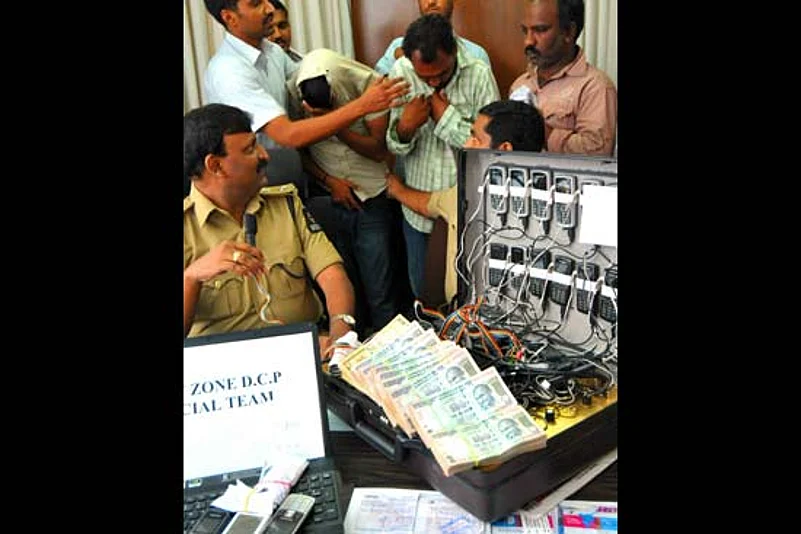
For, the symbol of match-fixing is the mobile phone, however unfair it might be to man’s best (non-living) friend.
Remember the Sharjah matches, the private boxes and Dawood Ibrahim? Sure, he might have been speaking to his family too, asking about dinner.
Gambling and match-fixing in cricket are much older than the telephone; there is a reference to gambling in cricket as far back as in 1646. Alexander Graham Bell, inventor of the original telephone, was born 200 years later.
Yet, how easy it has all become with the mobile phone. Of course, to adapt a line favoured by the gun lobby, mobile phones don’t fix matches, people fix matches.
And sometimes it is not a fix, so much as premature knowledge that is important. There is a slight transmission delay in live TV coverage of a match which a bookie with a cellphone watching from the stands can take advantage of. In his award-winning book, Bookie Gambler Fixer Spy, Ed Hawkins writes: “If India are playing abroad, (the bookie’s) man will sit in the stand with a mobile phone in his ear relaying the information (to) inform his subscribers what has happened seconds before it appears on screen.” But it isn’t just about the specifics. “The minutiae of inside information,” says Hawkins, “is used to manipulate markets in favour of the syndicate, bookmaker or punter, not to win specific bets.”
For all this, the mobile phone is not the ‘equaliser’ of Hollywood westerns, but an ‘enhancer’ of possibilities.
No match is scheduled for Mackay at the World Cup in Australia next year. Perhaps the stadium has a museum now. One where landlines of two decades ago are displayed as antique pieces.