What is wrong with the OSA?
- Has several vague, "all-inclusive" provisions; anyone can be prosecuted for sharing even harmless information
- What is "secret" has not been defined, leaving scope for misuse
- Any document can be deemed secret on the opinion of an "expert"
- Heavily loaded against the accused. Only Section 5 has a provision for bail which is rarely given.
- Is used as a vendetta tool to book whistleblowers and unpliable officials.
***
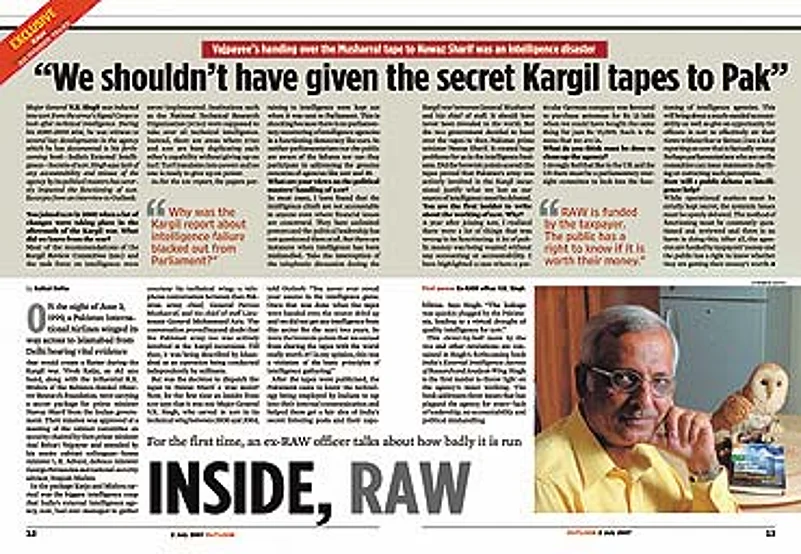

However, on September 26, when Singh's application for anticipatory bail came up for hearing, the court refused to accept the CBI's contention that he had jeopardised national secrets in any manner. Singh got bail and the CBI can arrest him only after it had presented an application supported by evidence. While the CBI sets out to gather "evidence" against Singh under the OSA, described by most legal experts as a "draconian" act, many intelligence officials told Outlook that there is nothing secret in the book. Clearly, Singh's revelations have ruffled the powers-that-be in RAW. Instead of taking cognisance of of the concerns raised by Singh, the government has decided to nail him.
According to insiders, it all points to personal vendetta. And Singh did not pull any punches. For instance, he cites the case of a senior officer going on leave without authorisation to protest being overlooked for promotion. According to CBI sources, the officer is none other than the present RAW chief, Ashok Chaturvedi. It is a fact that he had gone on leave when Amber Sen was promoted as special secretary ahead of him. After several months on leave, Chaturvedi was promoted and subsequently took over as chief in February this year.
Sources also told Outlook that the government was upset with Singh's revelation that a communication system meant for the PM's security was bought from a private company bypassing mandatory procurement rules. Ironically, RAW, the department which pressed for action against Singh, and the investigating agency CBI, both report to the PM.
Maj Gen V.K. Singh is the latest in the line of people to be targeted under the OSA. The law, which is heavily loaded against the accused, is usually invoked whenever the state wishes to settle scores or rein in whistleblowers. Here are some examples:
- Capt B.K. Subbarao was hailed as one of the finest nuclear scientists in the country. He was seconded from the Indian navy to help with the nuclear submarine programme but ended up being branded as a spy. Reason: he detected serious flaws in the designs being drawn up for the prototype at the Bhaba Atomic Research Centre (BARC) in Trombay. This upset the top brass in the nuclear establishment. Subbarao was hounded out of BARC and arrested under OSA at Mumbai airport in 1990 before he boarded a flight to the US. His repeated appeals to the judiciary fell on deaf ears till the prosecuting agency was directed to come up with the "evidence" it had to prove his guilt. It turned out to be Subbarao's doctoral thesis on nuclear science, submitted to IIT Powai! As the case began to crumble, Subbarao had to face 65 judges in the search for justice. Finally, two years after his arrest, Subbarao was acquitted.
- Iftikar Gilani, a Delhi-based Kashmiri journalist, was picked up by the IB for allegedly accessing secrets "prejudicial to the safety and security of the nation". After several months in jail, it finally came to light that the case against Gilani was based on a book published by the Institute of Strategic Studies, Islamabad, 13 years ago. The opinion of the director general of military intelligence (DGMI) stating that the material recovered from Gilani was not secret was kept away from the courts. Finally, after then defence minister George Fernandes directed the DGMI to personally appear in court with his revised opinion, it was taken into account. The case was dismissed.
- Ajay Kumar, a low-level functionary in the Indian Parliament, was not so lucky with the OSA. The evidence against him: possession of parliamentary reports that had already been tabled. The prosecution chose to ignore the fact these were on sale in Parliament. His lawyer V.K. Ohri told Outlook: "They finally planted a hand-written map of a cantonment that even the army officers have said on record does not have any position authenticated. In fact, they don't even know whether the places marked in the crude map exist or not. Finally, in the age of Google Earth what is the relevance of a hand-drawn map?" asks Ohri. Ajay Kumar is still fighting the case.
- Babulnath Maurya, a designer who served in naval headquarters, was also booked under OSA. Incredible as it may sound, the evidence submitted by the prosecution against Maurya were files which were on his desk. "Can you believe the absurdity of the case," asks Ohri, also Maurya's lawyer. "The papers which were supposed to be on his official desk were collected from his office drawer as proof that he was spying."