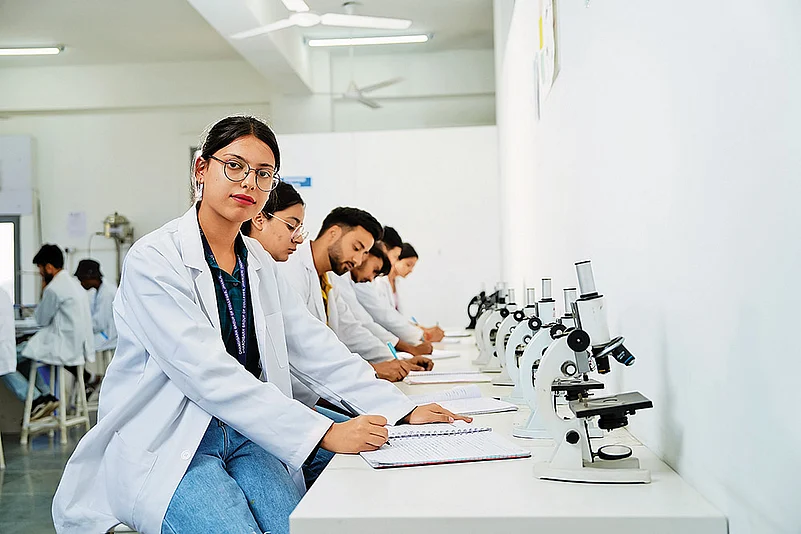
Women account for nearly three in five candidates who appear for and qualify the National Eligibility cum Entrance Test (Undergraduate) (NEET-UG), India's medical entrance examination. Yet that dominance disappears at the very top of the merit list. In 2026, women made up about 58% of qualifiers but held just 26 of the top 100 ranks, including only two of the top ten.
Since 2019, the number of women appearing for the NEET-UG has grown faster than men. That trend held even through 2026, a year the exam is better known for a paper leak, student suicides, and a chaotic retest that eventually forced Dharmendra Pradhan’s resignation as the Union Education Minister.
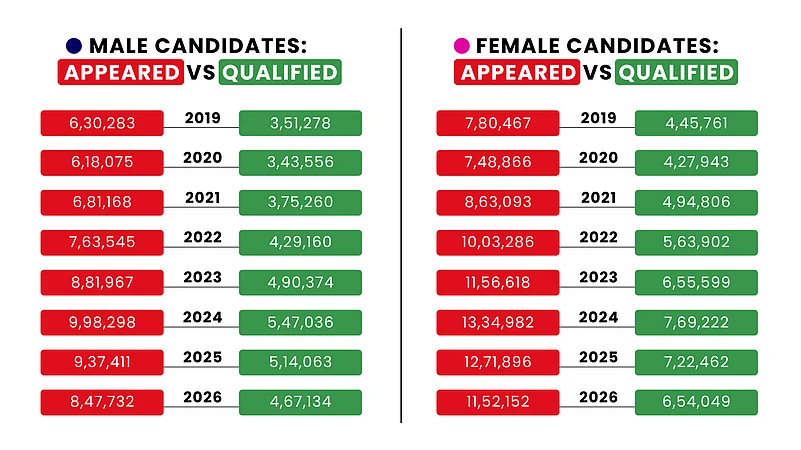
The data from the National Testing Agency (NTA), conducting NEET-UG since 2019, shows that women have been the leading gender in every aspect of NEET: from registration, appearance and qualification. Between 2019 and 2026, women accounted for at least 55% of candidates who appeared and qualified every year.

The NEET Rush
In May, before the NEET-UG exam on May 3, the NTA said 22.79 lakh candidates registered for the exam, making the 2026 edition one of the “largest entrance examinations in the world”. While 22.05 lakh students appeared for the May 3 exam, the re-test, held on June 21, saw more than two lakh fewer students.




The retest saw 19.99 lakh students: 8.47 lakh men and 11.52 lakh women.
Each year between 2019 and 2026, women outnumbered men in terms of registration, appearance and qualification.
The analysis of the data from the NTA shows that growth in the number of women candidates over the years had pushed the NEET pool from 15.19 lakh registrations in 2019 to 22.8 lakh registrations in 2026. The peak was registered in 2024 at 24.06 lakh. In 2015, when this exam was conducted by the CBSE as the All India Pre-Medical Test (AIPMT), only 6.32 lakh candidates registered.

Women Missing For Top Rank
In 2026, for every 100 candidates writing the exam and qualifying, about 58 were women. But when it comes to the top 100 ranks, there were just 26 women. In the top 50, just 12 women and only two in the top ten.
The pattern extends beyond 2026. In 2025, there was just one woman in the top ten, five in the top 50 and 15 in the top 100. In 2024, there were no women in the top ten, only nine in the top 50 and 26 in the top 100.
Overall, women consistently have a slightly higher qualifying rate than men in almost each year. The male qualifying rate ranges from 55 to 56% every year while the female qualifying rate ranges from 56 to 58% every year.
A Decade of Exam Scandal
This is not the first time that the national-level medical entrance exam faced paper leak or mass scale cheating. In 2015, the re-test was held after mass scale cheating was reported. The re-test order from the Supreme Court impacted more than six lakh students.
In 2024, paper leak was reported again but only in parts of Bihar and Jharkhand with re-test held for a limited 1,563 candidates.
Student Suicides
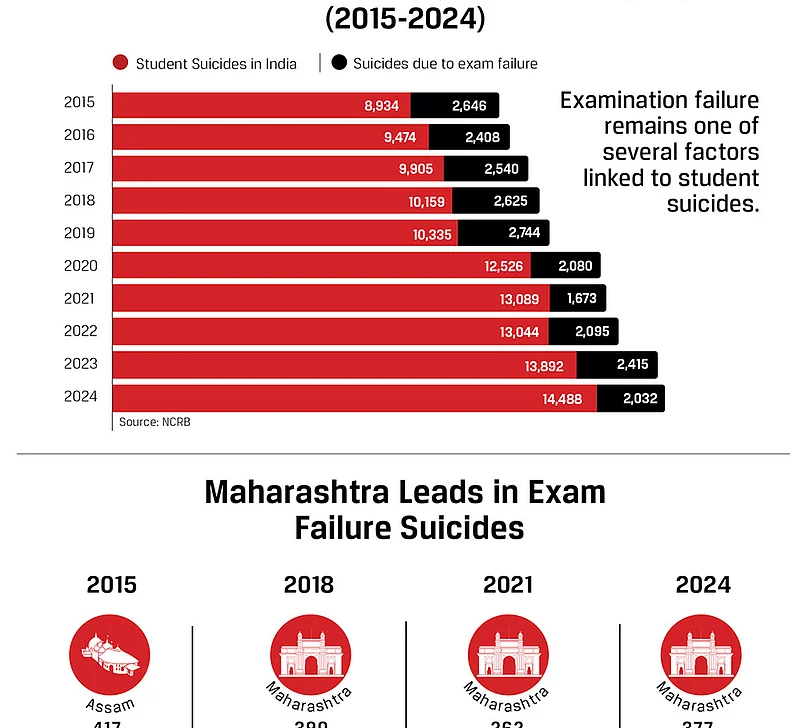
Between the main NEET-UG exam in May and the re-test in June, at least 12 aspirants died by suicide, bringing the attention back to the issue.
The data from the National Crime Records Bureau (NCRB) shows roughly 32 students die by suicide every day nationally, based on the 2015 to 2024 period.
Among the several reasons, examination failure is consistently cited as one of the leading factors. Maharashtra has recorded the highest number of exam-failure suicides in every NCRB cycle since 2015.
As NEET-UG continues to attract record numbers of aspirants, particularly women, the data point to a dual reality. Participation in India's largest medical entrance examination is becoming more inclusive, even as concerns over the pressure of high-stakes competitive examinations continue to grow.
Research: Nivedita Singh | Graphics: Jayati Srivastava
(This story appeared in Outlook magazine’s August 17 issue, 'Parliament on Street', which takes an incisive look at the student protests against recurring examination paper leaks, the zing of Gen-Z politics and the Jantar Mantar protest at Delhi which triggered a strong response all across India, sending out a clear reminder that while governments are formed in Parliament, democracies remain alive on the streets)