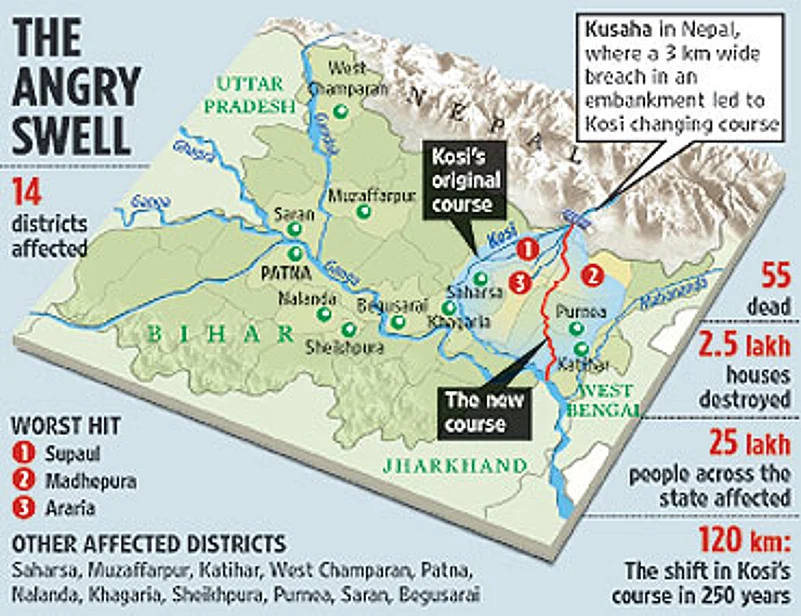

Chief minister Nitish Kumar in an air message to the people (on August 26) asked those in the flood-affected districts to move to safe places at the first opportunity. He warned that what they had witnessed might well be a prelude to a "full-scale deluge". Yet, despite the warnings, people in the most part have resisted the local administration's evacuation efforts. It is never easy to abandon land and property. Minister for disaster management Nitish Mishra, whose village in Supaul district itself is under five feet of water, says, "We have instances of people, particularly the middle class, who have had to be unwillingly evacuated to safe and higher places. People should understand this is not just an annual flood...this is a catastrophe."
Even as the district authorities grappled with the task of evacuating over one million people trapped between the original and the new stream of the river, other exigencies around. In Madhepura, 550 inmates have to be shifted to the neighbouring Saharsa jail. "We can't afford to take chances with the inmates," says IG Prisons Sandeep Poundrik.

Swept away: People huddle on a road along the Indo-Nepal border
Going without food for hours and days, victims have been venting their ire on politicians and local officials too. BJP MPs Lakshmi Mehta and Sukhdeo Paswan, representing Forbesganj and Araria parliamentary constituencies, got wind of it first hand, heckled by the people when they visited the camps. They apparently were expecting their representatives to come with food supplies. Naturally, politics and accusations have followed. Janardan Singh of Bishunpur village, Supaul district, was in Patna to protest the inadequate relief work under the banner of the All India Flood and Drought Affected Federation. He accused the nda legislators and parliamentarians of "manipulating relief measures" and alleged that some of the affected had been going without food for several days.
Could the calamity have been averted? The desilting of the river near the Kusaha barrage is an annual operation carried out by engineers from Bihar and Nepal ahead of the monsoon. But this year, work was delayed because of the politically charged situation there. When desilting finally got under way in the first week of August, it was already too late. Incidentally, the barrage built in 1950 was declared unsafe 20 years ago.
Computing the financial losses will be no easy matter. The Bihar government says any realistic assessment can be made only after the flood situation eases. Prime Minister Manmohan Singh, who took an aerial survey of the affected region on August 28, has declared the floods a national disaster and announced a central assistance of Rs 1,000 crore. He also promised 1.25 lakh metric tonnes of foodgrains for the flood-ravaged districts.




A bridge washed away in Purnea district
As is the wont, post-disaster there have been accusations and counter-accusations aplenty. The Union water resources ministry says the Bihar government should have alerted it on the delay in desilting. Nitish says he had deployed sufficient resources for the work. Kathmandu's take is that, as per protocol, the Indian ministry of external affairs should have taken up the matter with it.

Army boats drop off rescued people in Sursur, Araria district, on August 27
Even as the blame game goes on, hunger stalks the districts. Thousands are starving on the high embankments and national highways. Not a day goes by when squabbles don't break out over the meagre food supplies or even the plastic sheets that help keep out the alternating onslaught of rain and searing sun.
Land, the main source of livelihood for the small and marginal farmers, continues to be under water. The landless peasant is even worse off, there will be no farming till October-end. Migration is the only option left for him. But even for that, he will have to wait for the floodwaters to recede. Then the vicious cycle starts again. It will be time to take loans from the shylocks to rebuild the hut, leave the family to its fate to go in search of work outside the state.