



Launched their first joint military project—the UNICORN next-generation naval communications system
Reinforced a shared commitment to a free, open, and rules-based Indo-Pacific to counter regional pressures
Expanded cooperation into securing supply chains, semiconductors, and critical minerals to reduce overdependence on single suppliers
At a time when the security architecture in the Indo-Pacific witness a turbulent phase, India and Japan, have moved to deepen their strategic partnership with a renewed focus on defence cooperation, maritime security and defence technology, signalling a stronger effort by the two countries to shape the security framework of the Indo-Pacific.
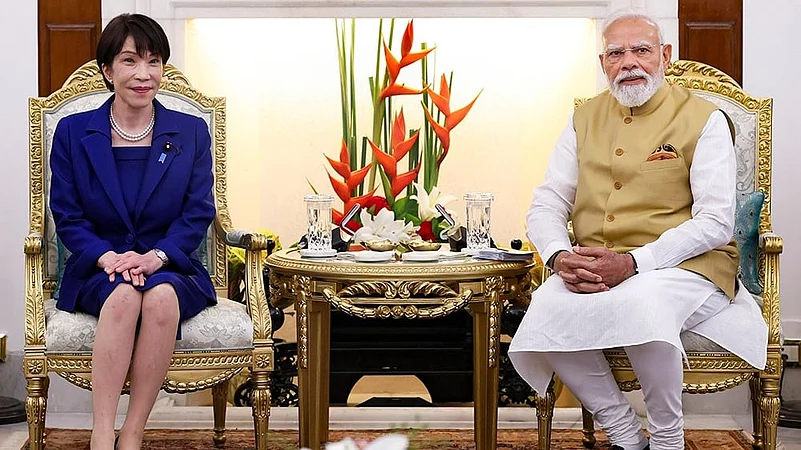
Japanese Prime Minister Sanae Takaichi, on her first official visit to India, held wide-ranging talks with Prime Minister Narendra Modi at the 16th India-Japan Annual Summit in New Delhi on Thursday.
The two leaders adopted a comprehensive joint statement titled, “Advancing a Partnership of Strategic Convergence and Trust for Shared Growth, Prosperity and Resilience.”
The summit placed defence and security cooperation at the centre of the bilateral agenda, alongside economic security, energy resilience, technology and people-to-people ties. The two leaders described India and Japan as “natural and indispensable partners” at a time of heightened geopolitical uncertainty, supply-chain disruptions and growing contestation in the Indo-Pacific.
A key outcome was the announcement of the first India-Japan defence co-development project, involving the Unified Complex Radio Antenna, or UNICORN, a next-generation naval communications system. The project marks a shift in the defence relationship from exercises and dialogue towards co-development of military technology, a move that could have wider implications for India’s push for defence indigenisation and Japan’s effort to expand security partnerships.




The UNICORN system is expected to strengthen secure naval communications and interoperability, an important requirement as the Indian Navy and Japan Maritime Self-Defense Force increase their engagement in the Indian Ocean and western Pacific. For India, the agreement offers access to Japanese technological capabilities in a sector where Tokyo has developed a reputation for high-end precision systems. For Japan, it provides a pathway to work with a major regional military power and expand the practical scope of its defence diplomacy.
The two sides also agreed to hold the next India-Japan 2+2 ministerial dialogue involving their foreign and defence ministers in Tokyo later this year. The mechanism is expected to review progress in security cooperation, including defence equipment and technology, maritime domain awareness, joint exercises and regional developments.
India and Japan already participate in the Malabar naval exercise along with the United States and Australia. Both are also members of the Quad, which has increasingly focused on maritime security, critical technologies, resilient supply chains and monitoring developments across the Indo-Pacific.
The summit’s defence emphasis comes amid concerns over coercive actions in the South China Sea, instability in the East China Sea, threats to sea lanes and growing pressure on countries dependent on maritime trade. India’s interests are closely tied to the security of the Indian Ocean, while Japan depends heavily on sea routes passing through the region for energy imports and trade.
The joint statement reiterated the importance of a free, open and rules-based Indo-Pacific. PM Modi welcomed Japan’s updated Free and Open Indo-Pacific vision, saying it aligns closely with India’s Indo-Pacific Oceans’ Initiative and the MAHASAGAR vision for security and growth across regions.
The strategic convergence also extends beyond conventional defence. India and Japan adopted agreements on economic security, energy resilience and artificial intelligence, reflecting concerns that future security challenges will involve supply chains, critical minerals, semiconductors, digital infrastructure and emerging technologies.
The economic security framework is expected to promote project-based cooperation in sectors such as semiconductors, critical minerals, information and communication technology, clean energy and pharmaceuticals. Such cooperation could reduce vulnerabilities created by overdependence on a limited number of suppliers and strengthen the resilience of both economies.
For India, the summit reinforces its Act East policy and expands its network of security partnerships without entering into a formal military alliance while, for Japan, closer engagement with India provides a strategic anchor in the Indian Ocean and strengthens its effort to preserve a regional order based on international law and freedom of navigation.















