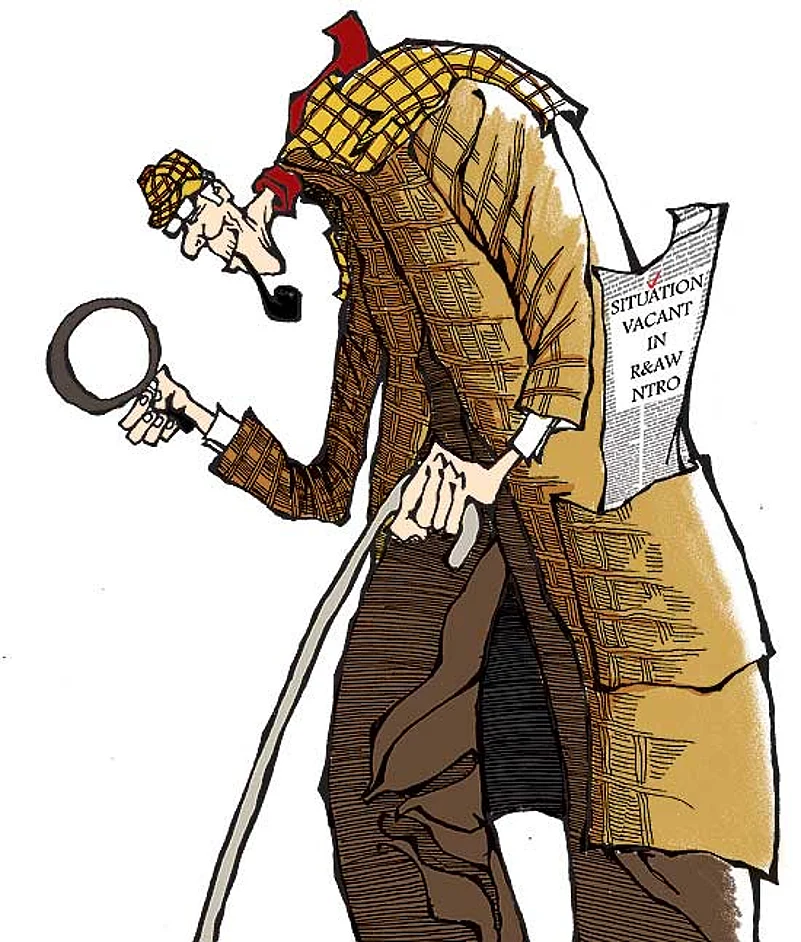
Stretchable Tenures...
- V. Kumar: Retired special secretary, RAW. Rehired as advisor to NTRO (a specialist tech group) despite opposition from Union home minister P. Chidambaram. Now, he is the acting chairman of NTRO.
- Amber Sen: Retired as special secretary, RAW. Appointed strategic intelligence advisor. After a two-year-tenure, he retired a second time. Still with RAW.
- D. Nath: Former IAF officer. Joined RAW in the 1970s and retired a decade ago. Hired by NTRO for five years and retired. Now, rehired by RAW.
- P.K. Mathur: Retired from RAW's administrative wing. Rehired by RAW in an operational posting.
- M.K. Bhandari: Retired general cadre officer from RAW. Taken back as a consultant.
- Ramesh Kumar: Retired from HRD department of DRDO. Hired by NTRO.
- S.S. Moorthy: Served at a DRDO lab (DESIDC) before retiring. He was brought back to NTRO for a second innings after retirement.
- Anil Chowdhry: Retired special secretary, (internal security), MHA. Months after his retirement, he was hired as an advisor to NTRO.
- Maj Gen A.K. Tripathi & Maj Gen V.K. Negi: Both retired and sought re-employment in NTRO. However, the appointments committee of the Union cabinet turned down their candidature. They were both hired by NTRO as consultants, though.
***
In a few weeks, the government will initiate the process of appointing the next chief of Research and Analysis Wing (RAW), India’s external intelligence agency. The toss-up will be between experienced officers and a lobbyist regarded as part of a clique that almost destroyed the organisation, when it was taken over, two years ago, by Ashok Chaturvedi. By all accounts, the succession battle is expected to begin soon.
It’s not just about the top job. The agency is also in the middle of a far greater crisis: it is running out of good men. Ad-hoc appointments, faulty personnel policies, the disinclination of career officers from other departments to work with RAW on deputation—these factors have pushed RAW to its worst manpower crisis since its creation in 1968. The problem has also spread to the National Technical Research Organisation (NTRO), carved out of RAW in 2004 to meet India’s strategic intelligence needs for the best technology. The specialist technical group is now gasping for breath and is desperately seeking qualified personnel.
The two organisations are responsible for gathering intelligence from across the world. However, they are turning into retirement homes that bestow handsome salaries and perks upon occupants. The important task of gathering external intelligence stands endangered.
Take the case of D. Nath. A month ago, he began his third innings in India’s intelligence community after he was called out of retirement to deal with the emerging Kashmir crisis. Strangely enough, neither was Nath the best man RAW had on Kashmir, nor was he aware of current trends, having retired from RAW at the beginning of the decade. Nath had earlier been pulled out of retirement to head the central monitoring services of NTRO when he was in his mid-sixties. Now nearing 70 years, Nath again finds himself in the hot seat.
He is not alone. RAW and NTRO have seen a flurry of appointments in the past few months. Amber Sen retired from RAW four years ago after he was edged out by a politically savvy colleague for the post of RAW chief. Sen was asked to go and Chaturvedi took over, and his tenure is considered one of the worst and controversial chapters in RAW’s history. Incidentally, before retirement, Sen was handling the operations desk, considered the most prestigious assignment and generally going to the most competent of officers.
But the then National Security Advisor (NSA) offered Sen a sop by hiring him as the “strategic intelligence advisor” in the Prime Minister’s Office. After a two-year stint, Sen retired a second time. Again, early this year, RAW sought out his services. He is working when he should be settled deep in the joys of comfortable retirement like other bureaucrats his age.
Sen’s third stint is understandable, given his competence. But RAW has even refused to let go of officers from its “ministerial” cadre, the administrative wing in charge of paperwork and file-keeping that is unrelated to intelligence in any way. P.K. Mathur is an administrative officer who has never served in any intelligence-related capacity. However, as a “farewell gift”, Mathur was sent as a first secretary in the Indian embassy in a Southeast Asian country before he retired. This is a post usually reserved for senior operational RAW but Mathur got to keep it for two years. This caused RAW some embarrassment with its foreign service counterparts. He would have then retired but for a brand new “favour”: his services were extended as he was found to the best man, one who knew all “the rules and regulations and the administrative set-up of RAW”. He continues to serve and enjoy all perquisites.
Ironically, RAW’s present crisis is the legacy of two men, Chaturvedi and his deputy Sanjiv Tripathi, who served as as the additional secretary (personnel) and then as the head of its technical wing known as the Aviation Research Centre (ARC). Tripathi is back in contention as the new RAW chief if the current chief, K.C. Verma, chooses to retire a month before the actual date of his retirement. During Chaturvedi and Tripathi’s run in RAW, the organisation was hit by several controversies, resignations and security lapses, causing embarrassment to the government.
It was also during this period (2007-09) that some of RAW’s finest officers quit. While Sen retired from service, Chaturvedi’s attempts to promote Tripathi led to R. Banerji, an expert on Pakistan, Afghanistan and terrorism, leaving. Chaturvedi also ensured that its China expert, P.V. Kumar, would be sidelined. Two other senior officers, Jayadeva Ranade and Ravi Nair, put in their papers under controversial circumstances. RAW was without experts in the two countries that matter the most, Pakistan and China. The exodus at the top ensured that officers from other departments began to cry off any offers of deputation in the intelligence agency. Now, ad-hoc extensions to non-essential personnel like Mathur are ensuring that the last vestige of professionalism is corroded away.
The NTRO hasn’t fared any better. Last week, unable to find a suitable officer to replace its chairman, K.V.S.S. Prasad Rao, the government decided to continue with “acting chairman” P.V. Kumar, who had lost out in RAW when Chaturvedi made allegations of corruption against him in a case related to the procurement of interception equipment. This was cited by Union home minister P. Chidambaram, who felt that a person found “unfit” to head RAW could not be posted as the head of another intelligence agency. However, Kumar was brought out of retirement to first serve as “advisor”, and now “acting chairman”, of NTRO till he retires for the second time a few months later. NTRO has seen its share of pensioners. Ramesh Kumar, an HRD manager from DRDO, was brought back when he was nearing 70. S.S. Moorthy, a little over 70 and with a work background in DRDO laboratories, was also brought in.
“The rot in these organisations is too difficult to correct,” a senior intelligence official told Outlook. “Even if the questionable appointments were to be brought to the notice of the nsa or the prime minister, there is little that they can do. These organisations are now run as personal fiefdoms with no accountability or oversight. Even if they do want to do something, the systemic problems will never be addressed.”
A case in point is the much-delayed inquiry report and the pending cag investigation into NTRO’s financial and administrative illegalities. Unless the government acts swiftly and with specific intent, the systemic rot in the intelligence apparatus will be difficult to set right. Meanwhile, one can simply watch sensitive and strategic outfits turning into retirement homes meant for the rehabilitation of favourites.
Corrected on web: Mr Ashok Chaturvedi's name in the first paragraph was published incorrectly as M.K. Chaturvedi in the print magazine and the error was spotted after the story had gone for print