As diplomats in Washington pushed ahead with fragile talks on the future of southern Lebanon, a fresh dispute erupted over whether Israeli forces had actually begun pulling back from occupied territory. A US State Department official described the move as a "good faith gesture" toward Beirut, but both Israeli and Lebanese officials swiftly contradicted the claim, showing how tenuous the ceasefire remains.
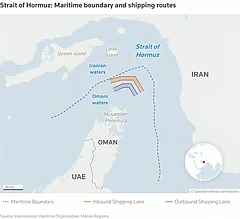
The uncertainty at the border comes at a particularly sensitive moment for West Asia. Even as negotiators attempt to stabilise the northern front, Iran has intensified pressure by declaring the Strait of Hormuz closed to vessel passage, accusing Israel of violating ceasefire commitments and the United States of failing to uphold its obligations.
Together, the twin flashpoints threaten to disrupt one of the world's most critical energy corridors and deepen instability across the Gulf. For India, which relies on imports for nearly 89% of its crude oil needs and has growing strategic stakes in the region, the fallout could extend far beyond diplomacy—raising energy costs, widening external imbalances, and jeopardising key connectivity projects central to its economic ambitions.
For India, the world's third-largest oil importer, this twin crisis poses an immediate and severe threat. Data from the Petroleum Planning & Analysis Cell (PPAC) shows India's crude oil imports during April-May 2026-27 stood at 41.7 million metric tonnes valued at US$35.5 billion, with import dependency of 88.7%. The nation consumed 39.39 million metric tonnes of petroleum products during this period, a 5.1% decline from the same period last year.



Conflict Escalation and Regional Spillover
The conflicting statements over Israel's withdrawal highlight the fragility of diplomatic efforts. A ceasefire between Israel and Hezbollah, announced after US-mediated talks, was previously undermined by continued Israeli military strikes in southern Lebanon. Hezbollah's leadership rejected parts of the agreement, particularly Israel's stated intention to maintain freedom of military operation in Lebanese territory. The persistent fighting has put pressure on US-Iran peace negotiations, with Iran insisting a complete halt to Israeli attacks in Lebanon is a prerequisite for implementation.
While US Central Command reported that 55 merchant ships transited the Strait of Hormuz on June 20, Iran's blockade threat has created significant market uncertainty. The International Energy Agency's Oil Market Report for June 2026 noted that heightened geopolitical risks in the Middle East continue to pose supply disruption concerns.
Impact on Energy Prices and Trade Deficit
The tension has contributed to crude price volatility. According to PPAC data, Brent crude averaged US$107.55 per barrel during May 2026 compared to US$64.22 per barrel during May 2025. The Indian basket crude price averaged US$106.23 per barrel during May 2026, up from US$64.04 per barrel a year earlier.
India's vulnerability to West Asian instability is substantial. The nation imports over 85% of its crude oil requirements, with the Middle East accounting for a significant portion of supply. PPAC data shows that during May 2026, India processed 22 million metric tonnes of crude oil, out of which only two million metric tonnes came from indigenous sources. The remaining 20 million metric tonnes was imported.
Liquefied natural gas imports also face disruption risks. The Monthly Gas Report for April 2026 from PPAC noted that LNG imports were 2,266 MMSCM, 20.97% lower than the corresponding month of the previous year, with actual figures expected to be much lower due to the Middle East conflict. Total natural gas consumption for May 2026 was 5,061 MMSCM, 12.87% lower than May 2025.
The widening trade deficit is another concern. According to NITI Aayog's Trade Watch Quarterly for April-June FY26, India's merchandise trade deficit widened amid global uncertainties. Higher oil import bills, if sustained, would further strain the current account deficit and pressure the rupee. PPAC data shows that India's net oil and gas import bill for April-May 2026-27 stood at US$32.3 billion, a significant increase from US$21.3 billion during the same period last year.

Risk to Strategic Infrastructure Projects
The conflict threatens major connectivity initiatives central to India's regional strategy. The India-Middle East-Europe Economic Corridor (IMEC), signed during the G20 Summit in September 2023, faces potential delays due to regional instability. IMEC comprises an Eastern Corridor connecting India to the Gulf and a Northern Corridor connecting the Gulf to Europe. The project includes a shipping route from India to the UAE, railway lines across Saudi Arabia and Jordan to Israel, and shipping routes from Israel to Europe.
The corridor is designed to provide an alternative route for trade and energy flows, reducing dependence on vulnerable maritime chokepoints like the Strait of Hormuz. However, persistent security challenges in the Persian Gulf and wider region underscore India's economic vulnerability to geopolitical shocks.
West Asia remains a critical trade partner for India, with exports to the region including agricultural products, textiles, and engineering goods, while imports are dominated by crude oil and petrochemicals. Any disruption to shipping lanes would affect these trade flows. According to Reuters, oil supply from the UAE to India surpassed pre-war levels in May 2026 as buyers sought to secure supplies, indicating a shift in sourcing patterns amid regional uncertainty.
Broader Economic Impact and Human Cost
The conflict's impact extends beyond energy to India's broader economic interests in the region. Millions of Indian expatriates live and work across the Gulf, making their safety and remittance flows major concerns for New Delhi. Remittances from the Gulf region form a significant portion of India's foreign exchange inflows, and any disruption to employment or repatriation of funds would have macroeconomic consequences.
India must balance strategic partnerships with Israel in defence and technology against long-standing ties with Iran and Gulf Arab states. This diplomatic tightrope becomes increasingly challenging as regional tensions escalate.
UN Proposals and Way Forward
The UN Security Council is set to deliberate on three proposals from Secretary-General Antonio Guterres to maintain peacekeeping operations along the Israel-Lebanon border as the current 8,100-member UN mission in southern Lebanon ends on December 31. All options presented by Guterres aim to maintain UN military monitoring of the Blue Line, support Lebanese Armed Forces deployment, and strengthen political efforts to end fighting that persists despite a nominal ceasefire.
Guterres emphasised that "a uniformed United Nations presence working to facilitate de-escalation, dialogue, liaison and coordination, and support for the Lebanese Armed Forces would be necessary" under all options. The proposals build on the 2006 UN Resolution framework demanding Hezbollah disarmament, Israeli withdrawal, and Lebanese army deployment as the sole military force. A Security Council decision is awaited to stabilise the region and avert further escalation.