A new modelling study warned the Ebola outbreak in the Democratic Republic of Congo has already spread to Uganda and could reach South Sudan within weeks.
Health experts urged neighbouring countries to strengthen surveillance, contact tracing and outbreak response amid the absence of a vaccine for the Bundibugyo strain.
An Ebola outbreak in the Democratic Republic of Congo (DRC) has spread to Uganda and now carries a high risk of reaching South Sudan within weeks, according to a new modelling study published in The Lancet Infectious Diseases.
The study estimated a nearly 70 per cent probability that the virus will reach South Sudan over the next 12 weeks, raising concerns over regional preparedness and public health capacity.
As of June 22, 2026, the outbreak caused by the Bundibugyo strain of the Ebola virus had recorded 1,048 laboratory-confirmed cases and 267 deaths in DRC. The World Health Organisation (WHO) said the virus circulated undetected for nearly six weeks before it was identified.

Researchers from the WHO Regional Office for Africa warned that, in the absence of an approved vaccine for the Bundibugyo strain, neighbouring countries must urgently strengthen public health measures including border surveillance, contact tracing and safe burial practices.
Although DRC’s intensified containment efforts are beginning to reduce transmission rates, researchers said the outbreak continues to pose a major regional threat.


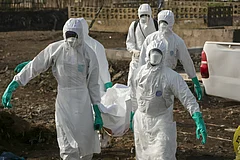

Using computer-based transmission models, the study projected outbreak trajectories under low, medium and high transmission scenarios. Under the most likely scenario, cumulative confirmed infections were expected to reach around 990 by late June 2026, with approximately 174 deaths, before potentially rising to 8,210 cases by September if transmission continues unchecked.
South Sudan was identified as the country facing the highest risk.
Dr Marie Rosaline Belizaire, WHO’s Emergencies Director for Africa and incident manager for the outbreak, who is also among the study’s authors, said preparedness efforts should focus urgently on South Sudan.
“South Sudan also has some of the weakest public health infrastructure in the region, with known gaps in case management, contact tracing, safe burial practices and border surveillance,” the researchers noted.

The study estimated the risk of Ebola importation into Rwanda at 8.6 per cent and Burundi at 2 per cent, though researchers said those projections could change depending on surveillance systems, travel flows and response measures.
The authors stressed that the projections should be treated as an early situational assessment designed to support preparedness planning rather than as definitive forecasts, adding that estimates would continue to evolve as additional verified data becomes available.
Hatchett said the absence of a licensed vaccine for the Bundibugyo strain remained one of the biggest concerns and warned that the outbreak echoed the delayed international response seen during the 2014 West Africa Ebola crisis.
“The lesson from that experience is clear: scale up the response early, before the situation becomes unmanageable. This is a rapidly growing, potentially exponential process. By the time the growth becomes obvious, it can accelerate very quickly. The priority must be to strengthen control measures now before the outbreak spirals further,” he warned.
Hatchett also pointed to India’s vaccine manufacturing capacity as an important global resource.
“India’s COVID-19 response demonstrated its ability to rapidly scale vaccine production, with institutions such as the Serum Institute of India (SII) showing remarkable manufacturing capability and partnership capacity,” he said.
He added that influenza viruses and coronaviruses continue to represent the biggest pandemic risks for South Asia because of their ability to spread rapidly across large populations.
“Nipah virus is also a significant concern for India because of its presence in the region, although it currently lacks the level of transmissibility required to trigger a large-scale pandemic,” he said. “However, any evolution that increases its transmissibility could dramatically raise its threat level.”
(The Indian Express reported)