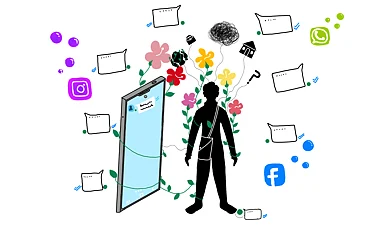
Love is political, shaped by identity, power and resistance.
Outlook’s January 24, 2022 issue, explores how it exists between emotion and social structures, constantly being rewritten.
In a world that polices intimacy, love remains both defiance and necessity.
"The greatest you'll ever learn is to love and be loved in return."
But Moulin Rouge? In this economy?
Love has always carried a burden of meanings and perspectives hovering in a curious space between subjectivity and traditional diktats. However, it is equally essential to read love as a text which keeps writing itself as the wheels of society keep turning. Love is as much shaped by boundaries and identities where the political and the personal fuse to shed past constructs, biases and patriarchal definitions as it is by emotions. At Outlook, love has always been looked at as a political act in a world where it is defined to be free, but rarely is.
Ahead of Valentine’s Day, in Outlook’s January 24, 2022 issue, we looked at love from the prism of the present day, capturing the refractions. Tanvir Aeijaz in his piece 'Auctioning' Of Muslim Women Is Symptom Of A Cancer That's Crippling India' looks at how patriarchy and society perceives the agency of a woman - by diving into an instance where photographs of Muslim women—mainly students, journalists and activists—were uploaded on an app called ‘Sulli Deals’, where they found themselves being traded off. The platform represented a market site to buy a ‘Sulli’—an abusive word for Muslim women—as a ‘deal of the day’. Aeijaz writes, “The deals were targeted against Muslim women, majorly vocal women, and neatly excluding other religious categories. The deals appeared to be a meticulous stratagem to rip off the dignity and womanhood of Muslim women."




Naseer Ganai, based in Srinagar, in his piece Lament of Separation, wrote about Habba Khatun’s sensuous songs threading in the 16th century history, where, after the Mughals annexed the independent kingdom of Kashmir and exiled its last king, Yousuf Shah Chak, his beloved queen, Habba Khatun, was left wailing. In the wilderness, she sang for her beloved, pleading for one glimpse. Yousuf never returned, but 500 years down the line, Kashmiris believe Habba’s songs still echo in the valley.
In her piece, City of Djinns, Ananya Vajpeyi peeks into the heart of Delhi, where the past is being erased, and history is under siege. The present reshaped. Vajpeyi writes of a Delhi where the present brings with it “a strange feeling of transience and an eerie sense of lingering in the past, and a struggle with demonic communalist forces.

Lachmi Deb Roy looks at the idea of ‘decoupling’ in her piece Friends Without Benefits: Decoupling Is A 21st Century Idea Whose Time Has Come, and how it defines dissolution of a marriage in the conventional sense, but with a twist. where a lot of social, psychological, economic and judicial thought is yet to shape it.
The cover of the issue, which asks the necessary questions, mostly conversing, rarely answering, is designed by artist, filmmaker and production designer Aradhana Seth, effectively foregrounds the central theme - ‘All We Need Is Love’.
In all of its politics, boundaries, complexities and definitions, all we do need is love.