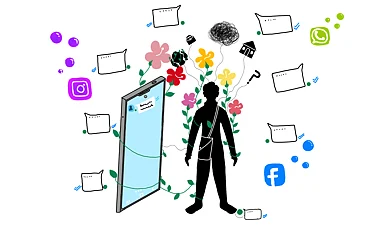
Documentary filmmaker, editor and writer Paromita Vohra introduces the anthology Love Sex and India as a book of personal stories.
In conversation with Lalita Iyer of Outlook, Vohra reflects on dating apps and orgasm anxiety.
Sexual life is incredibly heterogenous and impacted by our social identities – gender, class, caste – but also our biographies and something in our individual nature.
Documentary filmmaker, editor and writer Paromita Vohra introduces the anthology Love Sex and India as a book of personal stories: a kaleidoscopic collection about intimacy and pleasure, love and heartbreak, sex and beauty, experiments and mistakes. The book was born from intimate, confessional and quietly radical voices drawn from a decade of Agents of Ishq - India’s most-loved digital platform about love, sex and desire. The anthology refuses easy binaries - shame versus liberation, repression versus progress -- and instead assembles what Vohra calls a more heterogenous republic of love, where heartbreak, hesitation, lust and longing coexist with social realities of gender, class and caste. In conversation with Lalita Iyer of Outlook, Vohra reflects on dating apps and “orgasm anxiety,” the crisis and reinvention of masculinity, and why talking about sex is never a neutral act - but can be a deeply human one.
Excerpts from the conversation:
AOI has years of essays, stories, art, and confessions. How did you decide what represents “Love, Sex and India” in this moment? How has the universe of conversations around sex changed in the decade since AOI was born?
I think the one pattern that emerges is that in lived experience not everyone operates in a binary of shame and taboo versus liberation. Rather they are constantly surprising themselves in their sexual and emotional journeys, unlearning and learning things. And they want to share these journeys alongside others – which in some ways is what AOI offers. There your experience is not representative of every other woman or queer person or any particular identity, and not there to necessarily speak for only ideology. Rather it is unique to you but also connected to other journeys of sexual and emotional exploration and self-discovery.
Sexual life is incredibly heterogenous and impacted by our social identities – gender, class, caste – but also our biographies and something in our individual nature. The frame of experience creates an inclusive plane where we are connected through certain emotional commonalities --heartbreak, hesitation, lust or longing, the most human parts of ourselves, while being different due to our social realities.
Love, sex and desire course beneath everything we do in some way. They are a way of being in the world and also a way of being outside the world’s demands. What people do in their private lives may not always cohere with their public selves – and yet, through these ways of living, people understand themselves better, their relationships alter and slowly change something in the world. Through the many different accounts on Agents of Ishq people reshape the contours of the discourse and in a very gentle way, refuse to be boxed or categorised into homogeneity.
I think the stories really give us permission to be ourselves, to not fear our mistakes but see them as something that we learn from and grow from to be a different version of ourselves.



With dating apps, therapy-speak, sexual self-awareness - we’re supposedly more “evolved” than ever. And yet intimacy feels brittle. Do you think choice has complicated love more than it has freed it?
Love has always been complicated – because love is not a homogenous experience. It’s different each time – no matter what your patterns. Being in love is intoxicating and each time offers a sense of renewal and possibility. Yet being in love is fraught with doubt and hesitation and the ghosts of all that has passed in our emotional lives before as well as our social realities. So the idea of love as a difficult thing which asks something of you – perhaps to bear vulnerability in oneself and others, to bear the vulnerability of waiting, and to develop a supple relationship with rejection – has been ever-present.
It is easier to find other people perhaps – we are no longer restricted to a limited pool. But meeting someone is only the beginning of a complicated journey which is sometimes thrilling and often challenging. No one really talks about that journey – I mean we don’t even have good rom-coms of that kind anymore. Dating apps become about success and failure. For instance they are very skewed in ration of men to women and exacerbate the anger men feel about not getting matches. They are a tool, but they begin to define our reality in some ways.
I think what dating apps and therapy-speak transmit is the idea that love or life can be not-complicated, that it’s as easy as a swipe or as identifying a symptom. By presenting themselves as the solution to love and loving, they leave us unprepared for intimacy, because they promote a certain notion of invulnerability and invincibility as ideal. Sexual self-awareness can also
often become a checklist that fixes what it means to sexually self-aware – so it can create a new kind of conformity and it plots a linear journey from being repressed or oppressed to being a victor of sexuality. If we are trying to fit into some homogenous method of meeting and mating then we are merely conforming to a new norm, rather than opening ourselves up to what we want and how we can be with other people.
In one workshop with young men I had asked the question – ‘what’s the hardest thing about dating?” and one person replied, “the effort not to fall in love.” In a survey we did at AOI, so many women spoke about ‘orgasm anxiety’ as a pressure they feel because of a new culture of sex positivity which seems to imply that to not have good sex is to be a failed modern person, This was so striking. In a world defined by very particular notions of success, dating apps, therapy speak and the social media discourse of sexual awareness are in danger of asking us see life as a number of goal posts, sexual, emotional and social. If one is so tense about meeting the standards set up by others and which constantly surround you, it’s not surprising that people feel extremely inhibited and unsafe showing an un-curated self. That’s a loneliness that can really eat into your ability to form relationships of all kinds, including the one that gives us the most confidence and resilience – friendship. Showing oneself fully to others becomes a source of too much anxiety in this context and so intimacy becomes hard to share.
All of these things also fix you as a type and fix what ‘type’ of person you want. In reality we are often surprised by whom we are attracted to and fall in love with. This surprise allows us to exist outside scripts. They provide an illusion of choice but limit life to only acts of choosing, not exploring or committing to something.
A lot of this in the age of social media also creates absolutes and binaries of what relationships should look like – red flags being a common example of how one is told to assess others. There is a lot of terminology and people often feel they have to describe themselves through those terms rather than move through the world in an open-ended and poetic way.
Most of all I think they tell us we have to do everything on our own and it’s win or lose– and that really undermines the mutuality on which relationships rest.
Personal freedom can’t really be a syllabus. Rather, it is the ability to know your sexual and emotional self and to be able to actualise that journey for yourself without hurting others.
After years of reading submissions on love and sex, is there anything that still surprises or unsettles you?
Each story is different. But when a story is written with an emotional truth, some alchemy happens. You find yourself completely drawn into the narrator’s emotions and one always emerges quite amazed by people’s ability to be honest, at what I would call, their wisdom, no matter their age, and the way they are able to recognise their experience. People’s determination to tell their story and their willingness to claim it – to not be anonymous, always surprises me, even when I think I am used to this.
I would say though that the stories we received in the early years were a lot more energetic and surprising and they had a real sense of discovery in them – complex emotions in gay sex that don’t really get discussed, a woman’s anger at her sexless marriage, a young woman’s struggles with vaginismus, a young man’s realisation he is kinky during a game of charades – there was a real shimmer of discovery in these and a kind of frankness. Because there was not much precedent for personal essays in India and certainly not around sex, I think people were very unfettered in the way they spoke of themselves, whether or not they were good writers.
Certainly in more recent times one notices that there is a tendency to speak of one’s life in more jargonistic terms, a lot more hiding behind language and theory, a certain self-consciousness that has crept in because of the huge weight of social media on this part of life. So self-discovery is far more mediated now and it’s rarer to get exuberantly unfettered narratives.
You’ve held space for so many other people’s stories of longing, confusion, heartbreak and heat. What does that do to you?
There are beautiful days and there are difficult ones. Most of the time, you feel astonished at people’s vulnerability, humour, wildness. You feel tender towards it. I think the process of engaging with stories in this way – when you don’t want to serve them as clickbait and ‘raw unfiltered’ things, is a real invitation to empathy. You understand why people do what they do even when you don’t agree with them – and that’s an important experience. You enjoy the way people have a sense of humour about themselves.
You do relive your own difficult times and sometimes you are jealous that today, people can speak of and be acknowledged for things you could not when you were young. You feel anxious that you don’t hurt their feelings or
make them feel judged in any way when you suggest edits. It’s a difficult task, requiring sensitivity but also some clarity. I feel my background as documentary filmmaker has helped me in many ways to listen deeply and try to understand what people mean inside what they are saying. And the colleagues who have worked at AOI have also all been incredibly empathetic people, fundamentally kind and open, in the way they engaged with others’ narratives.
Sometimes one also wishes that more people could bring this look of love to stories – we know the world isn’t always that kind or that open-hearted and the internet feeds on people’s rawest emotions in violent ways.
But yes, when people write to say they came out to a parent while they were working on the story with us, or moved out of a tough relationship, or that they were happy for the kindness of the process, we are moved and it is hard to describe the emotion that flood you, of having shared a human moment in a world that makes this very hard.
How do you think Indian masculinity is coping with changing sexual and emotional expectations?
There is definitely a feeling of crisis – at first when we began AOI, we centered the experiences of women and queer people for a simple reason. Standards of what sexual life should be have often been set on the basis of a stereotypical idea of male sexuality – aka “men want a lot of sex and are always ready for it”. As we began to play out a more expansive notion of sexualness though – one which encompassed many kinds of touch, sexual emotions, and different orientations, including asexuality, it destabilised that idea of male sexuality too. We definitely noticed how easily and joyfully women and queer people claimed the AOI space in different ways, but how straight men hovered at the edges.
When we do a piece that says there is no one masculine libido, this can make men anxious, even while it makes them feel seen and they aren’t easily able to feel the relief that others do when their realities are shared.
So we know there is a backlash against this ask for vulnerability – we see it all around us. But at the same time I would say that there are also men who are changing. Men who, after #MeToo genuinely reflected and men who want to shrug off some of the burdens of patriarchal masculinity.
Men do lack spaces to talk about emotions in more reflective ways, without self-pity and anger and don’t seem to have the skills to create these the way queer communities and women have done. Sometimes men reach out to us saying they would like to write for AOI but then they are rarely able to actually do it. They are more comfortable with writing opinions.
However a lot of men – especially non-English speakers – have submitted poetry to AOI and it’s been a surprise how comfortable those poems have been with the body and sensuality.
So I guess I am saying that masculinity like anything else should be seen more heterogeneously – one kind of masculinity need not stand in for all masculinities.
Editing love and sex in India is not a neutral act. What surprised you most about the submissions or conversations?
I suppose the question is really, why should we talk about sex and how much should we talk about sex? The answer is we should talk about it only as much as we really wish – not as much or as little as someone else wishes us to do. Not everyone who does not talk about sex is repressed. Not everyone who speaks of it is liberated. Merely talking about sex does not add up to much – it’s how we talk about it. To talk about sex is in a way to talk about life and who we are as people. Yes sex reveals power relations, but it also reveals how desire can unmake these and how at heart human beings yearn to shape their lives and feel their emotions and desires without being shamed for them. At their core, the stories in Agents of Ishq refuse the gaze of shame or someone else’s right to decide the meaning of their experiences, sexual or emotional. They may talk about a painful experience or a joyful or confusing one, but they determine what it means. That is why they feel like a kind of republic of love, with place for everyone.
Because it is not a neutral act, because it is not clinical, the stories matter so much as they do not categorise experience as much as render it in all its diversity. And what also matters is the language in which they are told. The stories have a real desi flavour – not only in their circumstances, but also in the cadence they use, the words they use. By not having standardised English, by retaining the sound of whatever other language they speak, and words from people’s own mother tongues, the stories celebrate the incredible variety of experience and also assert the right to a private life of one’s own definition.
AOI has years of essays, stories, art, and confessions. How did you decide what represents “Love, Sex and India” in this moment? How has the universe of conversations around sex changed in the decade since AOI was born?
We have never tried to be representative of all of India. That is why the anthology is called Love Sex and India – not Love and Sex in India. This is an ever-growing universe, and people have many different interpretations of what it means to be an Agent of Ishq – their definitions keep changing the outlines of the project and by extension what contemporary sexuality is.
For the anthology we selected stories that reflected a range of emotional and sexual experiences that make up intimate life – friendship, social pressure, yearning for love, upturning norms, disappointment, possibility, anger, violence, self-definition. These are perennial realities of life and in a way when people write about these things the stories are always about the contemporary moment they are living in. I think that’s a little different than stories about topics like kink or polyamory etc, which may seem radical in one moment and formulaic in another. Stories which did not fit into a formula were the ones we chose because that is really where one glimpses the possibilities of a particular time we live in.
Also, the way we read on the internet and how we read a book are different. The stories in the book hope to create a space for inner reflection for the reader who traverses a landscape that is both familiar and unexpected.