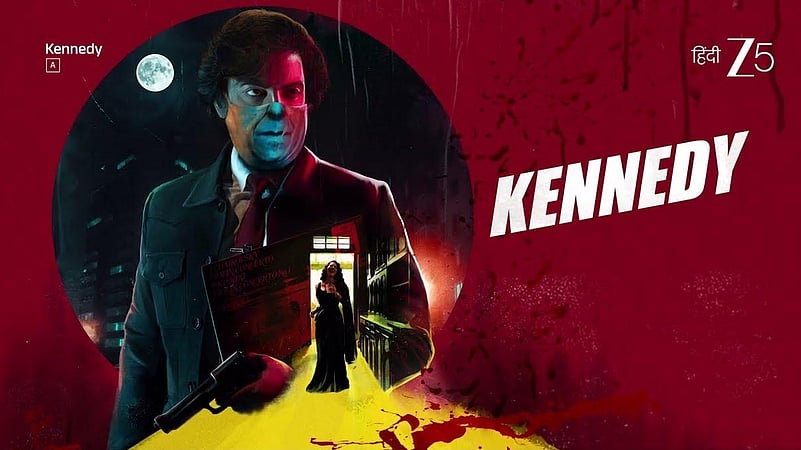
In light of Kennedy, this listicle gathers an array of companion neo-noir watches that interrogate institutional decay, urban alienation and the moral fatigue of contemporary India.
Across these narratives, crime emerges as an embedded structure within the city, shaped by ambition, revenge, survival and systemic complicity.
Together, they frame violence as consequence, tracing how modern identities are forged, distorted and often erased within labyrinthine urban systems.
Crime has remained one of cinema’s most enduring genres because it dissects the fault lines of contemporary life. Its narratives often unfold in metropolitan spaces dense with surveillance and anonymity, where police, criminals and civilians circulate within the same compromised ecosystem. Neo-noir crime thrillers, in particular, have refined this terrain into a philosophical form. These films probe institutional decay, psychological fracture and urban alienation while constructing intricate narrative puzzles that demand active participation from the viewer. The eventual act of making sense of these fractured timelines, unreliable characters and concealed motives produces a rare narrative catharsis—one grounded less in moral resolution than in recognition.
After a prolonged and uncertain release trajectory, Kennedy (2023), fronted by Rahul Bhat and directed by Anurag Kashyap has finally become accessible to viewers through streaming on Zee5. The film follows a police officer presumed dead, who continues to operate covertly as an executioner. Earlier Hindi neo-noirs often anchored crime in aspiration—economic mobility, revenge or the search for belonging. In Kennedy, crime assumes a bureaucratic quality—violence is procedural, absorbed into the machinery of governance. The protagonist moves through Mumbai as a spectral presence, shaped by insomnia, isolation and institutional dependence.
In light of Kennedy, the following listicle traces a lineage of Hindi neo-noir films that reimagine crime as a structural and psychological condition. For viewers drawn to its atmosphere of institutional opacity and existential drift, these films offer a deeper engagement with crime shaped by urban alienation, fractured identities and systems that sustain violence:
1. Black Friday (2007, dir. Anurag Kashyap)


Black Friday reconstructs the 1993 Bombay bombings through a procedural lens without indulging in cinematic sensationalism. Kay Kay Menon’s investigating officer navigates a fragmented landscape of suspects, victims and ideological recruits. The film emphasises systemic causality, tracing how political unrest, communal violence and institutional failure converge into catastrophic consequence. Bombay is again rendered as a city shaped by collective trauma, where crime reflects broader political fractures rather than isolated deviance.
2. Johnny Gaddaar (2007, dir. Sriram Raghavan)

Johnny Gaddaar examines betrayal within a small criminal syndicate following a botched cash exchange. Neil Nitin Mukesh’s Johnny orchestrates a deception driven by greed and romantic obsession, gradually dismantling the fragile trust sustaining the group. His motivations remain fundamentally opportunistic, exposing crime as an extension of personal ambition rather than structural coercion. The film’s stylised use of shadows, confined interiors and temporal manipulation evokes classical noir traditions.
3. Kahaani (2012, dir. Sujoy Ghosh)

Kahaani follows Vidya Balan’s Vidya Bagchi, who arrives in Kolkata searching for her missing husband. Her apparent vulnerability conceals a calculated pursuit of justice shaped by personal grief. The film constructs Kolkata as a dense labyrinth, its crowded streets and festive public spaces providing both concealment and revelation. Vidya’s motivations reframe crime as a response to institutional indifference, transforming her from victim into orchestrator.
4. Talaash (2012, dir. Reema Kagti)

Talaash centres on Aamir Khan’s Inspector Surjan Singh Shekhawat, whose investigation into a film star’s death intersects with unresolved grief over his own son’s drowning. Kareena Kapoor’s enigmatic Rosie occupies a liminal space between witness and apparition, destabilising Surjan’s rational framework. Mumbai appears suspended between material and psychological realities, its nightscapes reflecting Surjan’s internal fragmentation. Violence becomes inseparable from mourning, positioning crime as an entry point into suppressed emotional trauma.
5. Shaitan (2011, dir. Bejoy Nambiar)

Shaitan follows a group of affluent, yet alienated young adults whose reckless behaviour culminates in accidental violence and extortion. Kalki Koechlin’s Amrita anchors the narrative as both participant and observer, her detachment reflecting generational disaffection. The film’s kinetic visual style mirrors the instability of its characters’ moral compass. Mumbai here appears disorienting and excessive, amplifying their emotional volatility. Crime emerges from boredom, privilege and psychological drift rather than economic necessity.
6. Bombay Velvet (2015, dir. Anurag Kashyap)

Bombay Velvet situates crime within the historical construction of Bombay during its transition into a global financial centre. Ranbir Kapoor’s Johnny Balraj seeks legitimacy through his association with organised crime, viewing violence as a pathway to social mobility. The film frames the city as a manufactured entity, shaped by political compromise and economic opportunism. Johnny’s motivations reflect aspirational desperation, where crime offers entry into otherwise inaccessible structures of power.
7. Andhadhun (2018, dir. Sriram Raghavan)

Andhadhun follows a pianist, portrayed by Ayushmann Khurrana, who becomes entangled in murder after pretending to be blind. Set in Pune, the film constructs crime through deception and coincidence. Violence here is sudden and darkly comic. Greed and survival guide the characters, while perception itself becomes murkier by the minute.
8. Satya (1998, dir. Ram Gopal Varma)

Satya follows an unnamed migrant (J. D. Chakravarthy), who enters Mumbai’s criminal underworld without economic or social anchors. His friendship with Manoj Bajpayee’s volatile Bhiku Mhatre lends him both emotional belonging and existential risk. The film situates crime within the structural realities of migration, where anonymity allows reinvention yet denies stability. Violence erupts suddenly, reflecting the precarious logic governing gang hierarchies. Mumbai here emerges as an absorptive organism, indifferent to individual loss, where crime offers both livelihood and erasure.
9. Monica, O My Darling (2022, dir. Vasan Bala)

Monica, O My Darling follows Rajkummar Rao’s Jayant Arkhedkar, a robotics engineer drawn into a murder conspiracy engineered by Huma Qureshi’s Monica. The corporate environment replaces traditional underworld spaces, positioning crime within contemporary professional hierarchies. The film employs stylised framing and dark humour to expose the fragility of meritocratic success. Violence is shaped by fear of exposure rather than emotional impulse.
10. Gangs of Wasseypur (2012, dir. Anurag Kashyap)

Gangs of Wasseypur chronicles generational feuds in the coal mafia of Dhanbad. Spanning decades and led by characters such as Sardar Khan, played by Manoj Bajpayee, the film portrays crime within caste, industry and political patronage. Violence here is excessive and cyclical. Character motivations stem from inheritance, revenge and territorial control—rendering crime as an inevitable lineage.
11. Sarkar (2005, dir. Ram Gopal Varma)

Sarkar examines Amitabh Bachchan’s Subhash Nagre, a political patriarch whose extrajudicial authority supersedes formal governance. His influence sustains order through coercion, complicating distinctions between justice and authoritarianism. The city appears structured by invisible power networks operating parallel to democratic institutions. Violence functions as governance, reinforcing Nagre’s legitimacy within both political and criminal domains.
12. Baazigar (1993, dir. Abbas–Mustan)

Baazigar presents Shah Rukh Khan’s Ajay Sharma as an avenger driven by childhood dispossession. His calculated seduction and murder of Shilpa Shetty’s character establishes a rare instance of a Hindi film aligning spectators with a morally compromised protagonist. The urban landscape facilitates his manipulation, offering proximity without accountability. Violence becomes instrumental, subordinated to Ajay’s pursuit of retributive justice.