In the dusty corridors of India's sub-registrar offices, property registration has long been synonymous with frustration. Multiple visits, endless queues, opaque processes, and the ubiquitous presence of middlemen have made what should be a straightforward transaction into an ordeal. But in Haryana, under the leadership of Chief Minister Sh. Nayab Singh Saini, this narrative is being rewritten not through incremental improvements, but through radical digital transformation.
Haryana's paperless registration system, now fully operational across all 23 districts, represents more than technological advancement. It is a fundamental reimagining of how government serves its citizens, demonstrating that when political ‘will’ meets technological innovation, the seemingly impossible becomes routine.
The transformation is comprehensive. What once required weeks of office visits can now be completed in 48 hours from the ease of home. Citizens log into the Haryana e-Registry portal https://eregistration.revenueharyana.gov.in/, upload documents, pay fees digitally, and receive blockchain-secured certificates via email. The entire process application, verification, payment, and certificate generation is paperless and transparent.
The numbers tell a compelling story. Processing time has dropped by 90 percent, from 20 days to just 48 hours. With over 2.60 lakh registries completed so far under the new paperless registration system, perhaps most remarkably, there have been zero cases of document forgery in digitally registered properties—a stark contrast to the old system where forged documents were a persistent menace.

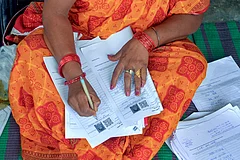
But the real breakthrough lies not just in speed or security, but in the integration of registration with mutation the process of updating land ownership records. This seemingly technical detail addresses one of the most vexing problems in Indian land administration: the dangerous gap between registered ownership and revenue records.
For decades, a property transaction in India involved two parallel processes. Registration established legal ownership, while mutation updated revenue records. These processes often occurred months or even years apart, creating a twilight zone of legal uncertainty. Disputes flourished in this gap. Banks hesitated to lend. Property markets operated with persistent friction.
Haryana's innovation is to collapse this timeline. Under new policy directions issued recently, mutation is now entered immediately after registration. This isn't just faster—it fundamentally eliminates the space where corruption and delay traditionally bred. Every revenue recordinHaryana now exists in digital form -a
transformation that has eliminated the chaos of paper- based systems entirely. No more missing files, no more discrepancies between departments, no more opportunities for manipulation.
The policy goes further. Sale deeds cannot be registered unless the seller's name appears in existing revenue records, creating a self-verifying chain of ownership. For legacy cases where mutation waspending, special camps have been scheduled to clear the backlog. Approximately two lakhs such cases have been identified, representing years of accumulated delay that is now being systematically addressed.
Haryana's system draws on best practices from across India while adding its own innovations. Karnataka's Bhoomi-Kaveri integration pioneered auto-triggered mutation. Telangana's Dharani portal demonstrated near- simultaneous registration and mutation. Maharashtra's e- Mutation system showed how digital verification could work. Gujarat's e-Dhara proved the concept's scalability.
What distinguishes Haryana's approach is while several states have introduced online appointment systems that require multiple visits to registry offices—for document submission, verification, and final registration—Haryana has streamlined this to a single visit for biometric verification and photographs once the token is generated. Citizens apply online, upload documents digitally, pay fees electronically, and only visit the Modern Tehsil for identity verification—a process that takes minutes, not hours.
The state hasn't just digitized forms—it has rebuilt the entire ecosystem. Blockchain technology ensures immutability of records. Cloud storage eliminates physical files. Integration with the Haryana Unified Land Records System ensures seamless consistency across departments. Real-time notifications keep all stakeholders—buyers, sellers, and banks—informed throughout the process. Most significantly, full auto- mutation through Web-HALRIS eliminates manual intervention entirely: the moment a registration is complete, mutation occurs automatically, removing delays and human error from the equation.
Districts like Gurugram, Faridabad, and Sonipat, which handle the highest registration volumes, have become proving grounds for the system's robustness. When a system works in high-volume urban centers and remote rural taluks alike, it demonstrates genuine maturity.
Parallel to the digital transformation, Haryana is revolutionizing the physical infrastructure of land administration through the modernization of tehsils into "Modern Tehsils"—modeled on the highly successful Passport Seva Kendra framework. This isn't merely about renovating buildings; it's about reimagining the entire citizen experience.
The Modern Tehsil initiative recognizes a fundamental truth: digital transformation must be accompanied by physical infrastructure that supports it. Citizens who need assistance, lack digital access, or prefer in-person verification now encounter a professional, efficient environment rather than the cramped, gloomy, chaotic offices of the past. This hybrid approach exceptional digital services complemented by world-class physical infrastructure ensures no citizen is left behind in the transformation journey. The pilot will be rolled out in 4 tehsils starting April 9, and will subsequently be scaled to other tehsils as well in phased manner.
Many citizens, particularly older property owners, were skeptical of trusting their most valuable asset to a digital system. The government responded with extensive awareness campaigns, training programs, and crucially, on-site assistance at registry offices. Kiosks were established where government staff help citizens navigate the digital process at no extra cost.
This hybrid approach digital by default but with human assistance available has proven crucial. It ensures that lack of digital literacy doesn't create a new form of exclusion. Citizen satisfaction surveys report 95 percent approval a remarkable figure for any government service.
Recognizing that the transition to a fully digital ecosystem requires building trust at every layer, Haryana is also introducing an innovative hybrid safeguard: security- embedded paper for physical outputs. Every printed deed now incorporates multiple anti-forgery features— holograms, microprinting, UV-reactive inks, and security threads—creating tamper-proof physical documents that complement the blockchain-secured digital records. This dual-layer protection addresses a critical insight: while digital security prevents online fraud, physical security prevents offlinemanipulation of printed certificates. The combination has reduced forgery risks to near-zero, providing an added assurance that resonates particularly with banks, courts, and citizens who value both digital innovation and tangible security.
The paperless registry's impact extends beyond citizen convenience into economic fundamentals. Property transactions are fundamental to economic activity they enable credit, facilitate investment, and underpin the real estate sector while attracting heavy investment, ensuring a business-friendly environment for giant ventures. When these transactions are faster, transparent, and more secure, the entire economy benefits.
Banks can now verify ownership digitally in minutes rather than weeks, accelerating mortgage approvals. The blockchain-secured records significantly reduce lending risk. For the real estate sector, transparent and efficient registration increases market confidence and encourages investment. Administrative cost savings of over Rs. 50 crores annually can be redirected to other priorities. Perhaps most significantly, the system shifts the balance of power. The paperless registry makes intermediaries optional rather than essential, democratizing access to government services.
While Haryana's current system represents a significant achievement, it marks only the beginning of a far more ambitious vision. The state's roadmap charts a transformative journey from paperless registration to an entirely faceless systemwhere human intervention is eliminated entirely except for dispute resolution and complex cases. This vision is rapidly becoming reality, with Haryana poised to pioneer the next frontier in land administration through the launch of Next-Gen Faceless Property Registration System. Set to commence shortly as a pilot in Ballabhgarh Tehsil of Faridabad by April 2026, this groundbreaking initiative will be scaled up across the state in a phased manner. It aims to eliminate the need for physical presence or human mediation in the vast majority of property transactions, fundamentally reimagining how citizens interact with land registration services.
This faceless system, leveraging artificial intelligence and machine learning, will enable automated document verification using algorithms trained on thousands of registrations. Full auto-mutation through Web-HALRIS will ensure thatthe moment aregistration is complete; mutation occurs automatically without any manual intervention whatsoever.
The revenue department is also working on integrating advanced features into Bhu-Mitra which is already operational Whatsapp Chatbot. In Haryana, Bhu-Mitra is available in Hindi and English and provides 24×7 assistance for key land and revenue-related services. It is helping citizens by making services more accessible, transparent, and efficient, while also reducing the need for physical visits and human mediation. Through this chatbot, people can conveniently avail services such as jamabandi copies, mutation copies, compensation registration, deed registration assistance, deed token generation, land demarcation requests, complaint registration, and complaint status tracking from the comfort of their homes.
Interstate integration is another frontier. Currently, a citizen buying property in multiple states mustnavigate different systems and regulations. A unified digital system across states would eliminate this friction, though it requires coordination among state governments with different priorities and capabilities. Haryana's success provides a template that other states can adapt, potentially accelerating this national integration.
Other states are now studying Haryana's model. Several have sent delegations to understand the technical architecture and implementation strategy. This is how best practices spread not through centralized diktat but through demonstration effects that make excellence irresistible.
In an era when faith in institutions is fragile, initiatives that deliver visible, tangible improvement in daily life build the trust that democracy requires. When government works efficiently, when corruption finds no purchase, when services are designed around citizen needs rather than bureaucratic convenience, people notice.
The author of the above content, Dr. Sumita Misra, IAS, is currently holding key positions as Financial Commissioner Revenue and Disaster Management Department & Additional Chief Secretary, Health & Family Welfare Department, Government of Haryana
Disclaimer: The views and opinions expressed in this article are those of the author(s) and do not necessarily reflect the official policy or position of the publisher. While every effort has been made to ensure the accuracy of the information, the publisher is not responsible for any errors or omissions, or for the results obtained from the use of this information.