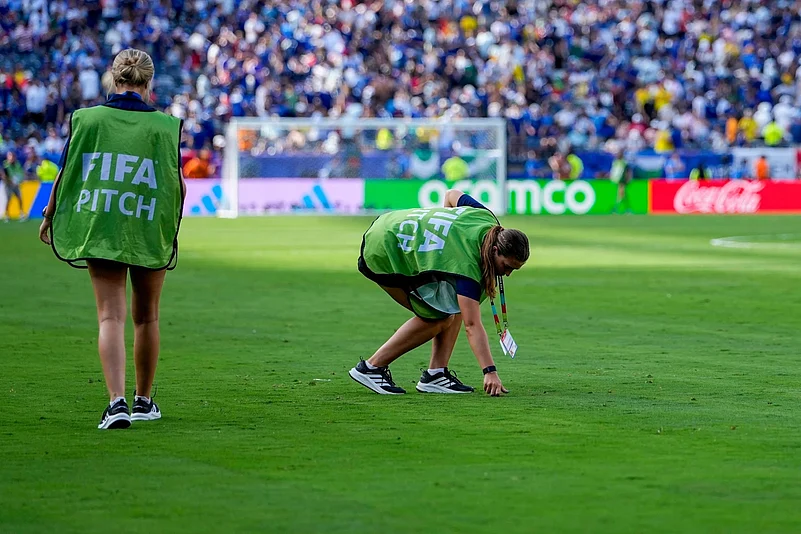
Players and coaches have questioned the pitch at the New York New Jersey Stadium
Neither team has played at the New York New Jersey Stadium yet
Before Norway faced Senegal in New Jersey, Solbakken compared the pitch to AstroTurf
Players and coaches have fielded a lot of questions about the pitch in East Rutherford, New Jersey, before and after World Cup games there. Opinions have varied.
Brazil’s Vinicius Junior was not a fan. France coach Didier Deschamps called it special — and not in a good way. Norway’s Stale Solbakken was asked several times about the surface before coaching his first game on it and came away more pleased about it than he expected.
While entirely different than the turf surface at the stadium that has been maligned by NFL players, the grass field with synthetic fibers stitched in to reduce the risk of divots and tears has drawn mixed reviews through the first seven games of the tournament there. After a nearly two-week break for staff to get it in the best condition possible, the most important game takes place there Sunday when Argentina and Spain meet in the final.
Neither team has played at the Meadowlands stadium yet, adding another element of uncertainty to the matchup.
Players and coaches say the turf plays fast — and better when it’s wet
Before Norway faced Senegal in New Jersey, Solbakken compared the Meadowlands pitch to AstroTurf. He said the short, firm grass could be good for teams who like to possess the ball. Torrential rain fell before and during the game on June 22, changing the complexion of how it played.



“The pitch was much better because of the rain, because the rain made it (so) that the ball doesn’t hang on your foot,” Solbakken said. “It’s going faster, smoother, and that made two good teams could play to their strength, so the pitch, due to the rain, was better. I’m more suspicious if there’s no rain because then it’s dry and short and then it could be more difficult, but with the rain today it made the pitch much, much better.”
It was dry when England met Panama in each team’s final group play game. England coach Thomas Tuchel also likened it to artificial turf for the shortness of the blades of grass — very different from the field in Foxborough, Massachusetts.
“It’s a very fast pitch,” Tuchel said. “It’s very short and a bit uneven because you see still the different layers of the grass and not fully even. So, it’s quite active. It is quite bouncy. ... This one was very hard and very fast but was good, playable, and no one complained.”
Vinicius after Brazil opened there against Morocco and scoring on June 13 said, “The field is not helping.” Rabiot, who played there against Senegal three days later, called it hard and rigid.
“In Europe, we play on pitches that are in a better condition,” Rabiot said through an interpreter. “The pitch was not in a good condition, in my mind. I saw that there has been also a lot of criticism, so I’m not the only one criticizing the state of it.”
Deschamps called it tough and said the pitch “took a lot out of the players’ muscles.”
By the time France returned to open the knockout stage against Sweden on June 30, Rabiot said he believed there had been a slight improvement and the grass was longer.
FIFA spent more than 5 years on the turf and made adjustments during the World Cup
FIFA said the preparations included testing and collaboration with turf experts and stadium operators. The pitch, with grass from the Carolina Green Sod Farm, got installed in early May.
After the hybrid fibers were added, workers followed a continuous cycle of top dressing, aeration, mowing and what FIFA called carefully managed irrigation.
The surface was monitored and tested throughout the process of five group play and two knockout stage games taking place there, including checks on moisture levels, firmness and overall playability. Norway versus Senegal showed officials just how much water the surface could hold and led to maximizing the irrigation hours before and during games, at halftime and hydration breaks.
“The objective throughout has been to deliver a surface that meets the highest possible standards for performance, consistency and player safety,” FIFA said in a statement to The Associated Press.
A 13-day window between Norway and Brazil meeting in the round of 16 and the final was by design, with FIFA aiming to optimize the conditions. The aim was to give the pitch a chance to recover and get prepared and hold ceremony rehearsals.
It’s not clear how the turf will play during the World Cup final
That is anyone’s guess, though heavy rain expected to hit the area Saturday could make it more like Norway’s first game at the stadium. While smoke from Canadian wildfires leaves questions about the air quality, the weather outside of that is set to be picture perfect: sunny and 82 degrees Fahrenheit (27.78 degrees Celsius).
When the World Cup ends, the grass will be removed and artificial turf reinstalled at MetLife Stadium before the Giants’ first exhibition game on Aug. 15. That process got underway at other stadiums across the U.S. after the final games there finished.
The NFL Players Association opposes that, saying 92% of its membership prefers playing on natural grass. Several players have posted on social media in recent weeks in favor of grass over turf.
Washington offensive lineman Laremy Tunsil posted Friday, “If stadiums can make grass work for the World Cup, they can make it work for NFL players.”