The Jaagat Jot Sri Guru Granth Sahib Satkar (Amendment) Act, 2026 converts a 2008 regulatory law into a penal statute.
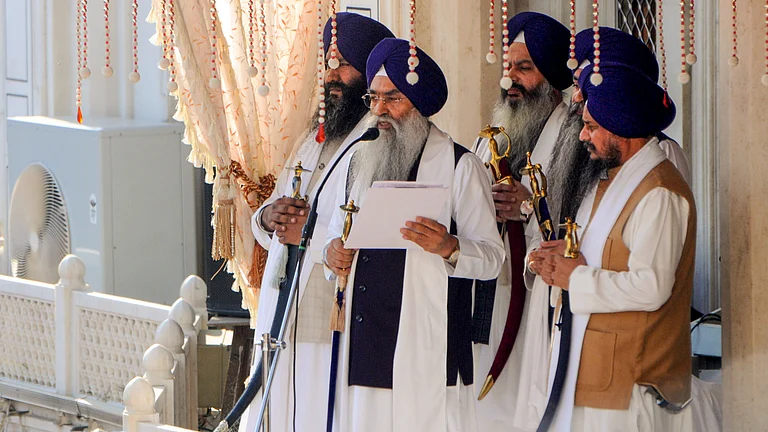
On June 29, the Akal Takht Jathedar summoned all 87 Sikh MLAs and ministers across party lines , handed over a list of 11 objections, and issued a one-month ultimatum to amend the law and suspend its implementation immediately.
Punjab Finance Minister Harpal Singh Cheema said the government would examine the amendments.
On April 13, 2026, Baisakhi, the most sacred day in the Sikh calendar — the Punjab Legislative Assembly convened a special session at Anandpur Sahib, and passed a historic piece of legislation unanimously. The Jaagat Jot Sri Guru Granth Sahib Satkar (Amendment) Bill was hailed by the ruling Aam Aadmi Party as a game-changer in the long battle against desecration of the holy scripture.
On June 29, 87 Sikh MLAs from every political party in the state, ruling AAP legislators, Congress members, Akali Dal members were summoned by Acting Jathedar Giani Kuldip Singh Gargajj. Chief Minister Bhagwant Mann was absent; he had not been summoned, but the Akal Takht had earlier declared him 'anti-Guru' and 'Panth-virodhi' in a separate controversy. At the end of nearly two hours of deliberations, all 87 legislators raised their hands to acknowledge that a mistake had been made.
What Is Punjab's New Anti-Sacrilege Law?
The original Jagat Jot Sri Guru Granth Sahib Satkar Act was enacted in 2008. It was primarily a regulatory law — its focus was on restricting the printing, publication, and distribution of the Guru Granth Sahib to authorised agencies, principally the Shiromani Gurdwara Parbandhak Committee (SGPC).The 2026 amendment transformed the character of the law entirely.



Under the Amendment Act, sacrilege is now defined as 'any wilful and deliberate act' committed with the intent of desecrating the Guru Granth Sahib. The punishments prescribed are severe: seven years' imprisonment and fines of up to ₹25 lakh for lesser offences, rising to life imprisonment for acts of sacrilege.
The law also requires the SGPC to maintain a central register of every physical copy of the Guru Granth Sahib, assigns a unique identification number to each, and creates the legal category of 'custodians'.
The 11 Problems — In Detail
The Akal Takht handed over its complete list of objections to the assembled legislators on June 29. The following are the 11 problems the highest temporal seat of Sikhism has formally raised with the Act, as communicated through various media outlets.
1. No consultation with the Akal Takht or SGPC. The legislation was drafted and passed without seeking the views of either the highest temporal seat of Sikhism or the Shiromani Gurdwara Parbandhak Committee, the only body authorised to print the Guru Granth Sahib.
2. Use of 'Saroop' instead of 'Bir'. The law uses the secular government term 'saroop' for a physical copy of the Guru Granth Sahib instead of the traditional Sikh term 'Bir'. This seemingly minor linguistic choice carries deep theological weight for the Panth.
3. Introduction of 'Custodian' as a legal category. The Act introduces the concept of a 'custodian', defined as any individual, institution, or gurdwara committee supplied with a copy of the Guru Granth Sahib. The custodian is made legally responsible for protecting the scripture. The Akal Takht says this creates fear among ordinary devout Sikhs who keep the holy scripture at home, placing them under a burden of legal accountability.
4. Public disclosure of custodians' identities. The law requires the SGPC to publish on its website information about who holds each 'Bir' of the Guru Granth Sahib. The Akal Takht objects that this exposes the personal details of devout Sikhs and could be misused by anti-Sikh forces and mischievous elements, putting individual Sikhs at risk.
5. Mandatory central register with unique identification numbers. Every physical copy of the Guru Granth Sahib must be assigned a unique identification number and entered into a central register maintained by the SGPC. The Akal Takht says this amounts to placing the living Guru under a government registration system.
6. The SGPC is made an implementing arm of the state. Several provisions of the law assign duties and obligations to the SGPC as though it were a department of the Punjab government. The Akal Takht objects that the government cannot use the SGPC as an instrument of its own regulatory agenda.
7. Placing the Sangat, granthis, pathis, and sewadars in the position of accused. The law places Sikh religious functionaries — granthis (scripture readers), pathis (reciters), gurdwara committee members, and sewadars (volunteers) within a penal framework in a manner that treats them as potential accused.
8. No law can apply to the Guru Granth Sahib itself. Jathedar Gargajj stated explicitly: laws may exist for those accused of sacrilege, but no law can be imposed upon the Guru Granth Sahib, the Sikh Sangat, or sewadars.
9. Interference in the SGPC's exclusive jurisdiction. The Akal Takht maintains that maintaining records of publication and distribution of Birs falls exclusively within the SGPC's jurisdiction
10. No provision for FIR against Dera chiefs for conspiratorial sacrilege. The Akal Takht demanded the addition of a specific provision requiring an FIR to be registered against a Dera chief if any follower of that Dera carries out sacrilege 'under a conspiracy'. The law as passed does not include this accountability mechanism, which the Jathedar says is essential given the history of organised sacrilege incidents in Punjab.
11. The government ignored prior objections. After the Assembly Speaker was summoned on May 8 and given 15 days to carry out amendments, the Akal Takht formally conveyed its objections in writing on May 11.
Why The Akal Takht Wants Changes Within One Month
The Jathedar was emphatic that the Akal Takht's objection is not to the principle of strict punishment for sacrilege. The objection is structural: the law, as written, places the Guru Granth Sahib, the SGPC, the Sangat, and Sikh religious functionaries within a secular legal framework in ways that amount to state interference in internal Sikh religious affairs.
The Akal Takht first communicated its objections in writing on May 11, when the Assembly Speaker was summoned after the law was passed. That produced no response. On June 15, the Jathedar escalated by summoning Sikh MLAs from across all parties. When that too produced no concrete government action, the June 29 hearing was convened.
Punjab BJP president Kewal Singh Dhillon added a separate political dimension: he raised the possibility that Sikh MLAs had passed the Bill without reading its full draft, noting that significant legislation affecting the Guru Granth Sahib had been enacted without adequate parliamentary scrutiny.
What Happens If The Government Refuses?
The amendments proposed by the Akal Takht would be forwarded through the Assembly Speaker, and the government would take a decision within one month after due deliberation. Though they did not commit to accepting the changes.
Punjab Assembly elections are expected in early 2027. The AAP government passed this law partly as a gesture ahead of those elections, calculating it would consolidate Sikh votes. The Akal Takht's intervention has complicated that calculation sharply.
If the government refuses to amend the law or delays beyond the one-month deadline the Akal Takht could call for a broader Panthic response, or issue a further hukumnama directing Sikhs to vote accordingly. Opposition parties, including Congress and the Akali Dal, have already signalled they will use every day of the one-month window to highlight the AAP government's original refusal to consult the Akal Takht before legislating on matters of faith.