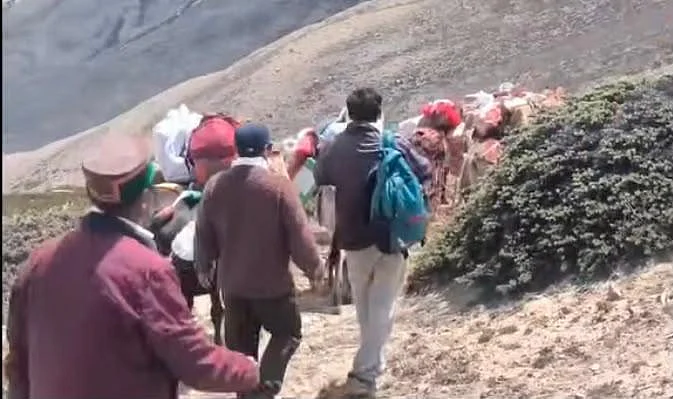
Shipki La traders suspend China border trade over IGST levy, calling the move commercially unviable.
The six-year-old Indo-China trade route reopened recently but faced disruption within days after traders’ protest.
Kinnaur traders seek IGST exemption, citing traditional livelihoods, difficult terrain and limited trade opportunities.
The revival of the historic Indo-China border trade, after six years, through the treacherous Shipki La Pass last week has hit a roadblock once again, this time within days of the return of the first batch of 16 traders, who had crossed over to the Tibet Autonomous Region of China.
Traders, mostly hailing from four border villages in the high-altitude Kinnaur district, have decided to respond to the operations in protest against the Centre's decision to impose the Integrated Goods and Services Tax (IGST) on imported goods, saying it has rendered the trade commercially unviable.
Hishey Negi, President, Kinnaur Indo-China Trade Association, said the association unanimously decided on Wednesday that no registered trader will undertake border trade with China through Shipki La until the IGST imposed on the items approved for Shipki La route trade is exempted, in line with the exemption already granted from customs duty.
After the return of 16 traders, the association convened an emergency meeting of the association, which represents all the registered border traders of Shipki La, and deliberated on the communication received from the Customs Department regarding the levy of Integrated Goods and Services Tax (IGST) on goods imported through the Indo-China Border Trade via Shipki La, as told to Outlook over the phone on Wednesday.


The Association observed that while customs duty has been exempted under Government of India Notification No. 38/96-Customs, dated July 23, 1996, to encourage and sustain traditional border trade, the imposition of IGST has substantially increased the financial burden on traders.
“Considering the limited value of trade, difficult terrain, transportation by mules, short trading season, and the socio-economic objective of this border trade, the levy of IGST makes the trade commercially unviable," Negi maintained.
He further said, “The Association has unanimously resolved that no registered trader will undertake border trade with China through Shipki La until IGST is also exempted, in line with the exemption already granted from customs duty."
Confirming the development, Deputy Commissioner Kinnaur Amit K Sharma said the imposition of the IGST was, indeed, a surprise for the traders, who earlier had been exempted from this before the GST trade regime was enforced by the Government of India (GoI) because there was no bilateral trade happening via Shipki La in the past six years.
“The traders’ body has briefed me on this issue, and I will certainly take it up with the state government, urging it to approach the concerned ministry of the Government of India. Trade through Shipki La is indeed neither highly lucrative nor high in volume,” DC Kinnaur said.
Meanwhile, the association, in its memorandum submitted to the Deputy Commissioner, Kinnaur, said the Indo-China border trade is not a commercial import-export activity in the conventional sense; it is rather a special confidence-building measure and a traditional livelihood mechanism for the border communities.
“The objective of the government has always been to strengthen border areas, generate employment, preserve traditional trade practices, and improve the economic well-being of people residing in remote frontier regions," it reads.
Making a strong appeal to the Ministry of Finance, the Central Board of Indirect Taxes & Customs (CBIC), and the GST Council, the traders' body asked for extending the IGST exemptions to goods imported through the notified Indo-China Border Trade Route via Shipki La, on the same lines as the customs duty exemption already available under Notification No. 38/96-Customs.
The ancient bilateral “barter” through Shipki La (approximately 13,000 feet) has a unique history when local traders used to travel to the Tibet region and exchange several items, mostly local produce and handicraft/handloom products, at a common point where their counterparts also used to bring their products.
However, after the 1962 India-China war, the trade was stopped. However, due to the demand of the traders, whose livelihoods were mainly dependent on annual trade except for the winter snowfall months, it was resumed in 1994 and continued till the outbreak of COVID-19.
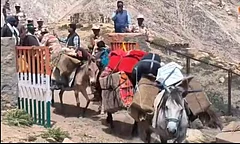
In the first batch, 16 traders from local villages, mainly Namgia, Chuppan, Nako, and Chango, remote highland settlements, set off for a trade expedition carrying goods on 14 mules.
The traders said that they sold everything they had taken and brought several items in exchange, but their stay was permitted only for 72 hours; they could not spend much time in the Tibet Autonomous Region (TAR). There was quite an excitement among the people who came to buy, besides traders.
“There is a strong cultural affinity among traders on both sides of the border. Many belong to second- and third-generation trading families who have known each other for decades,” said Cheering Pasang from village Dubling.
One of the popular items, which they could not bring back earlier, was high-value raw pashm, a fine fibre from the Changthangi goat, a native of the high plateaus of Tibet, said traders. The fibre for decades, has been a most sought-after product and part of the ancient trans-Himalayan trade.