






Both non-BJP-ruled states have notified the Centre's new rural employment scheme ahead of the July 1 deadline, reversing their earlier criticism after warning that staying out would jeopardise central funding.
Mounting debt, dependence on central assistance, and the political cost of disrupting rural employment benefits ahead of elections outweighed ideological objections to replacing MGNREGA.
While accepting VB-G RAM G, Himachal Pradesh has demanded higher wages and greater flexibility to address its unique hill geography and disaster-related needs, reflecting continued concerns over the scheme's implementation.
In December last year, the Aam Aadmi Party government (AAP) in Punjab convened a special one-day session of the state assembly to unanimously pass a resolution rejecting the Centre's flagship Viksit Bharat–Guarantee for Rozgar and Ajeevika Mission (Gramin) (VB-G RAM G).
The Congress promptly supported the resolution, alleging that the new framework would harm the interests of rural labourers, especially Dalits, OBCs, tribals, and women, all major beneficiaries of MGNREGA.
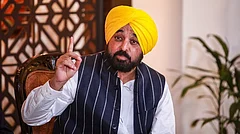
But now as the deadline for the union government’s new rural employment framework, replacing the old MGNREGA scheme, drew closer, the Bhagwant Singh Mann government took a U-turn and notified the VB-G RAM G scheme, sending surprises to the state’s opposition Congress and other stakeholders.
According to a gazette notification issued on June 26 by the Department of Rural Development and Panchayats, the scheme has been notified under the provisions of the Viksit Bharat Guarantee for Rozgar and Ajeevika Mission (Gramin) Act, 2025.


As per the gazette notification, the VB-G RAM G Scheme, Punjab, will come into effect from July 1 and will apply to all notified rural areas across the state.
The notification reads, “To align the rural development framework with the national vision of Viksit Bharat 2047 by providing an enhanced statutory wage employment guarantee of 125 days in each financial year to such rural households whose adult members volunteer to undertake unskilled manual work; And to focus on employment, growth, convergence and saturation, the government of Punjab is pleased to notify the Viksit Bharat-Guarantee for Rozgar and Ajeevika Mission (Gramin) [VB-G RAM G] Scheme, Punjab 2026, under the provisions of the Viksit Bharat-Guarantee for Rozgar and Ajeevika Mission (Gramin) Act, 2025,”
And it's not just Punjab; the Congress-ruled hill state of Himachal Pradesh has also decided to fall in line and notify the scheme ahead of the July 1 timeline set out by the central government.
Confirmed minister for rural development and Panchayati Raj, Anirudh Singh, who headed a committee to undertake a detailed study of all aspects of the scheme, said, “We are adopting the scheme. There is no other alternative for the state because of the timeline set out by the centre to notify the scheme. If we don’t do this, the state will be completely left to suffer."
Yet, he admits that under the proposed provisions, the wage rate currently fixed at Rs. 247 per day in non-tribal areas and Rs. 309 per day in tribal areas of Himachal Pradesh is highly inadequate considering the state's geographical conditions, inflation, and cost of living.
Only last week, Chief Minister Sukhwinder Singh Sukhu had reviewed the scheme and claimed that the new framework was in the interest of the state as it would deprive nearly 12 lakh workers in Himachal Pradesh. The state government is in favour of a reasonable increase in wages from the Centre.
He also suggested that the employment guarantee scheme should be demand-driven, as it was under MGNREGA. The provision of employment in rural areas should not be restricted by predetermined limits, and work should be provided according to need.
Moreover, the state is facing frequent monsoon disasters, and the conditions imposed on the non-hill states can’t be applied in Himachal Pradesh, he says.
The Rural Development Minister Anirudh Singh explains the changed stance to political pragmatism, reminding that the Centre has made it clear that only those states that notify the new scheme will receive budget allocations.
Why Punjab's U-Turn
Although a sudden reversal of the stand on the new scheme has drawn sharp reactions from the Congress and the Shiromani Akali Dal (SAD), the move is not only an ideological shift for the AAP but is also driven by pragmatism, both political and fiscal.
The analysts in Punjab say the decision is driven by three primary factors, of which the upcoming state assembly elections are certainly a dominant one. As the state is reeling under a high debt burden of Rs 4.47 lakh crore, any disruption of the funds from the centre could upset rural voters, who form a decisive chunk of the state’s overall vote bank.
Blocking funds for rural employment schemes could have given the BJP political ammunition to portray the AAP government as denying rural households their rightful employment benefits, much like the narrative witnessed in West Bengal. This was a politically costly proposition.
Punjab is already facing financial stress and challenges to meet monthly expenditures on salaries, pensions, power subsidies, and welfare measures for elderly citizens and widows. It was seen as impossible to adopt any substitute alternative to the centre’s scheme.
As the VB-G RAM G comes with substantial central funding, with the union government allocating nearly Rs 96,000 crore nationally. Remaining outside the scheme would have meant foregoing significant central support for rural employment and development works.
“Protecting the rural electorate’s interests and ensuring the inflow of central funding and avoiding confrontation with the centre, weighed heavily on the chief minister's mind," a senior bureaucrat said on the promise of anonymity.
Himachal Pradesh’s Congress government also could not afford to ignore the risk of losing central assistance at a time when its finances remain strained due to the scrapping of the Revenue Deficit Grant (RDG)—a loss of Rs 8,000 per annum and the end of GST compensations. The state remains dependent on the central funding and externally aided projects for development, welfare, and infrastructure projects.
Former Chief Minister Jairam Thakur, who is also the leader of the opposition, commenting on development, said, "The VB-G RAM G is not merely a renaming exercise but a substantive reform aimed at making rural employment more productive, transparent, and development-oriented."
The scheme, rather, increases the statutory guarantee from 100 days to 125 days, thereby providing greater livelihood security to rural households. The use of geo-tagging, digital monitoring, and technology-based implementation will help to ensure proper asset creation and curb leakages and corruption.
To focus on employment, growth, convergence, and saturation, the government of Punjab is pleased to notify the Viksit Bharat-Guarantee for Rozgar and Ajeevika Mission (Gramin) [VB-G RAM G] Scheme, Punjab 2026, under the provisions of the Viksit Bharat-Guarantee for Rozgar and Ajeevika Mission (Gramin) Act, 2025."
Punjab Congress chief Amrinder Singh Raja Warring criticised the AAP government, saying the timing of the scheme's implementation was "as important as it is surprising."
"Whether the sudden implementation of the scheme had something to do with the ongoing controversy related to the chief minister, Bhagwant Singh Mann," he asked, referring to the video row.
The Centre had rolled out VB-G RAM G as an alternative to MGNREGA, with its nationwide launch scheduled for July 1. Punjab and Himachal Pradesh, both non-BJP-ruled states in the north, faced practical and financial pressures in staying out of the new framework and eventually decided to join the national rollout.
















