Glacier retreat and erratic snowfall are disrupting farming and water cycles, pushing residents to leave hill villages.
Outmigration from Uttarakhand’s hilly districts has reduced some villages to single-digit populations.
Experts say infrastructure-led development overlooks climate adaptation and livelihood support needed to prevent further depopulation.
High in the Dhauli Ganga valley in Chamoli district, Lata village sits against a backdrop of receding snowlines and thinning glaciers. The silence there is not just seasonal. It is demographic. Once sustained by predictable winters, forest-linked livelihoods, and small-scale farming, villages like Lata are now witnessing steady outmigration. In some hamlets across Uttarakhand’s hill districts, populations have fallen into single digits. What were once vibrant mountain communities are increasingly described as “ghost villages.”
The story of migration from Uttarakhand’s hills is often framed around jobs and education. But local observers argue that climate change, particularly glacier retreat and altered snowfall patterns, is quietly reshaping the social geography of the region. “We only talk about glaciers when there is a disaster,” says Varsha Singh, an independent journalist who reports from Uttarakhand in a webinar organised by The Voice Of Glaciers Foundation. “We don’t talk about how the slow changes are affecting the daily lives of people who live near them.”
Snowfall patterns have shifted noticeably. Traditional winter snow, which once blanketed higher-altitude villages and replenished water sources gradually, has become erratic. Instead, snowfall is increasingly occurring later, in January and February, and is denser and more water-laden. Locally referred to as “summer snowfall,” it melts faster, disrupting the slow-release water cycle that agriculture depends on. For subsistence farmers, this change is not abstract. It affects soil moisture, crop timing, and yields.

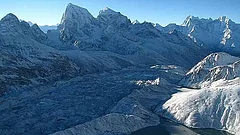
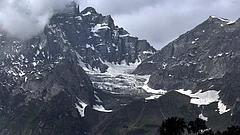

Scientific observations support these lived experiences. Research from the Wadia Institute of Himalayan Geology indicates that several smaller glacial lakes near Vasudhara Tal have been merging into a larger body of water. Satellite imagery from 2001 to 2020 shows a steady transformation in the glacial landscape. Such changes increase the risk of glacial lake outburst floods, while also signaling long-term shifts in water availability.
The economic consequences are layered. Reduced snowfall affects farming cycles and pasture conditions, impacting both crop production and livestock. With limited local employment options, younger residents are migrating to the plains in search of stable income. According to Anoop Nautiyal, founder of the SDC Foundation, most migration originates from Uttarakhand’s nine hilly districts, not its plains. “Climate is often treated as an excuse at the governance level,” he says. “But it has not been addressed systematically. Villages are emptying out.”
At the same time, state development priorities remain heavily infrastructure-focused. Road expansions, tunnels, and railway projects are seen as engines of economic growth and connectivity. While these projects may improve access, experts argue they do not directly address the environmental stress and livelihood fragility driving migration. The governance gap lies in connecting climate adaptation with rural economic planning.
Livelihoods in Uttarakhand’s hill villages are closely tied to forests, minor forest produce, livestock, and small-scale tourism. Yet community-led economic models remain underdeveloped. Forest rights frameworks exist, and Uttarakhand has a long-standing system of van panchayats, community-managed forest councils. However, experts suggest that these institutions are under-optimized.
“The policies are there. In fact, there may be too many,” Nautiyal notes. “The problem is simplification, access, and implementation. Are people actually able to benefit from these schemes?” He argues that better convergence of forest-based livelihoods, local governance bodies, and climate-linked financing, such as carbon credits, could create alternative income streams. If villages were able to monetize ecosystem services through carbon markets or sustainable forestry, migration pressures could ease.
There is also a case for stronger inter-state coordination. Himalayan states such as Uttarakhand and Himachal Pradesh face similar glacier-linked risks and demographic shifts, yet rarely present a united policy front to the central government. Given their fiscal dependence on federal transfers, collaborative advocacy for climate adaptation funding could be critical.
The transformation underway in the Himalayas is gradual but consequential. Migration is no longer driven solely by aspiration; in many cases, it is driven by ecological uncertainty. As glaciers retreat and snowfall patterns shift, the challenge for policymakers is to move beyond disaster response and address the structural links between climate, livelihoods, and governance. Without that shift, more villages may slip quietly into silence, their remaining residents counting in single digits against an expanding glacial lake.