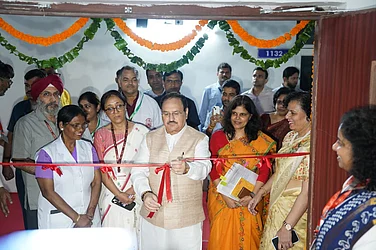
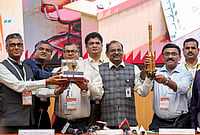
With tribal healers remaining the first—and often the only—point of care for millions living in India’s remote forested and hilly regions, where healthcare access is minimal or poor, the government has decided to join hands with them as health partners. As part of this effort, it has taken a step to set up a first-of-its-kind National Tribal Health Observatory—the Bharat Tribal Health Observatory (B-THO)—in Bhubaneswar, Odisha.
The aim is to formally integrate this trust-based system into the national public health framework to address persistent and emerging health challenges in tribal communities, said Tribal Affairs Minister Jual Oram at a recent event held in Hyderabad.
He noted that indigenous medicinal traditions have survived for centuries and must now be protected and strengthened. “We are not trying to modernise tribal healers,” he said. “We are recognising their wisdom, integrating it with science, and ensuring that it benefits future generations.”
With the launch of the National Tribal Health Observatory in Bhubaneswar and the formal inclusion of tribal healers as health partners, experts said India is signalling a shift towards evidence-based, culturally rooted solutions—an approach essential to eliminating diseases that continue to afflict the country’s most marginalised communities.
India is home to approximately 104.3 million tribal people, representing 705 distinct ethnic groups, with nearly 90 per cent residing in rural areas where access to public healthcare services remains limited. This disparity contributes to poor health outcomes, high mortality rates, and increased morbidity, making tribal communities more vulnerable to disease.



Addressing the gathering—which included nearly 400 tribal healers from across the country—senior officials stressed that despite decades of health interventions, tribal communities continue to shoulder a disproportionate burden of disease. Communicable illnesses such as malaria, tuberculosis and leprosy remain endemic in several tribal districts, while non-communicable diseases such as hypertension, diabetes and cancer are rising steadily due to changing lifestyles and environmental exposures.
Ranjana Chopra, Secretary, Ministry of Tribal Affairs, emphasised that community-led health solutions are not only culturally appropriate but also cost-effective and sustainable. “If India is to eliminate communicable diseases from tribal geographies, we need a final, focused push rooted in local realities. Tribal healers are indispensable to this effort,” she said.
During interactions with healers from Odisha, Maharashtra and Rajasthan, the Secretary noted repeated calls for formal recognition, dignity, and systems to ensure the intergenerational transmission of traditional medical knowledge. She said the Ministry has set an ambitious target to recognise and enable one lakh tribal healers as health partners across the country.
Echoing similar views, Manish Thakur, Additional Secretary, Ministry of Tribal Affairs, said, “Tribal healers command generations of trust and social legitimacy within their communities.”
“In regions where geographical remoteness, cultural barriers and workforce shortages limit access to formal healthcare, healers can play a crucial role in preventive care, early identification of illness, and timely referral.”
Health experts say this role is particularly vital in controlling diseases that require sustained community engagement. Delayed diagnosis and poor treatment adherence have long undermined efforts to eliminate tuberculosis and malaria in tribal belts. By involving healers—often the first to notice illness patterns—health authorities hope to bridge this gap.
The importance of the initiative is underscored by the continued vulnerability of tribal populations to lifestyle-linked illnesses. Balram Naik, Member of Parliament from Mahabubabad, Telangana, pointed out that tuberculosis remains prevalent in tribal areas partly due to tobacco consumption and poverty. While investments in schools, hospitals and hostels have improved awareness, he said sustained investment in healthcare infrastructure and roads is essential for long-term disease reduction.
The observatory, to be set up under Project DRISTI, will fill a long-standing gap in tribe-disaggregated health data. It will focus on systematic surveillance, implementation research and evidence-driven disease elimination strategies in tribal districts, with an initial focus on malaria, tuberculosis and leprosy.
Public health experts have long argued that the absence of granular, tribal-specific data has weakened planning and resource allocation. “Without reliable evidence, tribal health policies remain reactive,” said Dr. Jaya Singh Kshatri, Scientist-D, ICMR, who presented data from Odisha’s Tribal Health Observatory and the Tribal Family Health Survey. Findings from these initiatives revealed high levels of anaemia, undernutrition, poor maternal and child health indicators, and low awareness of chronic diseases—especially among women.
The Bhubaneswar-based observatory is expected to guide national- and state-level interventions by generating real-time, tribe-specific insights into disease trends, healthcare access and outcomes.
Experts also stressed that integrating tribal healers does not mean replacing modern medicine. Instead, it involves building respectful referral pathways. Kannan P., Consultant with the National Health Systems Resource Centre, outlined how healers can act as connectors—guiding patients from villages to sub-centres, community health centres and district hospitals, while reinforcing treatment adherence.
Global experience supports this approach. Dr. Dilip Singh Mairembam, National Professional Officer, WHO, cited international examples where indigenous healers improved disease outcomes by serving as community mobilisers and referral agents, provided their roles were clearly defined and supported.
The relevance of tribal healers is particularly evident in genetic and chronic conditions such as sickle cell disease, which disproportionately affects tribal populations. Dr. Sumit Malhotra, Professor at AIIMS Delhi, highlighted how healers can aid early screening, dispel myths and encourage timely care—critical to India’s goal of eliminating sickle cell disease by 2047.