This book reminds us that even the most rigid structures are held together by beliefs that can, at any moment, crack and fall apart.
The humour here feels both liberating and slightly dangerous.
Popular humour has historically functioned as a space of redirected rebellion.
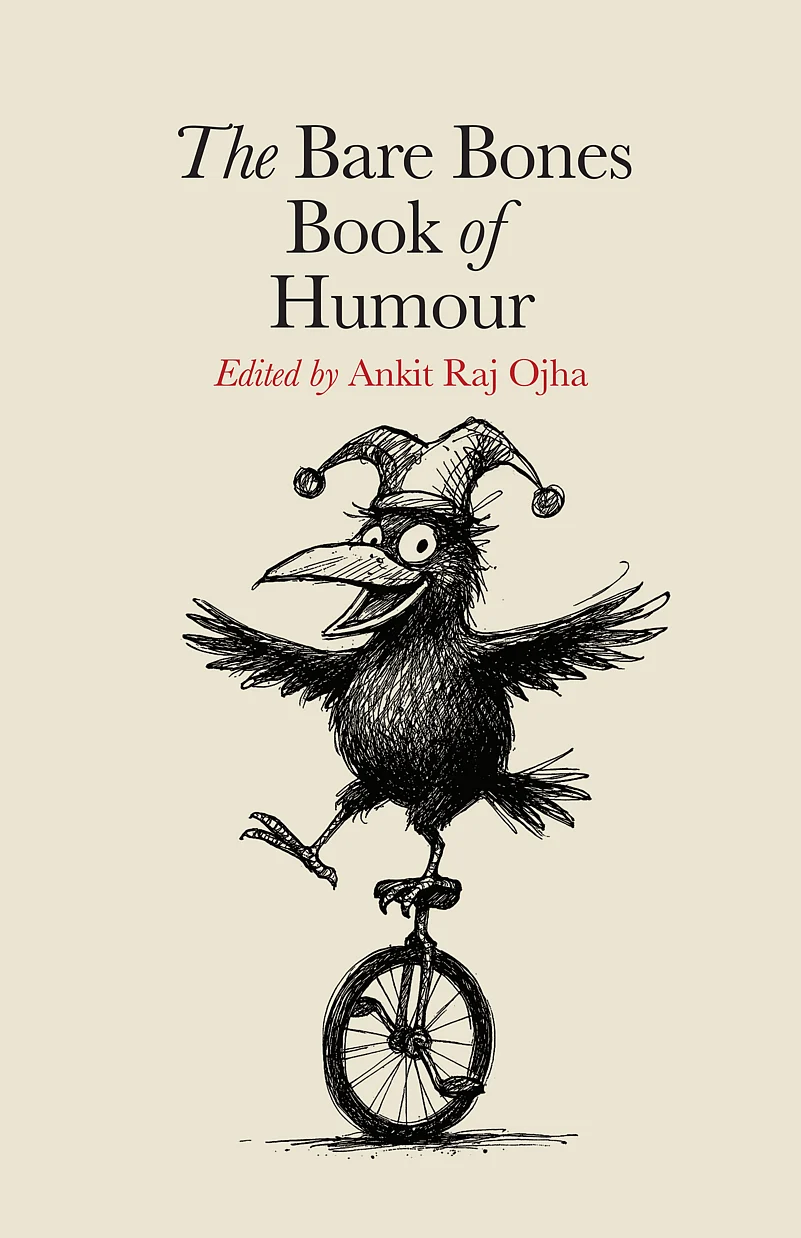
The Bare Bones Book of Humour (Bare Bones Publishing), edited by Ankit Raj Ojha, is a brand-new manifesto of the “un-serious” in literary culture, studded with 24 gems from eight countries. The book blips you into an existence where worlds collide and short-circuit—what appears stable is caught in an absurd moment of rupture, only to collapse and shatter.
This book treats laughter as lightness, a harmless excess of joy or amusement, but it also symbolises the splintering of a rigid social sham. For instance, in Merlin Flower’s ‘Robes and Roles’, which portrays a fantastical situation of a menstruating God, the story explores how power is performed rather than possessed: ‘Of course he was God. God Almighty, at that. He wished it away. It wouldn’t go.’ The humour lies in how easily gender roles and religious authority crumble once the biological rituals are inverted and the ‘robes’ of power are stripped away. François Bereaud’s ‘Funeral Hopping’ playfully violates norms of grief and decorum, exposing the performative aspects of mourning. Through characters and situations that make a ‘Renaissance Faire’ out of funerals, the tale discomfits us enough to question sincerity and ritualised emotion.



Doug Jacquier’s ‘A Tail of Co-dependence’ humorously explores the uneasy comfort of mutual reliance and blurring of boundaries between crime and law enforcement, while Grace Q. Hu’s ‘Two Good People’ is a deceptively simple story about the hypocrisy of morality and kindness in an immoral and unkind world. With a controlled irreverence, these stories suspend the smooth surface of convention and expose the fragility beneath it. Such humour feels both liberating and slightly dangerous: it announces that the apparent stability of authority, seriousness and decorum can suddenly give way under the weight of the absurd.
Psychologically, humour is the space for an internal conflict between two impulses, ideas or meanings without causing injury. In this sense, these stories both overload and bypass logic by fusing incompatible meanings, disrupting linear thought and forcing cognition to break down, where the impossibility of coherence finally releases itself as laughter at the limit of thought. For example, Abhilipsa Sahoo’s ‘The Haunting of Chill House’ makes a ‘haunted’ fridge the setting for a series of inconveniences rather than terrors. Amit Majmudar’s ‘Regeneration’ follows a middle-aged man anxious about erectile dysfunction, who learns a thing or two about the potency of belief and imagination over the science of physicality in nurturing desire.
However, humour often provokes the line of thought to linger despite the release through laughter, perhaps because of circumstantial solemnity and potential consequence. Nneoma F. Kenure’s ‘There’s a Man in My Bathroom’ focuses on a woman alone in her apartment while a plumber works in her bathroom, prompting exaggerated caution and comic paranoia via the symbolic security system of a kitchen knife and a phone call to a friend. In Allan Miller’s ‘The Developments’, the narrator’s attempts to halt the construction of a luxury housing estate opposite his home via increasingly dramatic obstacles fail, not because of supernatural curses or shadowy conspiracies, but a generational legacy of deception and moral compromise. In Ojha’s own ‘A Man of Culture’, the humour arrives via the collapse of pretense in a protagonist determined to appear sophisticated, revealing how ‘culture’ becomes a tool of status rather than appreciation.
Socially, humour occupies a paradoxical position. It is both the unseen casualty of a system governed by decorum and also a conspicuous tool used to challenge and unsettle that system’s rigid order. Popular humour has historically functioned as a space of redirected rebellion: far from being purified, these transgressions were reshaped and included in the art of conversation cherished by the upper classes, even as their disruptive origins were carefully managed. The Bare Bones Book of Humour contains many examples of this indirect defiance. Shih-Li Kow’s ‘A Job to Love’ satirises modern work culture and the demand for passion as productivity through exaggerated corporate language. Steve Akinkuolie’s ‘Because of Ram and Rice’ uses food and religious symbolism to explore everyday negotiations of belief, survival and compromise via human inconsistency. Swapnit Pradhan’s ‘Enlightenment Begins at Home’ mocks spiritual clichés by grounding them in an almost slapstick domestic routine of bowel movements.
This collection of quirky narratives directly opposes society’s obsession with decorum by showering it with subversive laughter and ridiculing the powerful by turning hierarchies upside down. The authors featured in the collection are what Jan Bremmer and Herman Roodenburg call, in A Cultural History of Humour, the ‘lords of misrule’: carnival figures who temporarily mocked authority and exposed its arbitrariness. Such hilarity does not aim to destroy the social order outright. Instead, it reveals that order to be contingent, theatrical and vulnerable. In doing so, The Bare Bones Book of Humour reminds us that seriousness is never absolute. Even the most rigid structures are held together by beliefs that can, at any moment, crack and fall apart.
(Pritikana Karmakar is Assistant Professor of English at GITAM [Deemed to be University], Hyderabad, as well as a poet and translator)