Those in power have always instinctively understood the potential of cinema, using it for propaganda, and on the other hand, censoring dissident voices.
However, films like Dhadak 2, Jolly LLB 3 and Homebound have brought back a critical edge to mainstream Hindi cinema that directly responds to the politics of the day.
Each of the films adopts a different route, but they share striking similarities in how they take advantage of the modes of popular.
Whispers are polyvocal acts. Their primary identity is aural—a sound that escapes one’s mouth but mostly as breath, as a result of a terse alignment of the vocal cords to prevent vibration. But the potential of what they can signify is immense. Whispering is something that comes naturally to human beings fairly early, as children, within friend groups and classroom settings. As we grow older, whispering becomes less socially acceptable, so the act is usually hidden. It occurs behind closed doors, in darker areas, which brings it closer to the realm of cliques or conspiracies. But whispering, especially when it occurs within institutions, can also be a response to the excesses of power, where a direct vocal challenge is admonished. All rebellions, therefore, begin with whispers. As secrets emerging from a shared experience of injustice or pain, whispers form the ground on which new political coalitions are formed. In 2025, while social media does act as a platform for building coalitions, it also leads to hardened echo chambers. Films that release in theatres, and make use of popular, accessible forms of storytelling, can often bring the urgency of a simmering political moment to its boiling point. The form here acts as both attraction and smokescreen, within which its content is whispered. This article discusses a few films released recently to varying levels of success and acclaim, to illustrate this point.

In a world where algorithms are rapidly being mobilised towards consolidating power, the act of paying for an admission ticket preserves an older relation of spectatorship, despite its various mutations over the past century. Theatrically exhibited cinema remains a medium where the presence of the spectator’s body is needed and felt. Those in power have always instinctively understood the potential of cinema as a mobilizer of crowds, using it for propaganda, and on the other hand, censoring dissident voices. Different regimes have deployed and destroyed films, and this is most evident, perhaps, in India with the sweeping powers the Central Board of Film Certification (CBFC) has enjoyed in recent times. A steady stream of films, many of them often carrying outright hate speech, but aligned with the politics of the current government, are released without much resistance. More importantly, this hate speech is usually coded in obtuse versions of actual events and narratives, where the cinematic address will often mimic the aesthetics of a political thriller, using archival footage and news media reports in the process. On the contrary, there are filmmakers, especially those working in Hindi cinema, who have witnessed extreme levels of censorship by the CBFC, creating a chilling effect for other filmmakers. Since COVID, digital media campaigns aligned with ideological projects aid in this process, amplifying the reach of state-aligned films while promoting boycotts of films that don’t fit their narratives.



Within this environment, there have been major pop culture moments led by films like Pathaan (2023) and Jawan (2023) that have defied these currents, positioning themselves as counter-narratives. But these counter-narratives are also woven within the language of Shahrukh Khan’s stardom first and foremost, carrying a messianic energy with him. In the past few months, however, we have seen a slight shift of the needle. Dhadak 2, Jolly LLB 3 and Homebound have brought back a critical edge to mainstream Hindi cinema that directly responds to the politics of the day. Each of the films adopts a different route, but they share striking similarities in how they take advantage of popular modes.

Shazia Iqbal’s Dhadak 2 is an official remake of the highly acclaimed Tamil film Pariyeram Perumal B.A. B.L. (2018). The central story, which deals with a Dalit student’s struggles with discrimination at law school after he falls in love with a Savarna woman, follows the same broader beats as the Tamil original. But Dhadak 2 adds its own unique layers in two specific ways. Popular Hindi cinema is often criticised for not presenting a clear cultural milieu of its spaces and settings, especially when it does remakes of acclaimed films from other film industries in India. Dhadak 2’s protracted censorship battle might give us hints about why this happens, especially in the current climate. However, despite possibly being stripped of its geographical markers and the blunted edge of its politics, the film registers itself as a significant document of the times. Departing from the largely male-centric story of the Tamil original, it invokes the grand legacy of epic romances in Hindi cinema, many of which have foregrounded class or regional differences instead of caste. In this way, and in giving a full arc to its female lead, it simultaneously tips its hat to genre classics like Qayamat se Qayamat Tak (1988) and Veer Zaara (2004) and updates the terms of reference for future love stories in Hindi cinema. Secondly, Iqbal channelises the anti-establishment energies of seminal “college-campus films” in Hindi cinema such as Rang De Basanti (2006) and 3 Idiots (2009) to address a large and under-served Hindi speaking audience.
Her most audacious choice in this process is the insertion of a fourth wall breaking student activist modelled on Hyderabad Central University student Rohit Vemula. This character, who was not in the Tamil original, fills a gaping void in the world of college campus-set Hindi films, injecting a much-needed dose of idealism in student politics, while specifically addressing caste. The use of the popular form, where certain moments are geared towards collective ways of expression in the film theatre, acts like a counter-punch within the political landscape. And the theatre, thereby, becomes not just another space in which the film is screened, but an enabling environment for the preservation and nurturing of certain modes of (political) filmmaking.

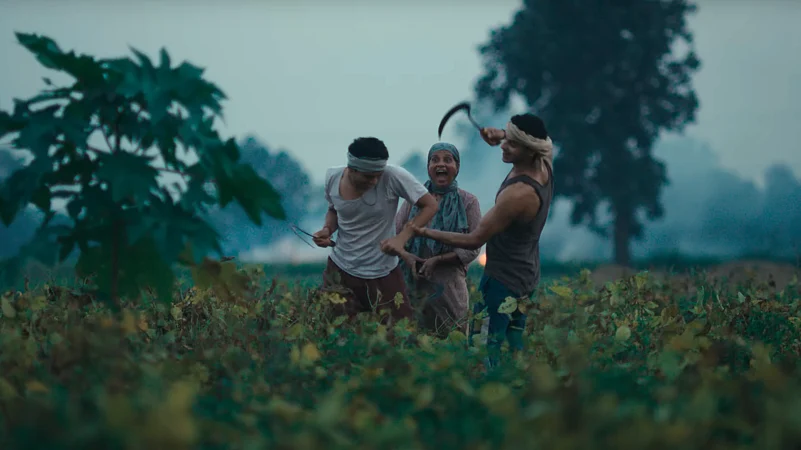
Subhash Kapoor’s Jolly LLB 3, unlike Dhadak 2, is a straightforward sequel that follows its characters from the previous two instalments. Its central hook, however, is that the film pits the two Jollys (Arshad Warsi and Akshay Kumar) against each other. Jolly LLB, starring Arshad Warsi, released in 2013, in the wake of allegations of corruption against the ruling elite. It captured the optimism surrounding the Indian judiciary then, with its triumphant use of the Public Interest Litigation as a plot device. Jolly LLB 2, with Akshay Kumar in the lead this time, released in 2017. In this second instalment, the focus was on encounter killings, terrorism and police corruption. The third instalment, released in September this year, is based on the 2011 farmers’ agitation against land acquisition in two villages in the state of Rajasthan called Bhatta and Parsaul. While the previous two instalments also carried progressive messaging, the third one carries extra weight. Its villain, the industrialist Haribhai Khaitan (Gajaraj Rao), speaks of his project ‘Bikaner to Boston’, where his strategy for acquiring land is defrauding debt-ridden farmers, one of whom dies by suicide. The farmer’s wife, played by Seema Biswas, barely speaks but displays a steely resolve, and urges the two Jollys to work together. While the three films share a common template—lawyers finding success by engaging in corruption and then trying to reform—Jolly LLB 3 firmly positions itself as a protest film.
This is evident in how Jolly LLB 3 invokes images of state violence as well as social movements in protest of such violence. Most prominent among these is the one major sequence where the entire state machinery descends upon the village to forcibly take the land from the villagers. This sequence also marks the entry of the bulldozer in popular film as an omnipresent object of suppression, destruction and displacement, cheered on by a pliant media, which brings to mind the reporting on the Jahangirpuri demolitions carried out in 2022 in Delhi. The film’s heroes, in response, urge the villagers to use their phone cameras as weapons to record everything that the state is doing. This harks back to the social media-driven farmers’ movement of 2021, which forced the Indian state to retract controversial farm laws that had threatened the farmers’ sovereignty over their own lands. The film, like the previous two instalments, ends with clear rhetoric from both sides, where lawyers speak directly to the off-screen audience, arguing as much for policy as for the specifics of the case. The final speech delivered by Jolly (Arshad Warsi) however, turns the gaze of the camera towards houses owned by the rich and the upwardly mobile, probing the viewers to check their privilege.

Therefore, unlike the previous films, this one ends on a somewhat sombre note, despite a sequence where a tractor appears on screen as a triumphant vehicle of grassroots resistance, bringing down a billboard that advertised the ‘Bikaner to Boston’ scheme. A space with a rich history of progressive messaging in Hindi cinema, the cinematic courtroom in Jolly LLB 3 is, thus, both an ode to classics like Raj Kapoor’s Awara (1951) and a necessary reality check on the current state of the Indian higher judiciary, criticised for bending to power in recent years.
Neeraj Ghaywan’s Homebound, in some ways, initially feels like a caress—a quiet, but firm hand on the shoulder—in contrast to the more verbose articulation of Dhadak 2 and Jolly LLB 3. The film, first and foremost, is a story of the characters Chandan (Vishal Jethwa) and Shoiab (Ishaan Khatter), a Dalit and a Muslim in today’s India, as they navigate structural challenges to merely study, work or love. To me, the film exists as one of the spiritual successors of the 1953 Bimal Roy classic Do Bigha Zamin, not just because of its exploration of rural struggle, but also because it draws inspiration from sources where the filmmakers had more room to express themselves (Do Bigha Zamin was adapted from Rabindranath Tagore’s poem “Dui Bigha Jomi” and Salil Chowdhury’s short story Rickshawala and Homebound from an editorial in The New York Times titled Taking Amrit Home by journalist Basharat Peer). Like Do Bigha Zamin, Homebound is an exploration of the deep spiral of agrarian crises and the resultant migration to cities. But unlike the former, Homebound is more about the unending tease of aspiration and social mobility that envelops the rural poor today. While poverty is the overwhelming social condition, it is anchored in hardened identities of caste and religion that constantly weigh down the promise of better days. And all of this is before the real tragedy strikes in the form of the COVID pandemic, snuffing out even that tiny spark of aspiration and foregrounding the scale at which apathy exists for the marginalised.
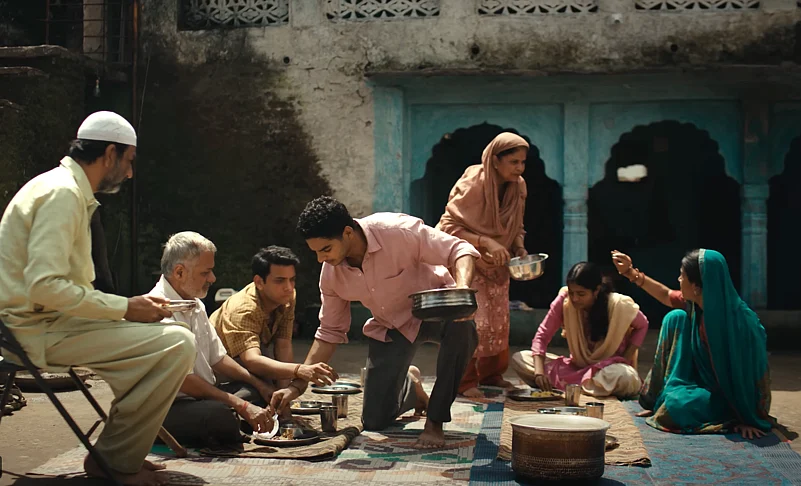
The film does not have the explosion of anger in Dhadak 2, or even an old school frontal address to the audiences like in Jolly LLB 3. In borrowing from neorealist tradition, Homebound instead chooses to piece together sequences that pierce through our bones, where the cinematography, performances and the score combine forces to create spectacles of emotion. For example, consider this sequence where Shoiab and Chandan, on their way back to their village on foot, stop in a village to ask for water. The villagers, in fear that they are bringing the disease to them, start to throw stones. As they are retreating, an old woman comes out with a jug of water in her hand, offering them a much needed sip. As she goes back, a close up of the old woman’s feet reveal to us that this lady has the same cracks as those of Chandan’s mother. For Chandan, this woman appears as his mother’s spirit, and for the audience, a representative of women’s labour in the fields—unspoken and unaccounted. It is moments like these that make you glance at the people sitting next to you in the theatre, as you follow sounds of a little gasp here and a quiet sob there. Homebound is peppered with such moments. By the end, the audience is unwittingly part of a social contract, the object of which is quiet reflection and its language—silence.
As the world goes through a surge in authoritarianism, new battle lines are being drawn with what is permissible to be expressed. Cinema’s role in this scenario is still in the process of being figured out. It is in this context that we need to think about the space of the film theatre as a site of resistance. Despite attempts at censorship as well as vicious social media campaigns against progressive politics in popular films, some filmmakers are holding fort, even if their protests, right now, might register as quiet whispers. The films discussed here reach their catharsis with a visceral address—Dhadak 2 ends with frame-shattering screams by its woman protagonist, while Jolly LLB 3 and Homebound register powerful expressions of women grieving their dead family members. If we pay enough attention, we may perhaps find, in these screams and tears, the seams of whispers that portend a loud rebellion.