







Eight months after Haryana launched paperless registration across all 23 districts, we went further—closing the century-old gap between registration and mutation, processing over 4.50 lakh registrations with zero forgeries, and clearing four lakh legacy mutation cases that families had waited years to resolve. This is the story of how change was planned and given a robust shape.
I have been in the Indian Administrative Service for 35 years. In that time, I have sat across the table from farmers who lost land they legitimately owned because a revenue record was never updated. I have watched widows struggle to navigate a labyrinth of offices to establish inheritance rights. I have seen disputes that began with a simple clerical delay in mutation consume families across generations, draining their savings in litigation and breaking relationships that never recovered.
I am not describing the distant past, but rather what was happening in Haryana as recently as eighteen months ago.
The Problem Was Never the Citizen
When systems fail repeatedly and predictably, there is always a temptation to locate the failure in the people who use them. “Citizens do not understand the process. Citizens do not bring the right documents. Citizens do not follow up properly.”
In three decades of public service, I have come to a different conclusion entirely. The problem with India's land registration system was never the citizen. It was the design. Consider what we were asking a property buyer to do. Registering your deed with the sub-registrar's office, a process that, in the old system, took an average of twenty days, required multiple physical visits, often some “other demands” generated mountains of paper, and offered no digital trail. Then, separately, approach the revenue department to have your ownership reflected in the jamabandi, the official revenue record, that determines whether a bank will lend against your property, whether your inheritance can be transferred, or whether your ownership will be recognised in a dispute. These were two entirely separate journeys, on two separate timelines, with no guaranteed connection between them.

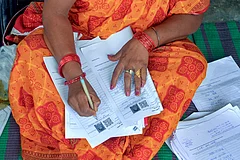
The gap between registration and mutation is that legal no-man's land where millions of Indian families have lived for months or years. It reflects a structural failure baked into the architecture of the system itself. And in that gap, an entire ecosystem had evolved to extract money from citizens who simply wanted what was already theirs. The system designed to protect that land had, for decades, become its greatest source of uncertainty.
What We Set Out to Do
When Chief Minister Sh. Nayab Singh Saini gave the mandate to transform land administration in Haryana, the brief was not to make the existing system faster but to make it citizen-friendly. We did that by rebuilding it from the citizen's experience backward, not from the department's convenience outward.
That distinction matters more than it might appear. A department-centric reform asks, 'How do we digitise what we already do?' A citizen-centric reform asks, 'What does a person actually need at the end of this process, and what is the simplest, most secure, most transparent path to getting it to them?'
The answer, when you ask that second question seriously, is both obvious and radical: a citizen who registers a property should walk away or log off with complete, legally recognised, fraud-proof ownership. Not a deed that will be followed, eventually, by a mutation. Complete ownership. In one transaction. On the same day.
Haryana launched Paperless Registration 1.0 simultaneously across all 23 districts in November 2025. We launched everywhere, at once, because the system had been tested rigorously before launch and because a piecemeal implementation creates its own category of inequity, where citizens in covered districts receive a service that citizens elsewhere do not.
What changed that day: processing time fell from twenty days to 48 hours, a 90 percent reduction. Physical paper was eliminated from the registration chain. Blockchain technology secured every record, making every deed immutable and permanently timestamped. Citizens received their certificates digitally, verified by QR code and delivered to their inbox. When a physical copy was needed, security-embedded paper holograms, microprinting, UV-reactive inks, and security threads ensured that the printed deed was as tamper-proof as the digital one. Every revenue record in Haryana now exists in digital form, integrated with the Haryana Unified Land Records System, ensuring seamless consistency across departments. Real-time notifications keep buyers, sellers, and banks informed at every stage of the process.
In the eight months since that launch, over 4.50 lakh families have registered property through the e-Registry portal on revenueharyana.gov.in. In all of those registrations, we have recorded zero instances of document forgery. Zero. I want you to sit with that number for a moment, because it represents something the old system could never have claimed. Districts with the highest registration volumes, Gurugram, Faridabad, and Sonipat, became proving grounds. A system that works under that pressure and in remote rural tehsils alike has earned the right to be called mature.
Eight months of live operation gave us something more valuable than any consultant's report: real feedback, at scale, from real citizens navigating a real system. We used every nugget of feedback. And, on June 23, 2026, we launched Paperless Registration 2.0 and, simultaneously, the Automated Mutation System, the reform that addresses the structural failure I described at the beginning. Here is how it works: the moment a property is registered, mutation is triggered automatically. The mutation number is generated at the point of registration itself. Cases not involving partition of joint ownership are approved within 24 hours. Cases involving partition, inheritance, family settlement, or court decree are resolved within ten days. Citizens can track their mutation status in real time and download their mutation copy from home without applying through any other application or route. It will now be a completely automatic update process after land registration, with no further hassle. No application is to be made to the patwari. No follow-up at the tehsil. No uncertainty. The gap that defined India’s land problem for generations has been closed.
We added one further protection that I consider among the most important elements of the entire system: a sale deed cannot be registered unless the seller's name already appears in the existing revenue record. A property transaction moves through three essential steps. Registration records the deed establishing the transfer of ownership and triggering the first revision of the land record. This initiates mutation, the updation of the jamabandi to reflect the new owner's name. Mutation, once sanctioned, culminates in the final revision of the Record of Rights (ROR), the authoritative document that establishes legal ownership in the eyes of the state. With all three stages now seamlessly linked in a single digital chain, the possibility of duplication, double sales, or fraudulent re-registration is eliminated at the root. Prime land and non-prime land khasra numbers have been implemented in the paperless registration system for the registration of immovable property. At the time of document registration, stamp duty and registration fee are calculated automatically by the new system. As a result, these measures have helped increase state revenue.
Before statewide rollout, the Automated Mutation System was piloted for one month, during which approximately 50,000 mutations were processed automatically – a dataset of real-world performance that informed every refinement. Pilot rigorously, learn honestly, and then scale. That sequencing is the correct approach to systemic reform, and it shows.
Paperless Registration 2.0 incorporates eighteen substantive improvements over the original platform, every one of them drawn from citizen feedback gathered during eight months of live operation. The entire platform was built in-house by our Revenue Department's IT Cell, without any additional government expenditure. I mention this not merely as a point of pride, though it is, but because technology reform in India has too often been synonymous with large and opaque procurement exercises.
Aadhaar-based e-KYC is now mandatory for both parties, ensuring identity is verified at the transaction's foundation. Companies and NRIs can appoint authorised representatives removing a significant barrier to institutional and diaspora investment in Haryana property. Deeds can be filled by the citizen directly, through a deed writer, an advocate, or a helpdesk, ensuring no one is excluded by limited digital familiarity. Tatkal appointments: urgent-category slots on the model of the Passport Seva Kendras are available because a citizen's time is worth protecting. Online stay verification was also added, which automatically restricts registration of disputed properties. All departmental clearances, including DTP approvals and NOCs, are processed digitally, eliminating the queue that used to form outside offices before a registration could proceed. QR code-based verification is embedded in every document. The Registration Clerk-1 and Registration Clerk-2 workflows, previously handled at separate levels with unnecessary friction, have been unified. Every party to a registration is identified through an individual photograph, establishing a clear and permanent record. The philosophy behind every one of these features is identical: remove every point at which a human intermediary could insert themselves between a citizen and a service that is their right.
The Backlog We Inherited — and the Responsibility We Accepted
I also want to highlight something that receives less attention than the new system but represents, in my view, an equally important commitment.
When we began this reform, over six lakh mutations were pending in Haryana's legacy system. Each one of those cases was a family in legal limbo, people who had registered property, in some cases years earlier, and were still waiting for the state to acknowledge what they owned. We could have declared this a problem created by the old system, to be resolved by the old system's slow processes.
We did not. Through a combination of automated identification, dedicated camps, and district-level monitoring with direct accountability, approximately five lakh of these legacy cases have already been cleared. The remainder are being addressed on a time-bound basis. A government that launches a new system without accepting responsibility for the failures of the old one has not reformed; it has simply relocated the problem. We chose differently.
The Citizen Who Almost Gets Left Behind
Every digital reform carries one risk that responsible governance cannot afford to minimise: the citizen who lacks digital familiarity, who is sceptical of trusting their most valuable asset to a system they do not fully understand, and who has never filed anything online in their life.
In Haryana's case, this risk was taken seriously from the beginning. Government staff at every registry office are available at dedicated help desks to help citizens navigate the process at no additional cost.
The Haryana Bhu-Mitra WhatsApp chatbot (9593300009) is available 24 hours a day in Hindi and English to answer questions ranging from mutation status queries to jamabandi copies to land demarcation requests to complaint tracking from a basic mobile phone, without requiring any office visit. For the farmer in a village with limited internet access, this is a significant convenience. It is a fundamental shift in who the system was designed for. For citizens seeking assistance, the department has also established a dedicated helpdesk reachable at 0172-271-1693 or helpdesk-rev@hry.gov.in, operational Monday to Friday, 9:30 AM to 5:30 PM so as to ensure support is available to those navigating new systems.
Our approach is digital by default, but with human assistance always available. The principle is that the system should serve everyone, not everyone who is already comfortable with technology. Citizen satisfaction surveys report 95 percent approval. I cite it as a reminder of what becomes possible when a system is designed around the citizen's experience rather than the department's convenience.
The Economic Case Is as Strong as the Human One
Property transactions underpin economic activity at every level; they enable credit, facilitate investment, underwrite the real estate sector, and signal the business climate to domestic and international investors. Banks can now verify ownership digitally in minutes rather than weeks, accelerating mortgage approvals and reducing lending risk. Administrative cost and time savings are freed for redeployment. And perhaps most consequentially, the system has made intermediaries optional rather than essential, democratising access to a service that once required knowledge, connections, or cash to navigate.
Haryana's contribution adds meaningful innovations like Aadhaar-linked identity authentication, auto-mutation triggered at registration, blockchain-secured records, security-embedded physical documents, and a faceless processing architecture, which is validated at scale before rollout. Several state delegations have already visited Haryana to study our technical architecture and implementation strategy. Best practices do not spread through mandates. Their spread through results are borne out by direct citizen experiences that establish both ease of doing business and ease of living beyond doubt, as in the case of Haryana’s structural land management reforms.
Disclaimer: The views and opinions expressed in this article are those of the author(s) and do not necessarily reflect the official policy or position of the publisher. While every effort has been made to ensure the accuracy of the information, the publisher is not responsible for any errors or omissions, or for the results obtained from the use of this information.















