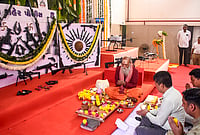
The Supreme Court declined to initiate suo motu proceedings over alleged police violence during the July 20 CJP Parliament march.
Chief Justice Surya Kant said the court was not interested in viewing videographic evidence submitted by a lawyer.
The July 20 protest witnessed clashes between demonstrators and security personnel near Parliament.
Dadar station blossomed with a creed of vegetables, passengers swirling with shoulders squirming against one another. But a few shoulders had to bear a heavier burden that day. Age did not define the authority of what they defied. They had not yet been freed from the burden of school bags, nor had they fully understood how the job market was culling, but they all joined hands in the parade that day as a homage to the July 20th protest in Delhi. It was a day where students steeled their legs to march to Sansad, demanding answers from Dharmendra Pradhan, who remained unyielding.
By 4:30 pm on Tuesday, the protest had not yet begun. The police vans, idling along the rain-slicked curbs of Shivaji Park with their diesel engines humming, were already filling up. There were no elevated stages, no loud bullhorns, no dense crowds chanting in unison. The air smelled of wet asphalt, salt breeze, and fried vada pav from the street stalls nearby. I arrived at the edge of the park on July 21 as a reporter for Outlook India to cover a student-led demonstration.
Officers positioned along the stone pathways intercepted citizens en route. They guided them toward waiting transport vehicles, the blue metal doors swinging shut with a heavy, metallic clang. Several individuals protested, pointing toward the open promenade to show they had not even reached the designated gathering site. Others asked why they were being taken or under what specific rule they were being held.

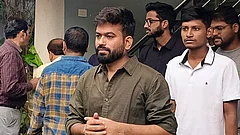


Rain gleamed on the pavement where a handful of young female protesters stood encircled, visibly shaken as police officers closed in around them. Moving toward the cordon, I called out to ask why they were being detained, identifying myself as an Outlook India reporter covering the demonstration. One of the girls was a first-year BAMMC student from St. Paul's. Being dragged away by police was hardly how she had envisioned the start of her journalism career. Another had moved to the city from Delhi just three months earlier. As I pressed the officers for answers, the chaos escalated. I was grabbed, roughed up, and thrown into the back of the detention van alongside them. Resistance and a press card are supposed to be a journalist's armor, but sitting in that van, I realized the issue wasn't simply that they were detaining protesters. It was how completely a total disregard for basic procedures consumed everyone in its path.


From Public Streets To Police Stations
The heavy machinery of state enforcement was running on full power. Fear is what you expect to find in a moment like this, yet what filled the police bus was the surprising, resolute spirit of 26 detainees.
In the front seat sat 16-year-old Rahul (name changed), his face concealed behind a mask. He wasn’t afraid of the police; he was terrified of his parents, who would lock him indoors if they spotted his face on the news. Traveling from Vasai to Shivaji Park had become a ritual for him whenever a demonstration called. Peering out from beneath a furrowed brow, he looked at the policewoman guarding the door and lied without blinking: "I’m 21." She simply stared back, under strict orders not to engage. Next to him sat Kartik (name changed), who had just flown in from Bangalore for a date, only to watch his evening turn into a nightmare as he was swept into the police fold. In the middle of the Mumbai Police detention drive, any room for dialogue or listening had utterly dissolved.
The four police buses split off, routing detainees toward separate outposts at Worli and Mahim to keep the crowds divided. Two of the buses hurtled toward Worli, though a five-kilometer stretch stretched into an agonizing hour as heavy evening traffic swallowed the road. When the vehicles finally pulled up outside the station, no one was allowed to disembark; the officers kept everyone stowed inside as a holding strategy until word came that the crowds at Shivaji Park had cleared. By 6:45 PM, the police finally began filing the students out in batches of eight.
Throughout the long wait, the atmosphere remained taut, driven by a mix of shouted slogans and underlying anxiety that no amount of chanting could quite dissolve. Shortly after, local Shiv Sena (UBT) party workers swept in with empty promises of "We’re here with you, don't worry." It was a gesture that rang hollow, coming two hours late to a release process already underway. While those brought to Worli managed to keep their mobile phones, whispers from Mahim suggested a far stricter protocol was unfolding there.
As many noted, the authorities had invoked prohibitory orders under Section 163 of the Bharatiya Nagarik Suraksha Sanhita (BNSS), which replaced the former Section 144 of the Code of Criminal Procedure (CrPC). This gave officials the legal authority to restrict public gatherings in the name of maintaining peace, though no clear official clarification was provided at the scene.

A Tale Of Two Protests
The main point of confusion, however, was how those powers were used. Article 19(1)(b) of the Indian Constitution gives every citizen the basic right to assemble peacefully without weapons, subject to reasonable safety checks under Article 19(3).
However, when people are picked up while simply walking toward a public space, before any large group, rally, or noise has even formed, the line between managing a protest and stopping it from happening at all becomes very blurred.
Notably, 48 hours earlier, I had stood on the same grounds watching a very different afternoon unfold. The protest was organised by the Uddhav Thackeray-led Shiv Sena (UBT), in solidarity with climate activist Sonam Wangchuk, who was taken to hospital by Delhi Police after his indefinite hunger strike in New Delhi, following a court order.
Wangchuk was observing a fast at Jantar Mantar in support of the protests of the Cockroach Janta Party (CJP). His deteriorating health- he had lost over 9 kg on salt and water alone- had become the emotional centre around which the gathering in Mumbai revolved.
Following restrictions that had prevented more extensive protests elsewhere in Mumbai, students, activists, political workers, and locals gathered at Shivaji Park. Rain had left parts of the ground waterlogged, pushing the crowd onto the surrounding roads.
On the ground, the protest represented broader concerns about the alleged NEET-UG paper leak, examination-related controversies, unemployment among educated youth, and the state of public education, even though many people attended in support of Wangchuk following his hospitalisation.
A middle-aged activist from the CJP network, who travelled from Delhi, said, "Sonam ji's fight is our fight. We have seen too many paper leaks, too much corruption in the NTA [National Testing Agency]. If the Education Minister won't resign, the people will make him."
The slogans oscillated with an unpredictable rhythm, laying bare the fragmented, ideologically blurred nature of modern street movements. One moment, the crowd shouted, "Sonam Wangchuk, hum tumhare saath hain," alongside demands for the resignations of Dharmendra Pradhan and Prime Minister Narendra Modi. Before the cadence could take root, a chorus of "Jai Shri Ram" cut through from one flank, quickly giving way to chants rallying around Aaditya Thackeray. Of the eight primary slogans echoing across the crowd, five belonged firmly to the Shiv Sena (UBT) playbook, ranging from "Uddhav Thackeray aage badho" to invocations of Chhatrapati Shivaji Maharaj.

One Protest, Many Political Voices
The gathering's focus shifted from one issue to another as various groups raised different slogans. The variety of political voices present at the demonstration was shown at times when several chants overlapped.
To the left of the main stage stood a separate group of student bodies, positioned away from the political platform. They had come carrying the unresolved anger surrounding the NEET controversy and the broader questions of accountability that had first animated the CJP’s protests at Jantar Mantar before students' organisations joined the movement.
As speeches from the Shiv Sena stage gathered momentum, many students refused to merge into the sea of party flags. Instead, they formed their own procession, choosing to walk repeated circles around Shivaji Park rather than stand beneath the political banners. Their march was quieter but deliberate, a physical assertion that solidarity need not require surrendering political independence.
The police found themselves negotiating these invisible boundaries as much as the visible crowd. Officers repeatedly attempted to channel people towards the main stage, where speeches were underway. Students taking independent rounds of the park were urged to join the larger gathering instead of continuing separate demonstrations. Some complied. Others politely refused, insisting that while their cause was the same, they did not wish to become an extension of any political party.
Yet the July 19 demonstration stood out for another reason.
Even though it was run by an established political party, not everyone present wanted to stand under party flags. Independent student groups, including members linked to the youth movement CJP, intentionally stayed away from the main stage. Instead of joining the main political rally, they formed their own line and walked along the outer rim of the park in steady loops. They wanted to support the main cause while keeping their own independent identity.
The police managed the crowd mainly through conversation. Officers walked alongside the marchers, gently suggesting that the independent student groups move toward the primary stage where party leaders were speaking. Some did; others politely said no.
The speeches went on. Slogans filled the damp air. The police monitored the crowd, but the gathering was allowed to happen. That memory stayed with me as I sat inside the quiet police station on July 21, watching the rain run down the barred windows.
The same location was being occupied with the same concerns about education and governance. Yet the police response had completely changed in just forty-eight hours. On July 19, having a major political party behind the event provided an invisible cover that allowed dissent to take up public space. On July 21, without that political party backing, people were stopped before they could even stand together as a group.
Outside, a clear difference in media coverage appeared as news of the detentions spread. Mahim Police Station, where one group of protesters sat in relative quiet, received almost no news cameras. Worli Police Station, on the other hand, suddenly turned busy late in the evening. Word had spread that Shiv Sena (UBT) leader Aditya Thackeray was coming to visit the detainees. A swarm of TV news crews and photographers gathered at the gates of Worli, bright camera lights cutting through the night.
Thackeray arrived right as the police were wrapping up their paperwork and preparing to let people go after their three-hour hold. Stepping inside the station, he said he wanted to hear the students out, listening to their side of the story and offering political backing.
Yet his visit felt somewhat indirect. Coming at the exact moment when the detentions were ending and the cameras were rolling, it raised a quiet question among those sitting on the wooden benches: where was this political shield when citizens were being guided into police vans hours earlier? The timing felt less like an emergency rescue and more like a planned photo moment.
The help was certainly welcomed by the tired students, but it highlighted a reality of public life: political attention and official support usually arrive after people have already been detained and processed by the system.
For Shakti Vaghela, one of those held at Worli on July 21, the evening ended with a sharp, sarcastic comment:
"We were picked up before we could even protest. Maybe next time we'll organise a funeral for democracy; funeral processions are permitted, protests, it seems, are not."