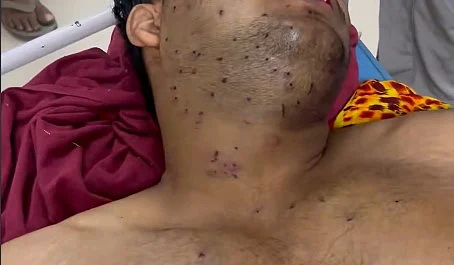
Medical reports from Lady Hardinge Medical College confirm the surgical removal of multiple metallic foreign bodies from 25-year-old protester Sheikh Irshad Mansoori.
Delhi Police had previously denied allegations of pellet gun use, claiming social media reports of gunshot injuries were not corroborated by medico-legal cases.
Official general diary entries reveal that a Delhi Police officer ordered pellet rounds and the Rapid Action Force fired seven pellet rounds during the July 20 clash.
A medical report of a 25-year-old protester contradicts official statements regarding the use of pellet guns during a July 20 demonstration in New Delhi. Sheikh Irshad Mansoori, a petitioner in the Supreme Court alleging the use of pellet guns during the protest, had multiple metallic objects removed during surgery.
Delhi Police issued a statement on Wednesday denying the allegations, as reported by Hindustan Times. The police stated that social media reports of gunshot injuries are not corroborated by medico-legal case (MLC) findings.
However, Mansoori's MLC from Lady Hardinge Medical College (LHMC) confirms that doctors retrieved multiple "metallic foreign" bodies from his body, raising questions about the riot control methods deployed.
Details Of Mansoori Surgery
Mansoori underwent surgery under general anaesthesia on July 21, 2026, according to his LHMC medical report dated July 24. The diagnosis section recorded a "Foreign body impaction in multiple sites of head and neck."
Surgical notes from the ENT department documented that surgeons extracted several objects. The operation theatre report noted a "Metallic foreign body retrieved (size around 2mm) from right maxillary antrum...right lower labial mucosa...right shoulder, right neck, left forehead..."


Ophthalmology records detailed further extractions near the eye. The notes described a "Foreign body felt at about 8-10mm along the superior border of medial rectus muscle...noncompressible metallic foreign body of approximate size 3x3mm cylindrical with one flat surface and sharp edges retrieved."
Mansoori said that doctors removed several objects from his face and upper body. "A total of seven pellets or as written in the medical documents metallic foreign body have been removed from my body post-surgery," he told Hindustan Times.
He added that some pellet-like fragments remain embedded in his face. Doctors advised against surgical removal to prevent additional harm. LHMC retained the extracted metallic objects.
Other Protesters Allege Injuries
Medical documents from other demonstrators highlight similar wounds. Prashant Singh, a 25-year-old Bihar resident and Supreme Court petitioner, received treatment at LHMC. His discharge summary noted "The patient has pellet injuries to the right upper limb, chest and inguinal region with first-degree severity." Singh said the hospital did not tell him what objects hit him or show him his X-ray reports, adding that he and his friends researched his wounds on the internet to determine they resembled pellet injuries.
A 28-year-old journalist, who requested anonymity, also sustained wounds. His MLC from Safdarjung Hospital documented "pellet injury marks" and recorded a "physical assault with pellet gun at Jantar Mantar at 4 pm".
The reporter said that approximately 20 metallic pellet-like objects remain lodged in his body.
Nootan Toppo, a 32-year-old woman from Gurgaon, received treatment at Ram Manohar Lohia Hospital. Her discharge papers cited a "suspected gunshot injury" to the right side of the ear.
The police dismissed the firearm allegations regarding Toppo's wounds. A Delhi Police statement stated that the "MLC records a lacerated wound in front of the right tragus, with the nature of injury described as blunt."
In another case, 19-year-old Sahil Lochab, a student aspiring to join the police force, had pellets removed from his body at AIIMS.
Police And RAF Response
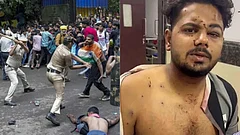
Official records confirm that security forces deployed pellet munitions during the Cockroach Janta Party's 'Chalo Sansad' march. A general diary entry filed at Parliament Street police station at 1:24 am on July 22 indicates a Delhi Police deputy superintendent ordered the use of at least two pellet rounds, according to the statement of a deputy commander of the Rapid Action Force (RAF) recorded in the entry and seen by the publication.
The Rapid Action Force (RAF), a specialised Central Reserve Police Force (CRPF) unit, fired an estimated seven pellet rounds during the unrest. The CRPF has already instituted an inquiry into the allegations.
A senior Delhi Police officer explained the operational protocol. "During any such demonstration...we call for paramilitary forces and ask them to bring anti-riot weapons. We don’t decide what all they can bring," the officer said, in remarks reported by the outlet.
The anti-riot weapons comprise plastic pellets, metallic pellets, shock batons and tear gas, according to Delhi Police. The inventory has not been shared with the Delhi Police and its use is only shared in a DD entry.
Investigating officers suspect the forces discharged metallic pellets. Evidence seized from protesters is currently held by LHMC and AIIMS. Police records indicate around six people suffered "pellet-like" injuries and their medical records are still being examined.
The use of metallic pellets remains a contentious law enforcement tactic. Such munitions have historically been used controversially in Jammu and Kashmir. Security forces typically use plastic pellets as an alternative intended to cause less serious injuries.