96 Attacks this year, mostly in the Gulf of Aden
40 Successful hijackings
$30 Million paid in ransom, says British think-tank Chatham House
268 Crew (approx) held hostage***
Strike Strategy
1. Usually mother ships masquerading as fishing dhows set sail to the high seas. Once they are close to the target, two or three skiffs with high-speed motors are released from the mother ship.
2. With warships patrolling the Gulf of Aden, pirates press two dhows into service. One sends distress signals and lures the warship away from the target. The other then conducts the raid.
3. Each of the skiffs has 7-10 men armed with AK-47s and rocket-propelled grenades. They approach the target from two or three points, fire warning signals, ask the crew to come on the deck and the ship to slow down.
4. The pirates then use grappling hooks and irons—some of which are rocket-propelled. They then climb aboard using ropes and ladders, take hostages and inspect cargo.
5. Usually, hijacked ships are taken to Nugaan region's fishing outpost, Eyl, the piracy capital of the world. (The Saudi supertanker was an exception. It was taken to Haradheere.)



6. Once anchored in Somalian waters, other members of the pirate gang join. Negotiators and translators arrive. They communicate directly with the owners of hijacked ships.
Roots Of Piracy
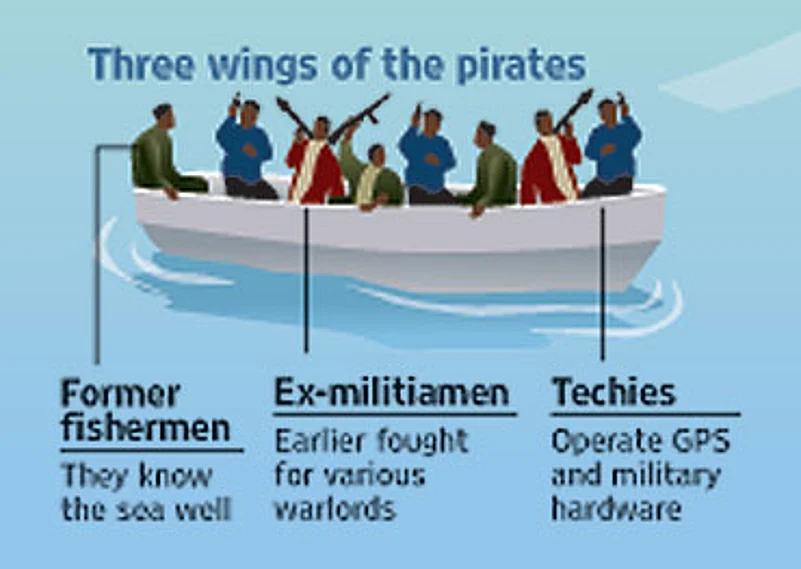
Ten years ago, Somalians found their traditional fishing methods no match for trawlers illegally entering the country's waters. No check on trawlers as government existed only in name. Many Somalian fishermen took to piracy. Piracy got a boost with warlords or sections of their militia providing protection, money & ammunition.
Importance Of The Gulf Of Aden
The Gulf of Aden allows ships going between Asia & Europe to access the Suez Canal without having to travel all around Africa.
***
The Indian naval warship ins Tabar has roiled the Gulf of Aden, warding off two piracy attempts early in November and then, a week later, dramatically sinking a fishing trawler the pirates had overpowered with the purported aim of using it for another foray. From then on, the swirling sea washing the shores of Eyl in Somalia has a murmur only the pirates can decipher. They listen to it in silence. The sea whispers: the Indian navy killed four of your brethren, their death must be avenged. And then the lapping tides, in their rhythmic monotony, murmur relentlessly: Revenge. Revenge. Revenge.
Eyl was populated only in 1927. Its inhabitants were Somalian fishermen who combined their knowledge of the sea with a certain insouciance. Located in the Nugaal region of Puntland, the semi-autonomous northeast province of Somalia, Eyl is now a booming town in the making. What’s more, it has acquired the infamy of emerging as the piracy capital of the world. At the moment, Eyl is host to 11 ships taken by pirates, up from the nine I saw during my visit there in July. The town crawls with pirates, young men with AK-47s and rocket-propelled grenades sauntering around on its beaches, or flitting on their skiffs between one anchored hijacked ship to another. With a lust for big bucks, and bound to each other by clan loyalties, these are the men listening to the sea.
Bashir Ahmad, 28, is your typical pirate of Eyl. He heard about the INS Tabar sinking a vessel of pirates over the radio. It sent his pulse racing: weren’t his friends planning a hijack? He talked to mates in Alula village near Bossasa, Puntland’s largest city. They confirmed the news, the tragic laced with some solace: four of the gang of nine had managed to escape. But Bashir isn’t appeased. "We want to take revenge against the Indians," he says.
For the pirates, the ownership of the sunk trawler is irrelevant. Two days before the media quoted a Thai shipowner claiming the trawler to be his, Mahmeed Abdulashi, a pirate based in Garowe, Puntland’s capital, had through his formidable piracy network told me what had happened. Two speedboats had overpowered the Thai trawler, hoping to use it as a mother ship—a larger vessel employed to launch and refuel skiffs that would strike the hijack target. And then the Indian navy struck. "Four of them survived, but I can’t tell you where they are."


Free at last: Capt Prabhat Goyal of the Stolt Valor in Delhi after his release
Mahmeed doesn’t bristle with vengeance, because he isn’t from Eyl, which is the preserve of the Isse Mahamud clan. In Eyl, though, pirates are mulling the nature of revenge. Siyaad Yuusuf, 38, provides a clue, "Our goal is to now locate an Indian ship flying the Indian flag. We want to capture it." But they say the crew members won’t be killed. In Eyl, even revenge is an opportunity to strike a rich bargain. Says Bashir, "From the owner of an Indian ship, we will demand ransom money much higher than our usual rates, even more than the value of cargo on board."
Eyl’s pirates claim they haven’t turned their wrath on Indians who are crew members of the hijacked ships parked there. Farhan Haaji, 32, is among those who captured the MV Delight, the Iranian ship which has in its crew seven Indians. He says, "We are dealing with the Indian hostages the way we deal with others. We don’t believe in killing hostages because it reduces our chances of a good bargain." For Farhaan and others, the nationality of ship owners is more important than that of its hostages. For the moment, Indian crew members on foreign ships can be said to be safe.
Also listening to the sea in Eyl are a clutch of clan elders. What they hear is remarkably different. The tide tells them: the Indian navy is welcome, attack the pirates, root them out from Eyl.
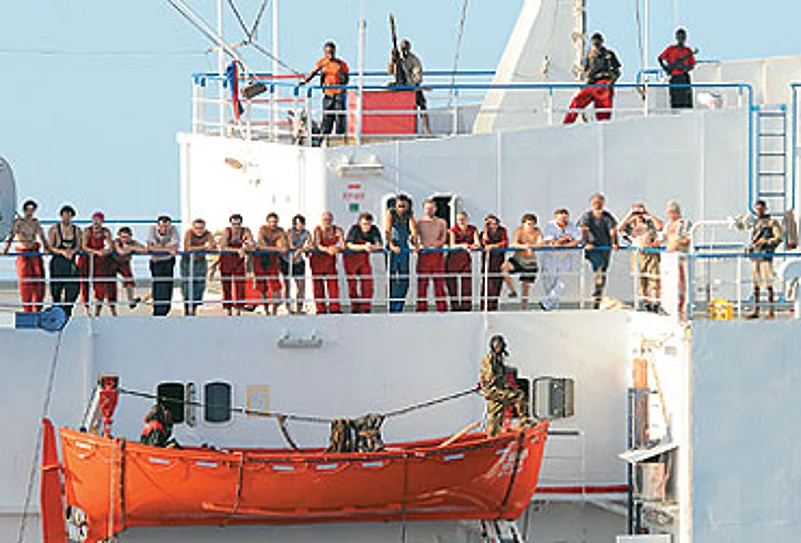
Roll call: Hostages on the hijacked MV Faina line up for inspection by the US Navy
When businessman Hassan Farah, 54, heard about the sinking, he and his mates rejoiced: "It’s only through persistent attacks on the pirates can we remove the menace." Adds Sheikh Ali Ahmad, 46, a fisherman, "We elders thanked the Indian navy for teaching these pirates a lesson. On Eyl’s behalf, we welcome the Indian navy." This response of clan elders partly stems from religious reasons. As Sheikh Ali Ahmad, who teaches the Quran, argues, "We are opposed to the pirates because their method of earning money is forbidden, haraam. This is why we welcome what India has done."
The elders are opposed to piracy also because young men with guns have displaced the elders from Eyl’s power structure. In recent months clan elders and sheikhs have held demonstrations against the pirates, demanding that the local authority should evict the sea-brigands from Eyl. But their protest is bound to fail, for the authorities are an inextricable part of the piracy network, and their hands are greased to ensure that no punitive action is taken against pirates.
Puntland president Adde Muuse, at a recent press conference, admitted to the police-pirate nexus. He said, "Yes, sections of the police take money and work for the pirates." But this isn’t the only reason why the police have failed to curb the sea robbers. As he explained, "We simply don’t have the capabilities to check piracy. The pirates have modern weapons and speedboats, we don’t have those. We request the international community to help us fight the pirates."
Indeed, Somalia has attained notoriety because of what it is: racked by unrest for 17 years, all vestiges of government authority were further eroded because of the debilitating clashes between the warlords and Islamic Courts Union (ICU) beginning 2006. Initially gaining ascendancy over the warlords, the ICU was vanquished in 2007 by the Ethipoian forces, which invaded Somalia at America’s behest. The Islamists regrouped, captured much of the territory in the south, and reduced the Transitional Federal Government (TFG) of the warlords to a nominal entity. Most provinces in the north now enjoy autonomous status.
With the Islamists seeking to impose order, the pirates of the south shifted north to Eyl, where fishermen had been battling the trawlers illegally entering the unregulated Somalian waters. Unable to compete with them, they took to piracy nearly 10 years ago. Their numbers augmented, and flush with arms, they ventured out to the high seas. Yuusuf justifies piracy, "Earlier, the trawlers would enter Somalian waters, destroy our fishing boats, and carry tons of fish away. This is our way of retaliating. You should look upon our demand for ransom as "tax" that the central government would have imposed on ships entering our waters and polluting it."

Few believe this eco-war talk, aware that attacks on the high seas are fuelled by a lust for fast bucks. Eyl is awash with their dollars, its predominant local currency. The once sleepy fishing outpost now boasts of hotels and restaurants and smart houses, where the pirates live and plot. Explaining their modus operandi, Ahmad Saalah, who was part of the group that captured a Greek bulk carrier on September 21, says, "Once we board a ship, we take the count of crew members, check their nationality, and inspect the cargo. If satisfied with the catch, we get the captain to inform the owners over satellite phone about the hijack."
Eyl springs into action once a hijacked ship sails in. A translator, with some knowledge of English, is brought on the ship to negotiate with the owner. He talks to the owner, and takes instruction from the pirates’ patrons who are usually Somalian traders in the United Arab Emirates or Djibouti. They finance piracy in the hope of lucrative returns. As Bashir explains, "If we get $1.75 million, we give $350,000 to the man who invested in us. Once the ransom money is paid, our friends (the patron’s men) come in plush Land Cruisers. We all then go to Garowe, Puntland’s capital, and divide our money there." The booty has to be spread among many, including the hundreds who, armed with AK-47s and satellite phones, keep a watch to ward off any rescue attempts.
Bashir cites his own example to illustrate the kind of money they come into: "I have three big houses in Garowe, I invest in speedboats and modern weapons, and I have wed beautiful women." The brides are from poor nomadic tribes, renowned for their beauty. This lavish lifestyle has become an impetus for unemployed men—and they are legion here—to join piracy, underlining the challenge inherent in keeping the sealanes safe.
Tackling the menace of piracy, says Cyrus Mody of the International Maritime Bureau, London, demands that the warships patrolling the Gulf take more than a preventive role. He suggests, "What is required more is that the navies engage not just when there is an attack or incident. They must also locate the mother vessels, go after them, board and inspect them, and if necessary, confiscate the vessels and weapons."
But the Gulf of Aden will remain roiled as long as global powers don’t stabilise Somalia and provide economic opportunities to its impoverished millions. Hunger, we all know, drives men to desperation.
Inputs from Sanjay Suri in London
(Abdiqani Hassan, a freelance journalist, conducted the interviews with the pirates over the phone)