A Pak Of Cards
What is at stake in the May 11 elections
The Issues Before Voters
- Stagnation For the past several years, Pakistan’s growth has been stuck at 2 per cent or thereabouts
- Security Law and order has slipped rapidly as Islamists have taken root and struck repeatedly in main towns and cities
- Basic facilities Water shortage and power outages have become the order of the day, especially in Punjab
- Drone attacks American aerial strikes inside Pakistan have become a hugely contentious and emotive issue
- Youth Like India, over 65 per cent of Pakistan is below 25 years, but illiteracy and lack of opportunities abound
- Unemployment A large number of youth are poorly educated and are easy target for the religious radical outfits
- Corruption Rampant corruption among all major political players, members of bureaucracy and a culture of graft has disillusioned voters
Why This Election Is Important
- This is the very first time that a democratically elected government has completed its full five-year term in Pakistan. Will this be the new trend or was it just an aberration?
- Other than the executive and legislature, other institutions that make a democracy work—judiciary, election commission, a free media—all are asserting to find their sovereign space.
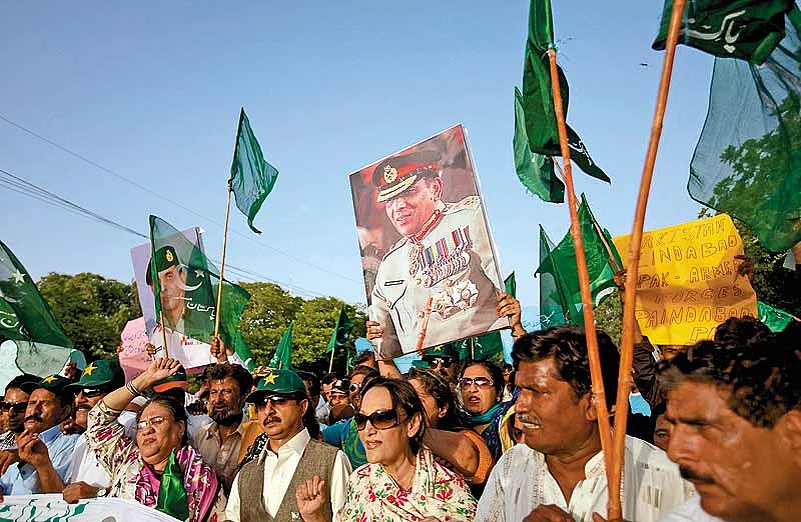
- Former military dictator Pervez Musharraf has been disqualified from contesting the elections, and is now under house arrest. He may soon be put on trial for some of the
serious charges he faces. - An anti-Indian plank, the hallmark of past Pakistan elections, is absent in these elections. While negative campaign is on about the US-led drone attacks, most political parties stress on strong ties with India.
- Pakistan, accused by India and others for sponsoring terrorism, is today a victim of regular terrorist strikes. The new government may play a key role for stability both in Pakistan and in Afghanistan, with the US due to pull out in 2014.


***
The hype and excitement that generally engulfs the Indian media during elections in Pakistan may have been missing so far. It could well be that a conjuncture of crucial domestic developments, social convulsions and ‘breaking news’ have fixed the gaze of Indian TV channels and newspapers inwards rather than towards India’s trouble-prone western neighbour. But policy planners in New Delhi have been watching with keen interest the fast-paced sequence of events in Pakistan that ranges from former military dictator Gen Pervez Musharraf’s return and his subsequent house arrest to the tussle between Nawaz Sharif’s PML(N) and Asif Ali Zardari’s PPP to corner a majority, as well as pretender Imran Khan’s bid to outsmart both and emerge as the ultimate winner.
A series of political changes can be expected in India’s neighbourhood—elections are slated in the war-ravaged Tamil areas in northern Sri Lanka for September; Bangladesh and Myanmar too are poll-bound. Nepal also is in transition. In the process, many new political groupings and individuals are likely to stake claim to power, posing new challenges for India. But the significance of the changes in Pakistan—both leading up to and following May 11, when it holds parliamentary and assembly elections in four provinces—cannot be overstated.
Recent years, particularly the period since 2008 when the PPP-led coalition government came to power in the aftermath of an assassination, has been one of great tumult for Pakistan. Though the PPP has made history by becoming the first elected government in Pakistan to complete its full-term, its five-year ride in power has mostly been a rough journey. The fight between the judiciary and the executive, and by extension, the national assembly, had often led to prolonged periods of chaos and instability. A stagnating economy, coupled with regular bloodshed targeting innocent civilians in routine ethnic and terrorist violence only added to that disquiet.


26/11 India still awaits action on Mumbai terror attack suspects. (Photograph by Reuters, From Outlook 06 May 2013)
But peace constituencies in the two countries yearning for normal, neighbourly relations between India and Pakistan could see positives through the dirty confusion and tangle of it all. Despite the 26/11 Mumbai terror attacks and occasional bouts of tension along the Line of Control, the two sides did manage to keep much of their inherent differences in check during this period. On the trade front, though Pakistan failed to grant India the ‘Most Favoured Nation’ status to accelerate trade relations, significant progress was made. Additionally, democrats would argue that an assertive judiciary, a vibrant media and an independent election commission trying to find a sovereign space for itself are all good signs for a country like Pakistan.
“We have worked in the past with all segments of Pakistani society. But on India, it is not only the elected government but the establishment in Pakistan that plays a key role,” says a senior MEA official. He makes it clear, perhaps with some cynicism, that no “dramatic changes” are expected, even after the elections, in Pakistan’s policy towards India.
True, Pakistan’s security policy, especially vis-a-vis India, is the exclusve domain of the Pakistani military establishment. Irrespective of the changes that have taken place in Pakistan—often encouraging liberal sections in India and elsewhere to hope serious attempts are being made at last to strengthen democratic institutions—the role of the Pakistani army has not diminished, especially on key foreign policy and security issues.
“The judiciary’s assertion, a little rumbling in the civil society and many such developments all betoken Pakistan’s domestic evolution,” says Vivek Katju, former secretary in the MEA. But he argues that it will be wrong to deduce from these that the military establishment has been weakened.
“If the Pakistani army is allowing the democratic process to continue, it’s simply because they have too many irons in the fire right now,” explains Katju. His referrence is to the army’s involvement in pacifying the Af-Pak border and freeing areas from groups like the Tehreek-e-Taliban Pakistan (TTP) that has been engaged in a long-drawn fight against the Pakistani military. “If and when the army wants, it can step in to pick up the reins of power in Pakistan,” Katju warns.
The domineering role that the Pakistan army continues to play in the country is not made light of by western observers either. Though in public much of their statements pertain to strengthening Pakistan’s democratic credentials and encouraging the election process, the US and its western allies know well that in the ultimate analysis it is the bosses in Rawalpindi rather than the ones in Islamabad that they would have to reckon with. What role the army would play becomes more significant as the deadline for the US and the western troops’ withdrawal from Afghanistan—slated for end 2014—draws closer.
Given the recent American involvement in Iraq and Afghanistan, and the history of their sticky past forays in these regions, Western experts concede that in much of the Muslim world, including Pakistan, American policies tend to get unpopular, and any elected government that is seen to collaborate with the US starts losing popularity on the streets. The anti-US political rhetoric that one is seeing in Pakistan’s present election campaigns is a reflection of the unpopularity of the US-led drone attacks on the Af-Pak border, which has led to deaths of many innocent civilians. And that is just one reason. Experts also point to the perceived disconnect between the American rhetoric on ‘democracy and freedom’ on the one hand, and its evident comfort in dealing with dictatorships and military rulers rather than elected civilian governments on the other.
But rampant anti-US rhetoric from soapbox orators in the campaign may not be too much of a bother for western policymakers as Antol Lieven, professor of war studies in King’s College, London, and author of Pakistan: A Hard Country, has argued. “If it is not as acute an issue as it might be, this is partly due to deep pragmatism (thoroughly soaked in cynical self-interest) on part of the Pakistani civilian-political elite, and partly due to the fact that in the end, it is the army that decides the key issues of foreign and security policy, or at least exercises a veto over them.”
Anti-US protests might be a rallying cry for the heaving streets of Karachi, Lahore and Peshawar, but for western governments it is the sectarian violence within Pakistan and the increasing presence of its home-grown terror outfits that continue to be an area of concern. As Daniel Twining, a South Asia expert of the Washington-based German Marshall Fund, says, “The US expects to see Pakistan’s post-election leadership take serious steps to crack down on the terrorism and sectarian violence that is increasingly penetrating Pakistan’s urban core.”
Twining also points out that if Nawaz Sharif’s PML(N) ends up becoming the largest party and forms the government, it could also raise serious questions on what kind of relations he has with the army establishment. Will he retain a compulsive wariness from having been a coup victim once? Will he be aggressive, or complaisant? However, to Twining, more than the future of Afghanistan, it is the ground situation in the terror-ridden cauldron that is Pakistan that should concern its own leadership and the outside world. “Should there be a change in political power from the PPP to the PML(N), all eyes will be on Rawalpindi, given Nawaz Sharif’s history with the generals.” But Twining added that “from a strategic perspective, the greater concern is whether the new civilian leadership and the army leadership can together enact a programme to prevent Pakistan’s destabilisation from internal militancy, which is the greatest danger than Afghanistan’s future dispensation.”
This is an area which is also of serious concern to the Indian establishment. For, despite the initial positive response, the civilian leadership in Pakistan failed to make any meaningful progress against those involved in Mumbai terror attacks. Every demand for action was stonewalled by requests for ‘conclusive evidence’. But as long as the army establishment in Pakistan is not on the same page as the civilian government, probable terror strikes against India will continue to remain a major worry for New Delhi. Therefore, irrespective of whether it is Nawaz Sharif, Asif Ali Zardari or Imran Khan who comes to rule Pakistan, a fundamental change in Pakistan’s approach in dealing with India would need more than a public commitment from a democratically elected civilian government.