The United States and Iran agreed to halt military operations ahead of emergency technical talks scheduled in Doha, Qatar, on Tuesday.
The emergency meeting, originally planned in Switzerland to discuss Iran's nuclear programme, was relocated and narrowed to the Strait of Hormuz dispute.
Renewed weekend clashes saw US strikes on Iranian military sites after attacks on commercial ships, followed by Iranian retaliatory strikes in Kuwait and Bahrain.
The United States and Iran have agreed to pause military attacks and hold emergency talks in Doha, Qatar, on Tuesday to settle their dispute over the Strait of Hormuz, following renewed weekend clashes in the Persian Gulf against the backdrop of a signed memorandum of understanding (MoU). The meeting was originally scheduled to take place in Switzerland, where it was supposed to focus on Iran's nuclear programme, according to a report by the Hindustan Times.
"We decided to stop all the kinetic activity," a senior US official told AFP, in remarks reported by Axios.
A second US official said the pause means vessels can move freely through the Strait of Hormuz while technical talks continue. The venue shift followed the weekend escalation, and the agenda was narrowed to the Hormuz dispute.
After the US and Iran traded attacks and Gulf nations came under fire, a Trump administration official said on Sunday that both sides will “stand down for now and vessels can move freely” in the Strait of Hormuz. It’s not clear yet what Iran’s position is on the matter.
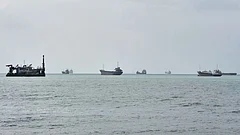


But even as the official says “vessels can move freely” in the Strait of Hormuz and an interim agreement is in place, this has not been reflected in the waterway, leaving commercial vessel operators and their crews facing confusion and danger.
Shipping Still Impacted
The US-Iran agreement signed earlier this month requires Iran to make its "best efforts" to ensure the safe passage of commercial vessels through the Strait of Hormuz. However, while Tehran has agreed to facilitate shipping, it has not ceded its influence over the strategic waterway. A broadly worded provision in the deal states that Iran and Oman will jointly determine the "future administration" of the strait, effectively giving Iran a formal role in its management.
According to AP, since the agreement, three separate shipping corridors have emerged. One runs through Omani waters to the south, another follows the central route that was commonly used before the conflict, and a third passes through northern waters under Iranian control.
Early signs suggest that many shipping operators are favouring the southern route near Oman. According to maritime intelligence firm Windward, more than half of the vessels exiting the Gulf on Thursday used this corridor. Ship-tracking data from MarineTraffic also showed several large merchant vessels and a container ship using the Omani route on Sunday while heading to Gulf ports.
Despite this shift, uncertainty over which corridor is safest has slowed efforts to restore maritime trade to pre-conflict levels. Ship operators now face a difficult choice: avoiding Iranian waters could expose vessels to potential attacks, while using the Iranian-controlled route raises concerns over possible Western sanctions if the agreement were to break down.
Weekend Strikes Shatter Ceasefire
The fighting resumed after commercial ships in the strait came under attack. Washington blamed Iran for the threat to shipping and then struck Iranian military sites. President Donald Trump defended the US strikes, saying American forces hit Iranian missile, drone and radar sites after Tehran broke the ceasefire.
Iran then hit US military facilities in Kuwait and Bahrain. Iranian Foreign Minister Abbas Araghchi said the US strikes violated the UN Charter and the MoU.
Dispute Over Article Five
The renewed conflict stems from clashing readings of Article 5 in the memorandum, which sets the rules for transit through the Strait of Hormuz. The waterway carries about one-fifth of global oil and liquefied natural gas flows.
Under that clause, Iran is to allow free commercial passage without charge for 60 days and remove mines and other obstacles within 30 days. The text also calls on Tehran to talk with Oman and other Gulf littoral states about the strait's future administration and maritime services while staying within international law and the rights of coastal states.
Nick Stewart, who heads the US technical team, is expected to attend the Doha talks.