Trump and Iran give conflicting accounts over planned Doha peace talks.
Strait of Hormuz attacks continue despite fragile US-Iran interim agreement.
Oil prices remain elevated as uncertainty clouds regional ceasefire efforts.
US President Donald Trump said on social media that Iran requested a meeting in Doha scheduled for Tuesday, a claim promptly denied by senior Iranian negotiator Kazem Gharibabadi. The conflicting accounts threaten ongoing peace negotiations, reported India Today.
Pakistan, acting as a mediator, said that talks would resume on Tuesday. The Trump administration similarly indicated on Sunday that technical discussions involving lower-level diplomats remained expected in the coming days.
These disputes coincide with a fragile interim deal reached earlier this month. The agreement requires Iran to dilute its enriched uranium stockpile in exchange for sanctions waivers, the reopening of the Strait of Hormuz, and gives both sides 60 days to work towards broader agreements.
Gulf Hostilities Escalate
The regional war began on February 28. Iranian hostilities immediately halted cargo and tanker movement through the Strait of Hormuz, a waterway through which about a fifth of the world's oil moved before the war began, triggering a global energy crisis. The strait has long been treated as an international waterway even though it lies within the territorial waters of Iran and Oman.
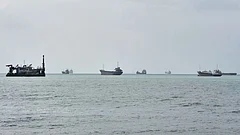


Over the weekend, Iran attacked vessels in the strait twice following efforts to open Oman's territorial waters to shipping. The US military launched retaliatory airstrikes in response to the strait attacks.
Hostilities widened on Sunday when Iran launched drone and missile attacks targeting Bahrain and Kuwait. Iranian forces also struck a tanker carrying Qatari crude oil.

Frozen Funds Dispute
Iranian President Masoud Pezeshkian, a reformist, sought to build domestic public support by praising the interim deal as "a great victory for the Iranian people", in comments carried by the state-run IRNA news agency. He said unfreezing assets was underway. "Based on the plans made, $6 billion out of the total $12 billion of Iranian resources in Qatar will be released and returned to the country, and necessary follow-ups are being carried out," Pezeshkian said.
The reality remains unclear. US officials said that no frozen assets have been released, and Qatar has not acknowledged any such transfer.
Oil Price Impact
US oil futures traded at $69 a barrel on Monday. Trump credited the interim deal for the drop, though pre-war prices were lower at $65 to $66. Brent crude stood at $73.25 a barrel, compared to $72 pre-war and an April peak of $126.
A sustained rise in oil prices could carry heavy political costs. Such increases threaten to undermine Trump's campaign claim ahead of the November elections that inflation is easing.