Seven American aid workers returning from the DRC Ebola response are undergoing a 21-day monitoring period at a US-funded bio-isolation facility in Kenya
The Laikipia Air Base facility is designed to monitor exposed but asymptomatic individuals and forms part of a broader US-Kenya regional Ebola preparedness strategy
The project has sparked a constitutional challenge, with critics questioning its legality, transparency and public consultation
The first occupants arrived quietly. Seven American humanitarian workers, all returning from the Ebola response in the Democratic Republic of the Congo (DRC), were transferred to a bio-isolation facility at Kenya's Laikipia Air Base rather than flying directly home to the United States.
The group, employed by the Christian humanitarian organisation Samaritan's Purse, began a 21-day monitoring period under the supervision of the US Public Health Service after changes to US public health measures in May altered travel arrangements for personnel returning from Ebola-affected areas. Some of the workers had treated Ebola patients, while others had served in support roles, as per a Reuters report.
Their arrival marked the first use of a facility that has become the focus of court proceedings, political scrutiny and public debate in Kenya, despite the country recording no Ebola cases linked to the current outbreak.



An Outbreak Spreads
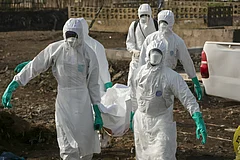
The current Ebola outbreak is centred in the DRC and Uganda. According to the World Health Organization (WHO), the circulating virus is the Bundibugyo species, for which there is currently no licensed vaccine or specific treatment.
On July 10, the US Centers for Disease Control and Prevention (CDC) confirmed that an American aid worker in the DRC had tested positive for Ebola after participating in the humanitarian response. The agency said there was no evidence of wider transmission outside the affected countries but urged continued vigilance.
Recognising the regional risk, WHO and Africa CDC launched a joint continental Ebola response plan on June 5, seeking $518 million to strengthen surveillance, laboratory capacity, infection prevention and cross-border preparedness across Africa.
Why Americans Came?
The movement of the seven Americans followed a series of public health measures introduced by the United States during the outbreak.
According to CDC guidance for travellers returning from Ebola-affected areas, individuals with recognised exposure may be subject to enhanced monitoring and movement restrictions during the virus's 21-day incubation period.
Reuters reported that, under the measures introduced in May, American aid workers returning from outbreak areas were required to complete their monitoring period in a third country before travelling to the United States. The arrangement led to the transfer of the Samaritan's Purse workers to Kenya.
The United States has also expanded financial support for the regional Ebola response. In a statement issued on June 3, the US Embassy in Kenya said Washington had committed more than $162 million in direct assistance to combat the outbreak, alongside broader humanitarian funding through international agencies.
Why Kenya Was Chosen As A Monitoring Hub?
The monitoring facility is located within Laikipia Air Base in central Kenya. According to Reuters, citing US and Kenyan officials, it is intended to monitor asymptomatic people who may have been exposed to Ebola rather than provide treatment for confirmed patients.
The US Embassy said the facility forms part of a broader strategy to strengthen regional outbreak preparedness. It described the project as "part of a holistic response" to reduce the risk of cross-border transmission and said it would not pose a threat to nearby communities.
The embassy also said expanding regional capacity to isolate and monitor exposed individuals would help preserve Kenya's existing healthcare resources while improving readiness should Ebola spread beyond the current outbreak zones.
Kenya's Ministry of Health has similarly emphasised preparedness rather than response. Health Cabinet Secretary Aden Duale said on June 12 that Kenya remained free of Ebola while strengthening surveillance, border screening, laboratory capacity and emergency response systems because of outbreaks in neighbouring countries.
The two governments further deepened health cooperation on Thursday by signing a strategic grant agreement aimed at strengthening Kenya's public health systems and regional health security.

Why Critics Objected?
The project nevertheless generated opposition soon after details of the facility became public.
Residents living near Laikipia Air Base, civil society organisations and constitutional activists questioned both the process through which the agreement had been reached and the decision to host foreign nationals exposed to Ebola in a country with no active outbreak.
The Katiba Institute, a Kenyan constitutional rights organisation, petitioned the High Court, arguing that the project raised constitutional and public participation concerns. Critics also questioned whether Kenya should assume additional public health responsibilities arising from an outbreak occurring elsewhere in the region.
Government officials, however, maintained that the facility formed part of Kenya's preparedness strategy rather than indicating the presence of Ebola within the country.
Inside The Court Battle
On May 29, Nairobi's High Court issued conservatory orders suspending the establishment of the facility while it considered the constitutional petition, Reuters reported.
Construction nevertheless continued after the ruling.
Following further hearings, the court found Health Cabinet Secretary Aden Duale in contempt for failing to comply with its orders.
Duale later appeared before the court, apologised and confirmed that construction had been suspended in compliance with the judiciary's directions, as per the report. The minister also maintained that the project formed part of Kenya's Ebola preparedness measures and that public concerns about the facility's health risks were not supported by scientific evidence.
The constitutional challenge remains before the High Court.

What Happens Next?
The Laikipia facility is now operational and monitoring its first occupants, while the legal challenge continues.
According to Reuters, the seven Americans entered Kenya voluntarily with the approval of Kenyan authorities and are being monitored by US Public Health Service clinicians. The workers remain under observation during the standard 21-day incubation period and are not permitted to travel elsewhere in Kenya.
The outcome of the High Court case will determine the future legal framework governing the facility. More broadly, it is expected to clarify how Kenya balances domestic constitutional requirements with international public health cooperation during cross-border disease outbreaks.