Israel’s Basic Law allows a rotational premiership, under which one leader serves as prime minister before an alternate prime minister takes over.
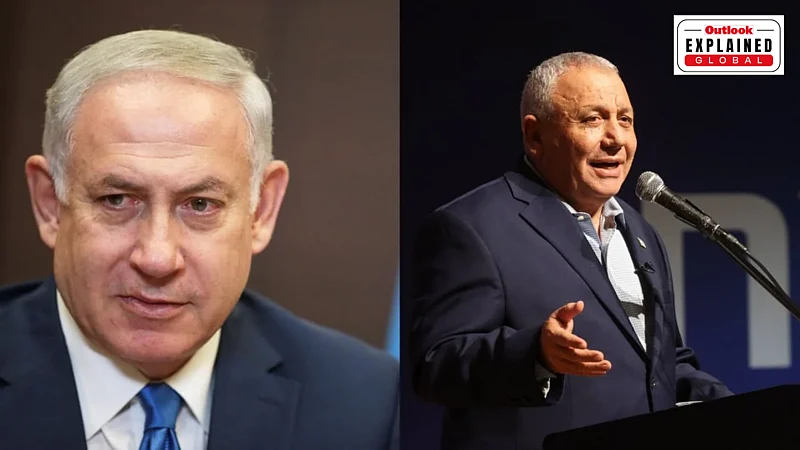
Netanyahu is reportedly willing to serve second to Eisenkot in a unity government, as neither political bloc has the 61 seats needed for a majority.
Eisenkot remains sceptical, while disagreements over policy, coalition partners and the October 7 inquiry could derail the proposal.
A country does not usually need two prime ministers to form one government. But Israel has a political arrangement that makes the idea possible: a rotational premiership, in which two leaders agree to occupy the country’s highest political office at different points during the same government’s term.
That possibility has returned to the centre of Israeli politics after Prime Minister Benjamin Netanyahu reportedly signalled that he could serve as the second prime minister in a rotation agreement with Gadi Eisenkot, the leader of the centrist Yashar party. Under the reported proposal, Eisenkot would take office first, with Netanyahu succeeding him at a later date. The offer has reportedly been conveyed through unofficial channels, and divisions remain within Netanyahu’s Likud party over the arrangement. It is not yet a concluded agreement.
The timing is significant. Israel’s October 27 election produced a fractured Knesset, leaving neither Netanyahu’s traditional alliance nor the opposition bloc with enough seats to form a government on its own. Eisenkot has been given the first opportunity to form a coalition, but the negotiations have exposed deep disagreements over who should govern, which parties should be included and what compromises are acceptable. A rotation deal could offer a way out of the impasse. It could also create a new set of political problems.




Can Israel Legally Have Two Prime Ministers?
The short answer is that Israel can have a government built around a rotating premiership, but that does not mean two people exercise the office of prime minister simultaneously. The country’s Basic Law: The Government recognises the position of an alternate prime minister, creating a legal framework through which the premiership can pass from one leader to another during the same government’s tenure.
The arrangement was formalised through an amendment to the Basic Law in 2020. It was designed to accommodate a power-sharing agreement between rival political blocs, allowing one leader to serve as prime minister first and the other to take over on a specified date. The law also provides for the functioning of a rotation government, including provisions intended to protect the balance between its two political blocs.
Israel has already experienced this arrangement. Following the political deadlock of the 2020 elections, Netanyahu and Benny Gantz agreed to form a unity government. Netanyahu served as prime minister first, while Gantz became alternate prime minister, with the understanding that he would eventually take over. The agreement was intended to give both blocs a share in government and prevent another election after a prolonged period of instability.
That experiment, however, did not run its intended course. The government collapsed amid disputes between the partners and a failure to pass the budget for 2020 and 2021. The Knesset was dissolved before Gantz could become prime minister. The precedent therefore demonstrates that a rotation is legally possible, but it also shows how vulnerable such an arrangement can be when the partners disagree over policy, appointments and the survival of the government.
In practical terms, a Netanyahu-Eisenkot arrangement would require more than a public announcement or an understanding between the two leaders. It would need a negotiated coalition agreement, the formation of a government and the confidence of the Knesset. The agreement would also have to spell out the order and timing of the rotation, the distribution of ministerial portfolios and the safeguards governing the two blocs’ participation in the government.
The legal mechanism, therefore, is not the biggest obstacle. The more difficult question is whether two political rivals, with sharply different constituencies and priorities, can agree on the terms of sharing power — and trust each other to honour them.
Why Is Netanyahu Offering Eisenkot The First Turn?
The answer lies in the arithmetic of the October 27 election. Netanyahu’s Likud-led alliance won 53 seats in the 120-member Knesset, while the bloc aligned with Eisenkot secured 48. Arab-led parties won the remaining 19 seats. Neither of the two main camps has the 61 seats required for a parliamentary majority.
The numbers have left both leaders negotiating from a position of uncertainty. President Isaac Herzog gave Eisenkot the mandate to form a government on November 8, after representatives of factions comprising 67 lawmakers recommended him for the task. That recommendation did not mean Eisenkot already had 67 committed votes for a coalition. It indicated which candidate those lawmakers believed should receive the opportunity to form the next government.
Eisenkot’s presumed bloc has struggled to assemble a workable majority. Its potential partners disagree over whether to rely on Arab-led parties, bring ultra-Orthodox factions into the coalition or negotiate a unity government with Likud. Each option carries political costs, particularly for parties that made campaign promises ruling out cooperation with certain groups.
For Netanyahu, a rotation agreement could offer a route back into government even if he does not occupy the premiership first. The possibility of serving second would allow Likud to enter a unity government while Eisenkot takes the initial turn. It could also preserve Netanyahu’s political relevance and give him a route to return to the top office before the next election, depending on the agreed timetable.
There is, however, a political calculation behind the order of succession. A Likud source had previously suggested that Netanyahu could accept serving second because it might allow him to be prime minister when Israel next goes to the polls. The latest reports indicate that the possibility is now being discussed more seriously, although there is no confirmed agreement on the duration or terms of a rotation.
The proposal has also exposed divisions among the parties that would have to support it. Naftali Bennett, whose B’Yachad party is part of Eisenkot’s broader bloc, has pushed for a unity government with Likud. But Yisrael Beytenu leader Avigdor Liberman has warned that Netanyahu could be using the rotation offer as a political manoeuvre to delay the formation of an alternative government and push Israel towards another election.
Liberman’s concern is not merely about who gets the first turn in the prime minister’s office. He has argued that Netanyahu could prolong negotiations, allow the talks to collapse and then use the failure as a reason to return to the electorate. The Times of Israel has also reported that Eisenkot remains sceptical of Netanyahu’s intentions and has continued preparing to form a government without Likud.

Why Could The Rotational Deal Still Fail?
For Eisenkot, accepting Netanyahu’s offer would involve a political risk that goes beyond sharing a government with a former rival. He has presented himself as an alternative to Netanyahu’s leadership and has argued that the country needs a change in direction following the Hamas-led October 7, 2023, attacks and the political and security controversies that followed.
In his public remarks on November 27, Eisenkot accused Likud of failing to make meaningful progress in negotiations. He said the two parties had held five meetings over two weeks but had not reached agreement on substantive questions, including a state commission of inquiry into the October 7 failures, the composition of the government and legislation requiring military or national service for all. He also warned against joining a government in which his bloc would serve merely as a rubber stamp for Netanyahu.
The differences are not confined to personalities. The proposed partners have conflicting positions on military conscription, judicial changes, the investigation into October 7 and the role of ultra-Orthodox parties. A rotation agreement might settle the question of who becomes prime minister first, but it cannot, by itself, resolve these policy disputes. Nor can it guarantee that the two camps will remain committed to the government once difficult decisions have to be made.
The immediate deadline adds to the pressure. Eisenkot has until December 6 to form a government, with the possibility of requesting a 14-day extension from the president. If he fails, Netanyahu could receive another opportunity to put together a coalition. If both attempts fail, Israel could face another election.
Israel’s rotational premiership is therefore less an arrangement for governing with two prime ministers at once than a constitutional device for sharing one office over time. Its success depends on something the law cannot provide: trust between the people expected to surrender power to each other. Netanyahu may be willing to wait for his turn. The question is whether Eisenkot believes that turn will ever arrive — and whether the rest of the coalition is prepared to wait with him.