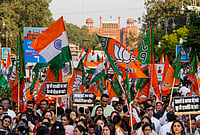
The Joint List and Ra’am hold a combined 19 seats, though the allocation of the final seat remains under review.
Ra’am has shown a greater willingness to join governing coalitions, while the Joint List has traditionally taken a more cautious approach.
Gadi Eisenkot may be more open than Benjamin Netanyahu to seeking support from Arab-led parties to form a government.
Israel’s October 27 general election has left the country facing another parliamentary deadlock. Prime Minister Benjamin Netanyahu’s bloc is ahead but short of a majority, while the opposition led by Gadi Eisenkot has also failed to secure enough seats to form a government. The two Arab-led parties, the Joint List and Ra’am, have emerged as potential kingmakers, with their combined 19 seats potentially giving the opposition the numbers to replace Netanyahu.
But despite their willingness to help end his government, the Arab parties face resistance from mainstream Israeli politicians. The election has therefore raised a central question: can parliamentary arithmetic overcome longstanding political opposition to Arab participation in government?
How Arab Parties Became Kingmakers
Israel’s 120-member parliament, the Knesset, requires at least 61 seats for a majority. According to the latest partial results from the Central Elections Committee, Netanyahu’s bloc holds around 53-54 seats, while Eisenkot’s opposition bloc has 48. The Joint List and Ra’am together have 19 seats, although counting of double-envelope ballots is still underway and the allocation of the final seat remains disputed.


Neither major bloc can currently form a majority on its own. Arab parties could help an opposition government cross the threshold or support a minority government from outside the cabinet, allowing it to survive parliamentary confidence votes.
Their position is significant because Arab political parties have historically struggled to secure a role in Israeli governing coalitions, despite representing a substantial share of the population.
Who Are Israel’s Arab Parties?
Arab citizens of Israel, many of whom identify as Palestinian citizens of Israel, account for around 21.1 per cent of the population, or approximately 2.16 million people, according to Israel’s Central Bureau of Statistics in April 2026. Most are descendants of Palestinians who remained within Israel after the 1948 war.
Although Arab citizens participate in elections and hold seats in the Knesset, their parties have often been excluded from government. Their priorities include tackling crime, improving infrastructure, securing municipal funding and addressing socioeconomic inequality, alongside broader concerns over Palestinian rights and Israel’s policies in the occupied territories.
Two Arab-led parties have emerged as key players in this election.
The Joint List, led by Yousef Jabareen, is an alliance of Arab-majority political groups with secular, nationalist and left-wing orientations. It advocates equality for Arab citizens, improved public services and an end to the occupation. It has secured around 12 seats in the latest results.
Ra’am, led by Mansour Abbas, is an Islamist party that has pursued a more pragmatic approach to Israeli politics. Abbas prioritises practical gains for Arab communities, including better infrastructure, municipal funding and action against crime. Ra’am has secured around seven seats, although the allocation of the final seat remains subject to counting.
The parties share an interest in improving conditions for Arab citizens but differ in their willingness to cooperate with mainstream Israeli parties and the terms under which they would do so.
Why This Election Is Different
The election recorded nationwide voter turnout of 77.7 per cent, the highest since 1999. Exit polls estimated turnout among Arab citizens at nearly 80 per cent, although official figures were still awaited.
The increase was particularly visible in Arab towns. In Nazareth, turnout reached 72.2 per cent, compared with 48.29 per cent in 2022. In Rahat, it rose to 82 per cent from 60.61 per cent.
The higher participation has been attributed partly to anger over the Netanyahu government’s policies and concerns about crime and inequality in Arab communities. The two Arab-led parties are projected to win 19 seats, nearly double the 10 they held in the outgoing Knesset and above the previous record of 15 seats won by Arab parties in 2020.
The election also comes three years after the Hamas-led attacks of October 7, 2023, and the subsequent war in Gaza. The conflict has deepened disagreements over national identity, security and the role of Arab representatives in Israeli government.
The results have given Arab parties greater potential influence over government formation, but their increased representation has not necessarily translated into wider political acceptance.
Why Netanyahu Has Ruled Out Cooperation
Netanyahu has rejected the prospect of forming a government dependent on Arab-led parties, framing such an arrangement as a threat to Israel’s national identity and security.
Ahead of the election, he presented voters with a choice between himself and US President Donald Trump, and Eisenkot and Ra’am leader Mansour Abbas. Likud has since ruled out negotiations with Arab parties.
The position reflects longstanding opposition within Netanyahu’s right-wing coalition to relying on Arab lawmakers. His far-right allies, including Itamar Ben-Gvir’s Otzma Yehudit party, are particularly opposed to such cooperation.
The Joint List’s opposition to Israel’s military campaign in Gaza and the occupation also puts it at odds with Netanyahu’s government. An alliance between the two sides therefore appears unlikely.
The more consequential question is whether the opposition can overcome its own reservations about working with Arab parties.
Is Eisenkot More Open To An Arab-Backed Government?
Eisenkot’s opposition bloc offers a more plausible route for Arab parties seeking to influence government formation, but he has not committed to working with them.
During the campaign, he ruled out including Ra’am in a government unless it accepted conditions concerning Israel’s identity and security. These included recognising Israel as a Jewish and democratic state, supporting the Declaration of Independence and universal conscription, and recognising Hamas as a terrorist organisation that must be destroyed.
The Joint List has long rejected defining Israel as a Jewish state, instead advocating a state of all its citizens. Abbas has gone further in accepting Israel’s Jewish character and condemning the October 7 attacks, but he has resisted demands to declare that Hamas must be destroyed, describing such conditions as loyalty tests.
Some figures within Eisenkot’s wider opposition bloc have advocated cooperation with Arab parties. Yair Golan, leader of the left-wing Democrats party, has argued that Israel must move beyond the distinction between Jewish and Arab votes.
Other opposition leaders remain opposed. Former prime minister Naftali Bennett and Avigdor Lieberman have ruled out cooperation with Arab-led parties. Yair Lapid has also said he would not form another coalition with Ra’am.
Even if Eisenkot agrees to negotiate, resistance within his wider bloc could make an arrangement difficult to secure.
Ra’am And The Joint List Have Different Strategies
Ra’am appears more willing to enter a governing coalition, while the Joint List has left open the possibility of supporting an opposition government from outside.
Abbas has said he is willing to join an Eisenkot-led government if a viable arrangement can be reached. He has also indicated that senior figures from both political camps have approached him about possible cooperation.
His approach builds on Ra’am’s participation in the government formed by Naftali Bennett and Yair Lapid in 2021. That coalition marked the first time an independent Arab party joined an Israeli governing coalition. Ra’am sought practical gains for Arab communities rather than making cooperation conditional on resolving the wider Israeli-Palestinian conflict. The government collapsed after around 18 months.
The Joint List has adopted a different position. Jabareen has said his party cannot join an Eisenkot-led government because of its support for Israel’s military campaign in Gaza and its occupation of southern Lebanon. However, he has left open the possibility of helping an opposition government survive confidence votes.
This distinction matters because Arab parties do not necessarily need cabinet positions to influence government formation. External support could help a minority government replace Netanyahu without requiring the Joint List to join a coalition whose policies it opposes.
Jabareen has said his party’s priorities include tackling crime, expanding economic opportunities and advancing equality for Arab communities. Any arrangement would therefore involve negotiations over policy commitments, not simply an agreement to vote against Netanyahu.
What Happens If Neither Bloc Can Form A Majority?
If the final results leave both blocs short of 61 seats, Eisenkot will have to decide whether to negotiate with Arab parties to form a government.
One option is a minority government supported by Arab lawmakers from outside the cabinet. A formal coalition involving Ra’am is another possibility, although Eisenkot’s conditions and opposition within his bloc could complicate negotiations.
A proposed unity government in which Netanyahu and Eisenkot share the premiership through a rotation agreement has also been discussed. However, it would run counter to the opposition’s stated aim of replacing Netanyahu. If negotiations fail, Israel could face prolonged political uncertainty, with Netanyahu remaining caretaker prime minister until another election is held.
The counting process has also become contentious. Likud has alleged fraud at Arab polling stations and called for investigations by the police, Shin Bet and Central Elections Committee, citing alleged bribery, threats, violence, forged documents and multiple voting. These claims have not been independently verified. A police source cited by Israeli media said there was no investigative or intelligence-based evidence supporting the allegations.
For now, the outcome depends on the final seat allocation and whether Eisenkot’s bloc can agree on a workable arrangement with the Arab parties. Their willingness to help replace Netanyahu is clear, but the terms of any support remain unresolved.
With inputs from Reuters and AP.