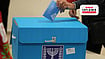
The latest partial count puts Netanyahu’s bloc at 53 seats, Eisenkot’s opposition bloc at 48 and Arab-led parties at 19, leaving no bloc with the 61 seats needed for a majority
Netanyahu could seek additional support from his existing allies, while Eisenkot could explore a unity arrangement or an opposition government reliant on external support from Arab-led parties
If coalition negotiations fail through the prescribed government-formation process, another election remains possible; the final seat distribution is still subject to the counting of outstanding ballots
Israel’s Tuesday election has left both major political blocs short of a majority in the 120-member Knesset, setting the stage for difficult negotiations over who will form the next government. The latest partial count available on Wednesday afternoon put Prime Minister Benjamin Netanyahu’s bloc at 53 seats, the opposition bloc led by Gadi Eisenkot at 48 and Arab-led parties at 19, according to official figures.
With 85.6% of the total vote accounted for, the figures remained provisional. Around 600,000 votes cast through double envelopes, including ballots from military personnel and other eligible groups, were still to be counted. Israel’s Central Elections Committee has set November 4 as the deadline for publishing the final results.
The arithmetic leaves several possible outcomes: Netanyahu could try to broaden his existing right-wing alliance, Eisenkot could seek outside support for an opposition-led minority government, or the two leaders could consider a unity arrangement. If no candidate can assemble sufficient parliamentary backing through the prescribed process, another election remains a possibility.


Why 61 Seats Matter
Israel’s proportional electoral system means voters elect party lists, not a prime minister directly. The parties that enter the Knesset then negotiate agreements to form a government. A party can win more seats than any rival without securing the parliamentary support needed to govern.
The latest figures underline that distinction. Netanyahu’s bloc, which includes right-wing, far-right and ultra-Orthodox parties, stands at 53 seats. Eisenkot’s broader opposition grouping has 48, while Arab-led parties have 19. Neither of the two main blocs can form a government with an outright majority on its own.
The figures also represent political blocs rather than single parties. The willingness of individual parties to work together, the conditions they attach to coalition agreements and the support they can secure in confidence votes will determine whether either side can govern.
The Central Elections Committee’s results portal will publish the official seat distribution as counting progresses. Until the count is final, coalition calculations remain subject to change.

Can Netanyahu Build Another Government?
Netanyahu’s immediate challenge is to retain his traditional partners while finding additional parliamentary support. His potential allies include Otzma Yehudit, led by Itamar Ben-Gvir, and Religious Zionism, led by Bezalel Smotrich, as well as the ultra-Orthodox parties Shas and United Torah Judaism.
These parties have their own priorities. Far-right partners have pressed for hard-line security policies and positions on settlements and the Palestinian territories. Ultra-Orthodox parties have sought to preserve exemptions from military service for students in religious seminaries and protect funding for religious education.
Those demands have complicated previous coalition negotiations, particularly over military-service exemptions. Netanyahu would need to accommodate his existing allies while seeking support beyond the current 53-seat bloc. Losing a partner over disagreements could make the numbers still more difficult.
After the election, Netanyahu called for a strong right-wing government and rejected the prospect of relying on Arab-led parties. Ben-Gvir also warned against a unity government with Eisenkot. Such positions narrow the options available to Netanyahu if his current partners cannot deliver a majority.
A strong showing by Likud, Netanyahu’s party, would not by itself settle the question. The decisive issue is whether the wider bloc can secure enough support to pass a confidence vote and sustain a government.
Could Netanyahu And Eisenkot Agree?
A national unity government would bring Netanyahu and Eisenkot into the same administration, potentially bypassing the immediate arithmetic problem. But such an arrangement would require a substantial political compromise, and no confirmed power-sharing agreement between the two leaders has been established.
The political gap is considerable. Netanyahu has called for a right-wing government and emphasised his security record, including the possibility of renewed joint action with US President Donald Trump against Iran. Eisenkot has argued that voters rejected Netanyahu’s leadership and urged him to leave politics. He has also warned against using security policy for partisan purposes, according to Reuters.
A unity arrangement could involve a rotation agreement, under which the premiership changes hands after an agreed period, or a division of responsibilities between the parties. Either option would require agreement on policy and on how long the government would remain in office. Some existing allies could refuse to join a coalition that crosses the political divide.
There is a precedent. In 2020, after three inconclusive elections, Netanyahu and Benny Gantz formed a unity government with a planned rotation of the premiership. The arrangement collapsed before the scheduled transfer of power, and Israel returned to the polls.
The example shows that a deal can resolve an immediate parliamentary impasse without guaranteeing a stable government. Any Netanyahu-Eisenkot arrangement would depend on the willingness of their respective parties to accept the compromise.

Can Arab Parties Back A Minority Government?
Arab-led parties could hold the balance of power. Their combined 19 seats, added to the opposition bloc’s 48, would amount to 67 seats on paper. But that arithmetic does not mean an opposition government is ready to take shape.
The Arab-led bloc includes the Joint List and Ra’am, which are separate political formations and should not be treated as a single party. Their support would depend on the terms of any arrangement and the willingness of other opposition parties to cooperate with them.
Eisenkot could seek to form a minority government that receives external support from Arab lawmakers rather than bringing them formally into the cabinet. Alternatively, abstentions during a confidence vote could help a candidate secure the support needed to take office. Such an arrangement would still require careful negotiation and would not guarantee support for every subsequent bill or budget.
The political obstacle is significant. Netanyahu has ruled out relying on Arab-party support, while Eisenkot and other opposition figures have also faced resistance within their camp to a government dependent on those votes. An opposition-led government would therefore have to bridge not only the seat-count gap but also disagreements over the political terms of cooperation.
The Arab parties’ performance has given them greater potential influence over government formation, but not an automatic right to determine the outcome. Their leverage will depend on whether the other blocs are prepared to negotiate with them.
When Could Israel Hold Another Election?
The deadlock does not automatically trigger another poll. Under Israel’s government-formation process, President Isaac Herzog consults parliamentary groups and assigns the task to a member of the Knesset considered capable of assembling sufficient support.
The first nominee normally has 28 days to form a government, with the possibility of an extension of up to 14 days. If that attempt fails, the process provides further opportunities for another candidate to try to secure parliamentary backing.
Only after these stages fail can the deadlock move towards dissolution of the Knesset and another election under the Basic Law. A new poll would then have to be held within the stipulated period, generally 90 days after dissolution. The exact timetable will depend on how the government-formation process unfolds.
Herzog has urged parties to keep an open mind in coalition negotiations and avoid another election, according to The Times of Israel. His role is to follow the constitutional process and identify a candidate who can form a government, not to choose a political platform or guarantee that a particular bloc takes power.

What Happens To Netanyahu Meanwhile?
Netanyahu remains prime minister until a successor government is formed. The outgoing government continues to exercise executive functions during the transition, so the election deadlock does not leave Israel without a functioning cabinet.
However, a caretaker administration without a parliamentary majority faces political uncertainty over long-term decisions. Major appointments, sustained policy commitments and decisions with significant security implications could attract greater scrutiny while the composition of the next government remains unresolved. This does not mean the caretaker government lacks legal authority to act.
The security consequences are particularly important. Netanyahu has raised the possibility of renewed joint military action with Trump against Iran, while the wider regional situation continues to involve Gaza and Lebanon. Eisenkot has called on security officials to resist attempts to politicise their work. The absence of a stable new coalition could complicate political decisions, even as the government retains its executive responsibilities.
Israel’s election has produced a problem of coalition arithmetic rather than a clear transfer of power. Netanyahu must seek support beyond his current bloc, while Eisenkot faces the challenge of bringing together opposition parties that disagree over Arab-party backing. A unity arrangement remains possible but unconfirmed. If no candidate can assemble sufficient support through the prescribed process, another election will become the fallback.