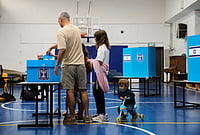
More than 31% of eligible voters had cast ballots by noon in Israel’s Knesset election, the highest midday turnout recorded since 1977
Yashar reported missing or damaged ballot slips, while police arrested three people on suspicion of planning to bribe voters to support the Arab-led Ra’am party
The Central Elections Committee said it had found no evidence of systematic sabotage, as separate allegations over voter tracking and polling-station procedures remained under scrutiny
Israel’s election authorities faced complaints about missing ballot slips, alleged voter tracking and suspected vote-buying on Tuesday as Israelis turned out in record numbers for the country’s 26th Knesset election. The Central Elections Committee said it had found no indication of systematic attempts to sabotage voting and was addressing individual incidents.
More than 31% of eligible voters had cast their ballots by noon, representing over 2.3 million people and the highest midday turnout recorded since 1977, according to Central Elections Committee. The high participation came as Prime Minister Benjamin Netanyahu faced a closely contested election, with voters weighing his leadership after three years of war following the Hamas-led attacks of October 7, 2023.
The complaints have raised questions about election-day safeguards, but the allegations remain distinct from evidence of widespread electoral fraud. Reports of missing ballot slips concern voting materials inside polling booths; they do not, by themselves, establish that votes were removed from the count or that the results were manipulated.


What Are The Ballot Complaints?
Gadi Eisenkot’s Yashar party filed a complaint with the Central Elections Committee, alleging that its ballot slips had been found missing, damaged or turned over in voting booths. The party cited nine incidents across the country and described them as evidence of a possible “systematic and deliberate” attempt to sabotage voting, according to AP.
Yashar called for missing slips to be replenished immediately and for polling stations to be inspected more frequently. The committee, however, said it had found no indication of systematic sabotage and was responding to individual complaints as they were brought to its attention.
The distinction is important. A ballot slip that is missing from a booth can prevent or inconvenience a voter seeking to support a particular party, but the discovery of such a problem does not establish whether it was deliberate, coordinated or capable of altering the election result. Those questions would require evidence beyond the existence of individual complaints.
There were also reports of shortages of Arabic-language ballot slips at some polling places. Ra’am leader Mansour Abbas urged supporters to vote despite unforeseen difficulties.
Separately, local media reports citing party activists suggested that campaign stands belonging to the Charedi Public party had been damaged outside several polling stations in Bnei Brak, Beit Shemesh and Beitar Illit. The party said a complaint had been filed with the election committee and police. The report did not establish a connection between the damaged stands and the complaints over ballot slips.

What Is The Vote-Buying Investigation?
Police said three people had been arrested overnight on suspicion of planning to bribe voters to support the Arab-led Ra’am party, as per AP. The arrests concerned suspected vote-buying and should not be treated as evidence of a wider operation to manipulate the election.
Abbas criticised the arrests, describing them as unjustified and an attempt to influence the election result. Police denied seeking to interfere with the vote.
The allegations are particularly sensitive because they involve a party led by Abbas, whose participation in a governing coalition could become relevant in a tightly contested election. Ra’am became the first Arab-led party to join an Israeli governing coalition in 2021, and its position could again matter in post-election negotiations.
Israel Democracy Institute’s election-day guidance says threats, coercion and promises of benefits linked to voting for a particular party—or to voting or abstaining—are prohibited. The arrests remain a matter for investigation; suspicion of an offence is not proof that it occurred.
Why Is Voter Tracking Disputed?
A separate controversy concerns allegations that Likud representatives were using a smartphone application to monitor which voters had arrived at polling stations and relay the information to party headquarters.
Naftali Bennett’s B’Yachad party accused Likud representatives of illegally tracking voters and filed a complaint, local media reported. The Central Elections Committee initially said it had received no reports substantiating the claim. It acknowledged one isolated incident involving photography at a polling station, where the official involved stopped taking pictures after the rules were explained.
B’Yachad subsequently said it had received further reports from representatives on the ground and filed another complaint. The committee’s initial response and the party’s later allegations remain separate developments; the additional claims had not established that the alleged tracking was widespread.
The dispute follows a September 17 ruling by Israel’s High Court of Justice barring party representatives from reporting in real time which identifiable voters had cast their ballots. The ruling overturned an earlier committee decision that would have permitted limited reporting. It left parties free to contact voters and encourage turnout, but restricted the transmission of information about individual voting participation.
The issue differs from the ballot-slip complaints. The tracking allegations concern voter privacy and the rules governing party representatives, while missing or damaged slips concern the availability and condition of voting materials in polling booths.

What Can Voters Do If A Slip Is Missing?
Israel Democracy Institute’s election-day guide sets out a procedure for voters who cannot find the ballot slip for their preferred party. They should notify the polling-station committee so that the missing slips can be replenished.
Voters can also use a blank white ballot slip, which should be available behind the voting screen, and write the party’s identifying letters—or its letters and name—in blue ink. If completed in accordance with the legal requirements, the handwritten slip counts as a valid vote.
The procedure provides a remedy for shortages at individual stations. It does not settle the separate question of why particular slips may have been missing or whether any reported incident involved deliberate interference.
The scale of the election also means that individual complaints must be assessed against the procedures in place across polling stations. The committee had announced arrangements for approximately 450 million printed ballot slips for around 7.3 million eligible voters, with voting materials distributed to 12,018 polling stations. The national supply does not rule out local shortages or misplaced slips, but neither does a local shortage demonstrate a coordinated attempt to influence the result.
What Does The Turnout Indicate?
The turnout figures point to a strong early pace, although they do not establish what the final participation rate will be. Reuters reported that 16.7% of eligible voters had voted in the first three hours, the fastest start since 1981. By noon, participation had exceeded 31%, the highest midday level since 1977.
The election is the first since the October 7, 2023, attacks and the wars that followed in Gaza, Lebanon and Iran. Netanyahu’s political future is at stake, with former military chief Eisenkot leading the main opposition challenge. A high turnout may affect the contest, but its political impact will depend on how votes are distributed among the parties and which alliances can command a majority in the Knesset.
The final outcome is not yet known. The Central Elections Committee’s timetable lists November 4 as the deadline for publishing the final official results.
For now, the committee’s position is that it has found no indication of systematic ballot sabotage. Complaints about missing slips, allegations of voter tracking and the suspected vote-buying case warrant separate scrutiny, but none should be presented as proof of coordinated election fraud before the evidence is established. The distinction between reported irregularities and verified interference will remain central as the count proceeds and any formal challenges are considered.