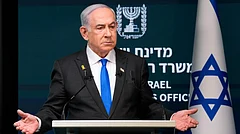
Netanyahu’s bloc won 53 seats, falling short of the 61 needed to form a government
Likud emerged as the largest single party with 27 seats in the 120-member Knesset
Arab-led parties secured 19 seats, giving them potential leverage in coalition talks
Israel’s election has produced no clear winner, with Prime Minister Benjamin Netanyahu’s bloc ending on 53 seats and the opposition on 48, while Arab parties took 19 seats in the 120-member Knesset. Neither side crossed the 61-seat mark needed to form a government, leaving coalition talks wide open. Voting in the Israeli election has concluded, with 100% of votes counted.
Likud finished first with 27 seats. Yashar followed on 21, while B’Yachad won 12 and the Joint List 11. The Democrats and Ra’am took eight seats each, United Torah Judaism, Yisrael Beytenu and Otzma won seven each, and the Religious Zionists and Shas secured six seats apiece.
The final count, released early Friday, showed no straightforward path to government formation. That has put Arab-led parties in a potentially decisive position and raised the prospect of hard bargaining between blocs that fought the election on sharply opposing lines.
Counting And Certification
Israel’s Central Elections Committee completed the counting of special ballots, known as double envelopes, on Thursday. The committee said it would release the final official results later.
The exercise covered 12,644 polling stations. A total of 5,589,836 votes were recorded, including 5,564,764 valid votes and 25,072 invalid votes, according to Ynet.
The results still need formal certification and must then be submitted to President Isaac Herzog. Israeli law requires that certification be completed by November 4.


Fraud Claims And Probe
Netanyahu alleged on Thursday, without offering evidence, that the strong performance of Arab parties was driven in part by voter fraud. Arab leaders rejected the accusation and accused him of incitement.
Likud sharpened the charge in a public statement. “The elections in Israel have been stolen!” Likud said. The party also alleged that foreign interference was “aimed at facilitating a foreign takeover of the Knesset, the Islamization of Israel and toppling of the right wing government.”
Israeli media reported that members of Netanyahu’s party had accused Qatar of involvement. Qatar denied that allegation, calling it “ridiculous and dangerous.”
The claims gained further attention after Supreme Court Justice Noam Sohlberg, who heads Israel’s election committee, said “serious suspicions” of foreign interference had been brought before him. He asked the Shin Bet security agency to investigate but said he could not verify the claims.
The election committee said the probe drew on classified intelligence and cautioned against “unfounded” reports. It added that the inquiry would not change the final outcome or single out any community.
The Shin Bet sought to narrow the scope of the matter. It said its investigation was not meant to “cast aspersions” on an entire section of the population that “exercised its right to vote in a democratic and lawful manner.”
The election committee issued its own rebuttal. It stated that “allegations of systematic violations of electoral integrity are baseless.”
Coalition Math Ahead
Netanyahu’s camp finished with 53 seats in the Knesset, while Gadi Eisenkot’s bloc took 48. The other 19 seats went to two Arab-led parties, putting them in a position to influence who forms the next government.
That arithmetic has left Israel’s parties with awkward options. Some Jewish opposition parties may now have to decide whether to work with Arab-led parties or join Netanyahu despite campaigning against him. A government needs 61 seats to control the Knesset and Netanyahu remains prime minister while coalition talks continue.
Eisenkot has not ruled out working with Arab-led parties. That path could give him the numbers to challenge Netanyahu in parliament. He accused Likud of trying to discredit the result. “They are doing this because they lost,” he said. He also brushed aside the foreign interference charge, saying: “I welcome the fact that Netanyahu is finally condemning Qatari involvement in the State of Israel.” Netanyahu has said it would be treasonous for Eisenkot to join forces with Arab parties. His camp’s challenge to the result appeared aimed at blocking a possible deal between Eisenkot’s rivals and Arab-led parties.
Ahmad Tibi, who is second on the Arab-led Joint List, said the opposition had contacted him about replacing the Knesset speaker. He said his party would support the opposition’s candidate.
Arab-led parties do not have to enter government to matter. Backing from outside the coalition could still help the opposition choose a new speaker, control the parliamentary agenda and push through laws before a cabinet is in place.
The option has a clear precedent. No Arab party had entered an Israeli coalition before 2021, and that government survived only briefly.
Political Fallout
The campaign rhetoric has spilled into the aftermath.
Ahead of the vote, Netanyahu and Likud cast Arab-led parties as a danger to Israel. Critics said the effort was meant to sideline Arab citizens, who are of Palestinian descent and make up about 20% of the country’s population.
That line of attack, along with opposition to Netanyahu and his far-right government, drove a sharp rise in Arab voter turnout. It also set the stage for the dispute now surrounding the result.
Yair Golan, head of the Democrats party, accused Netanyahu of “attempting to undermine the election results through an ugly delegitimization campaign directed against the will of the public — and against the Arab public in particular.”
The Joint List went further. “Netanyahu is working to steal the election,” the Arab-led party said.
Herzog described the moment as "a sensitive moment" and called for a full probe. He also warned that "we must not tarnish an entire community that sought to exercise its right to vote and take an active part in democracy."
If coalition talks collapse, Israel may go back to the polls early next year. Herzog and Eisenkot have both said they want to avoid that result. A Netanyahu defeat could also bring fresh scrutiny of corruption allegations and the security lapses tied to the Hamas-led October 7, 2023, attack.