Israel’s opposition bloc has 48 seats, while the Joint List and Ra’am hold a combined 19 in the 120-member Knesset
Their backing could give Gadi Eisenkot’s camp 67 seats, but cooperation remains complicated by disagreements over Arab-party support and participation
President Isaac Herzog’s consultations on Wednesday will begin the formal process of identifying a candidate to form Israel’s next government
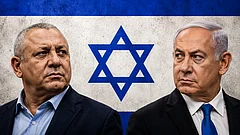
Israel’s opposition parties are coordinating around Gadi Eisenkot as they seek to replace Prime Minister Benjamin Netanyahu, with the two Arab-led parliamentary lists emerging as potential kingmakers after the October 27 election. A meeting between opposition leaders and separate discussions with Joint List representatives on Tuesday have brought the possibility of an Arab-backed government into focus.
The seat arithmetic offers a possible route to power. Netanyahu’s bloc has 53 seats, while the Jewish-led opposition has 48. The Joint List and Ra’am have 19 seats between them. If all 19 support Eisenkot, the opposition could command 67 seats in the 120-member Knesset, comfortably above the 61 required for a majority.
The Arab parties have not completed their formal recommendation process, and some opposition partners oppose relying on their support. The negotiations will test whether parliamentary cooperation can bridge differences over Israel’s identity, security policy and Palestinian rights.
Why Have Arab Parties Become Kingmakers?
The election left neither of the main political groupings with enough seats to form a government independently. Likud emerged with 27 seats, while Eisenkot’s Yashar won 21. Naftali Bennett’s Together secured 12, the Democrats led by Yair Golan eight, and Avigdor Lieberman’s Yisrael Beiteinu seven.



The remaining seats include 11 for the Joint List and eight for Ra’am, led by Mansour Abbas. Together, the two Arab-led lists hold 19 seats.
Their support could provide Eisenkot with a parliamentary majority without requiring either party to join his Cabinet. This distinction matters: recommending a candidate to President Isaac Herzog, supporting a minority government from outside and entering a governing coalition are three different political decisions.

What Is Happening In The Coalition Talks?
The opposition’s efforts to coordinate began taking shape on Tuesday. Israel’s public broadcaster reported that leaders of the change bloc met for the first time since the election, with Yair Lapid saying the parties needed to form a government.
Yair Golan also met representatives of the Joint List. He said the discussions concerned the steps required to replace the government. Israeli broadcasters separately reported disagreements within the opposition over whether Balad, a component of the Joint List, should be included in possible cooperation.
The next formal step begins on Wednesday, when Herzog is scheduled to consult representatives of all factions elected to the 26th Knesset. The President’s Office said the consultations would begin at 5 pm, with the President hearing each faction’s recommendations before deciding which member of the Knesset should be tasked with forming a government.
Under Israel’s Basic Law, he Government, the designated lawmaker gets 28 days to assemble a government. The President can grant an extension of up to 14 additional days. The proposed government must then secure the Knesset’s confidence.
The consultations will therefore establish which candidates have parliamentary backing, but they will not themselves produce a coalition agreement.
Why Are Arab Parties Willing To Consider Eisenkot?
The possibility of cooperation reflects political interests rather than a complete ideological alignment.
Arab-led parliamentary groups have repeatedly raised concerns about organised crime and violence in Arab communities, public-sector representation and development funding. In March, Hadash-Ta'al and Ra’am jointly submitted a no-confidence motion accusing the government of abandoning Arab society amid organised crime. In May, the two groups raised concerns over the integration of Arab citizens into decision-making positions in public institutions and government companies.
Budgetary issues are also likely to feature in negotiations. In June, the Knesset discussed a proposed diversion of approximately NIS 1.5 billion from the five-year development plan for Arab society towards enforcement mechanisms. Ahmad Tibi of Hadash-Ta'al criticised the proposal, arguing that it would affect civilian services and young people.
For these parties, supporting a government that replaces Netanyahu could create an opportunity to influence such policies. Ra'am also has a precedent for participating in a Jewish-led governing arrangement: it joined the Bennett-Lapid coalition in 2021, which remained in office until December 2022.
The Joint List has traditionally been more cautious about joining governing coalitions. Its political priorities, particularly on Palestinian rights and the nature of the Israeli state, also differ from Ra'am’s more pragmatic approach to parliamentary participation.

Why Has Eisenkot Ruled Out Netanyahu?
Eisenkot has publicly ruled out serving under Netanyahu, including through a rotation arrangement in which the two politicians would share the premiership. In an October 21 interview with Israeli radio station, he said he would resign if he broke that commitment.
His opposition is linked partly to accountability for the October 7, 2023 attack and the conduct of the subsequent war. Yashar!’s official platform calls for a State Commission of Inquiry to examine the attack, the decade preceding it and the government's handling of the war.
The party also proposes institutional changes, including a two-term limit for prime ministers, an independent judiciary, stronger parliamentary oversight and action against political patronage.
However, Eisenkot is not leading a conventional left-wing alternative to Likud. Yashar, describes its vision as a strong, secure, Jewish and democratic state. Its platform calls for strengthening the Israel Defence Forces, preserving a solid Jewish majority and introducing national service for all citizens, including Arab and ultra-Orthodox communities.
Its differences with Netanyahu centre more on leadership, accountability, institutional reform and aspects of governance than on a rejection of Israel's security framework.
Where Do The Ideological Differences Become Obstacles?
The biggest difficulty is that the parties considering cooperation do not share the same positions on Israel's national identity, military policy and the Palestinian question.
Yashar supports a Jewish and democratic state, a stronger military and compulsory national service. The Joint List, particularly its Hadash component, emphasises equality for Arab citizens, Palestinian national rights and opposition to discrimination. These positions create difficult questions for any agreement involving the parties.
Ra'am has shown greater willingness to negotiate within Israel's existing political system. Its participation in the 2021 coalition demonstrates that it can support a government led by Jewish parties without sharing their entire political programme. But that precedent does not guarantee agreement on the conditions Eisenkot may set.
There are also divisions within the Jewish-led opposition. Lieberman has agreed to recommend Eisenkot to Herzog but has ruled out joining a government that includes Arab parties or depends on their parliamentary support. This creates a contradiction: his recommendation could help Eisenkot receive the mandate, while his refusal to support an Arab-backed government could complicate the effort to secure confidence in the Knesset.
The reported disagreement over Balad adds another obstacle. Even if the Joint List is willing to cooperate, the other opposition parties may not accept every component of it. The 19 Arab seats cannot therefore be treated as a single, guaranteed bloc of support.

What Happens Next?
Herzog’s consultations on Wednesday will provide the first formal indication of how the parties intend to position themselves. The two Arab-led lists will have to decide whether to recommend Eisenkot, whether to support a government led by him from outside the coalition or whether to seek participation in the Cabinet.
Eisenkot, meanwhile, must reconcile the demands of potential Arab partners with the positions of opposition allies who oppose relying on their votes. Netanyahu has also expressed interest in a broader government, but insists on leading it and has ruled out an arrangement dependent on Arab-party support.
The election has given the Arab parties considerable parliamentary leverage, but 67 seats on paper do not amount to a functioning government. Eisenkot’s challenge is to turn that arithmetic into an agreement without losing the Jewish-led opposition partners whose support he also needs.