- K.S. Sudershan The aging RSS chief and those close to him remain active in trying to contain Modi
- VasundharaRaje The Rajasthan CM resents the special treatment given to her Gujarat counterpart
- Rajnath Singh Having failed to curb Modi, he's out to please him
- Sushma Swaraj Has problems with Modi but is now making overtures. Wants to be on the right side of the fence.
***
- Mohan Rao Bhagwat The RSS chief-in-waiting believes the parivar must learn to work with Modi
- Arun Jaitley The urbane lawyer has for the past several years been the strongest proponent of Modi
- Shivraj Chauhan The mild Madhya Pradesh CM truly aspires to be like Modi
- Venkaiah Naidu The former BJP president and Advani loyalist has a high comfort level with Modi
***
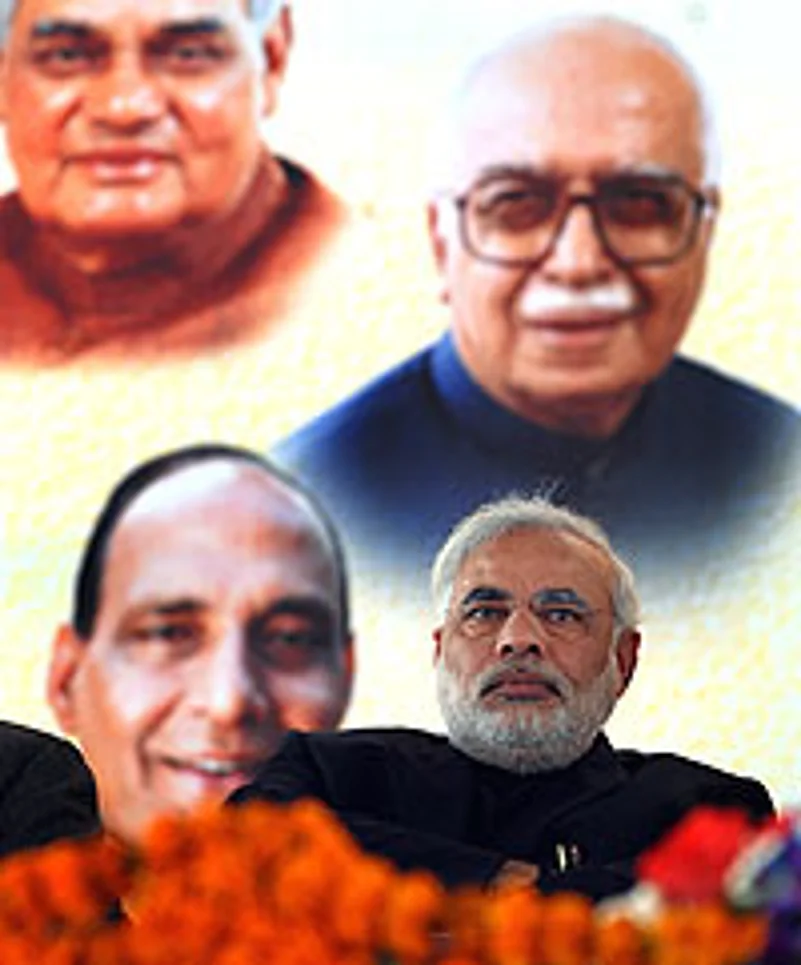

| Kings and commoners: Narendra Modi at the recent BJP conclave in Delhi |
Naturally, then, all the thrills and spills of the meet centred on Modi. He was mobbed by party members wherever he went, journalists accosted him at every chance and listened to wisecracks about the "secular media". Most leaders who spoke during the two-day session also made it a point to praise Modi, even some past rivals rolling over and making ingratiating noises in his direction. One senior leader even took him aside during the closed-door national executive that preceded the council meet to offer a long explanation about "lies being floated by the media".
Advani, to his credit, handled the Modi mania quite deftly. During his hour-long concluding address, he suddenly digressed on to the subject of the Gujarat chief minister: "Someone said to me that Modi has become bigger than the party. I said to them that in a family if a youngster does better than the veterans it is a matter of great pride for the whole family. It's not something to try and create trouble about." Advani and Modi have had a good working relationship for years. Advani's Lok Sabha seat is Gandhinagar in Gujarat and he will also want Modi's backing during the next election campaign.
Sources close to Modi say he would like to continue in Gujarat till the end of 2010, when the state celebrates 50 years of its existence. It's the sort of occasion Modi would want to play to the hilt, talking of "Gujarati asmita" and merging the state with his own persona, the message presumably carried by thousands of men wearing masks of the Man. But he is also testing the waters for a final shift to the Centre. The Pongal lunch with AIADMK chief Jayalalitha was one such event. In early March, Modi will address a major anti-terrorism rally in Gorakhpur, as part of another BJP attempt to revive its sinking fortunes in Uttar Pradesh.
Any doubts about his national ambitions were put to rest by the posturing in Delhi. On day one of the national council, full-page advertisements appeared in every Delhi daily about the many achievements of Modi in Gujarat. No other BJP CM, not even those from the three poll-bound states of Rajasthan, Madhya Pradesh and Chhattisgarh, glorified themselves in this manner. While all the other CMs spoke about the situation in their states, Modi did not talk about Gujarat, since "the achievements there are well-known". He gave a national speech attacking the UPA's "communal budgeting" (which he claimed would lead to mass conversions), the prime minister's handling of terrorism and the dynastic politics of the Congress. He also appeared a trifle patronising of the lesser CMs as he praised each one of them.
Not everyone was in the mood to grovel though. Rajasthan chief minister Vasundhararaje had earlier begun her speech with "Hum kisi se kum nahin... (We are not lesser to anyone else)." She had earlier told Outlook: "When we are told to repeat the Gujarat model in our states, I say we too will overcome anti-incumbency...but every state is different." Incidentally, it was BJP president Rajnath Singh who had asked his chief ministers to emulate Modi and the Gujarat model. Clearly, Rajnath's very public way of signalling that he had surrendered without a fight before the looming might of Modi. His uneasy relations with Modi are well recorded in recent BJP history.
Modi's current strategy appears to be to offer a gloved hand of friendship to all the various personalities who constitute the BJP. But it's an iron fist he's holding out. He fascinates his own party and the entire political class because he has survived and emerged powerful without being in the least apologetic for the Gujarat riots or the plight of Muslims in his state. In contrast, Advani has travelled down a more conventional path. Yes, he did lead the movement for the establishment of a Ram temple at Ayodhya but he also described the Babri demolition as "the saddest day of my life".
The Modi persona has much more to it than being the ultimate minority baiter. He's also delivered some sharp kicks on the shin to his own partymen as well as the larger Sangh parivar. Yet BJP members from across the country say there is a great demand for Modi, particularly in urban centres. Says former Union minister Ananth Kumar: "Whenever Karnataka has elections, Modi will be a very popular campaigner."
The BJP leaders who back Project Modi argue that middle India and the business community see the Gujarat CM as a man who can deliver and help generate wealth. "The urban class believe Modi is someone who does not let anything stand in the way of progress," says a senior leader. In other words, the ultimate leader for a right-wing party—a no-nonsense autocrat who does not allow minor matters like Muslims and dispossessed people derail the mighty march of development.
Add to this the fact that Modi is an autocrat who has turned democracy on its head to make it work for him in Gujarat. The question now is: can a man who does everything on his own terms become a national leader in a nation built on compromise?