Pralhad Joshi takes over the Education Ministry after Dharmendra Pradhan's resignation amid protests over the NEET-UG controversy.
His immediate challenge will be to restore credibility in the National Testing Agency and India's high-stakes examination system.
Joshi also inherits the unfinished implementation of NEP 2020, curriculum reforms and a broader higher education reform agenda.
Pralhad Joshi has been assigned charge of the Union Education Ministry after Dharmendra Pradhan resigned from the Union Council of Ministers amid mounting pressure over the NEET-UG controversy and nationwide student protests.
Inducted as part of the latest Cabinet reshuffle, Joshi succeeds Dharmendra Pradhan, bringing to a close his nearly five-year tenure at the Ministry of Education. Joshi, who was serving as Union Minister for Consumer Affairs, Food and Public Distribution and New and Renewable Energy, now takes charge of a ministry facing one of its biggest challenges in recent years.
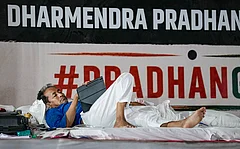
Pradhan's resignation came after a prolonged protest over irregularities in the NEET-UG examination and growing demands for accountability. In his resignation letter, Pradhan said he had stepped down with the aim of protecting students' futures, and national unity.
Joshi now takes charge of a ministry facing one of its biggest credibility challenges in recent years.
Exam Trust
The immediate challenge before Joshi will be restoring confidence in India's examination system.
The NEET-UG controversy has placed the National Testing Agency under intense scrutiny and triggered a wider government overhaul. The Centre has announced changes to the agency's functioning, including tighter supervision, a review of outsourcing practices and stronger technological safeguards.


More than 47 officials have also been removed as part of the NTA overhaul, according to reports. The government has also decided that NEET-UG will move to computer-based testing from next year.
But the challenge goes beyond introducing new technology.
For millions of students and their families, the central question is whether national examinations are secure, transparent and fairly administered. Joshi will have to ensure that the changes underway within the NTA lead to lasting institutional reform rather than a temporary response to the latest crisis.
NTA Overhaul
The new minister will inherit the task of completing the restructuring of the NTA.
The agency conducts some of India's most important entrance examinations, including NEET-UG, JEE Main and CUET. In 2026 alone, its four largest entrance examinations were estimated to have involved around 55 lakh candidates.
The NEET-UG crisis has led to a push for tighter control over examination processes, greater scrutiny of outsourced functions and improved technological safeguards. The move towards computer-based testing is also expected to reduce some of the vulnerabilities associated with conventional paper-based examinations.
But the bigger test will be accountability.
Joshi will have to oversee whether the new system can prevent leaks, identify wrongdoing quickly and ensure that students are not left to bear the cost of institutional failures.
NEP 2020
Alongside the examination crisis, Joshi inherits the unfinished implementation of the National Education Policy 2020.
The policy has already triggered major changes in school and higher education, including the rollout of a new National Curriculum Framework and new NCERT textbooks aligned with the NEP.
The government has also pushed competency-based learning and assessment reforms, multilingual education, Indian knowledge systems and greater use of digital learning platforms such as DIKSHA and SWAYAM.
The next phase will require these reforms to move from policy announcements to consistent implementation across schools, colleges and universities.
Higher Education
Joshi will also oversee the next stage of higher education reforms.
The four-year undergraduate programme, Academic Bank of Credits and multiple entry and exit provisions have been introduced as part of the broader effort to make higher education more flexible.
The government has also expanded institutions including IITs, IIMs and central universities, while pushing research, innovation and the internationalisation of Indian higher education.
The challenge now is implementation at scale.
The new minister will have to balance the government's long-term reform agenda with the immediate political pressure created by the examination crisis.
Bureaucratic Reset
The change in ministerial leadership comes alongside a bureaucratic reshuffle in the Education Ministry.
Higher Education Secretary Vineet Joshi was shifted to the Ministry of Panchayati Raj, while Naresh Pal Gangwar was appointed the new Higher Education Secretary. TK Anil Kumar took charge as Secretary of the Department of School Education and Literacy.
Gangwar, a 1994-batch Rajasthan cadre IAS officer, was previously Secretary of the Department of Animal Husbandry and Dairying. Anil Kumar, a 1995-batch Karnataka cadre IAS officer, was earlier Additional Secretary in the Ministry of Rural Development.
The administrative changes have come as the government seeks to strengthen the functioning of the Education Ministry and the NTA following repeated examination controversies.
Pradhan's Legacy
Pradhan took charge as Union Education Minister in July 2021 after succeeding Ramesh Pokhriyal.
His tenure was defined by the implementation of NEP 2020, one of the most significant attempted overhauls of India's education system in decades.
The ministry rolled out the National Curriculum Framework and new NCERT textbooks, while promoting competency-based learning and assessment reforms.
The government also proposed holding Class 10 and Class 12 board examinations twice a year to reduce the pressure of a single high-stakes examination.
In higher education, the four-year undergraduate programme, Academic Bank of Credits and multiple entry and exit provisions were introduced at several institutions.
But the latter part of Pradhan's tenure was increasingly overshadowed by controversies over competitive examinations.
The Paper Leak Crisis
The NEET-UG controversy became the defining crisis of Pradhan's tenure.
Irregularities in the examination triggered protests, legal challenges and intense political criticism. The crisis placed the NTA under unprecedented scrutiny and led the Centre to announce a series of reforms.
The controversy later resurfaced in 2026 after irregularities were found in the NEET-UG examination held on May 3. The government cancelled the examination, handed the investigation to the CBI and announced a retest. NEET-UG is also set to move to computer-based testing from next year.
The crisis has also raised broader questions about India's examination ecosystem. Several national and state-level entrance and recruitment examinations have been cancelled, postponed or investigated over suspected leaks and irregularities.
The latest controversies have ensured that the new minister's first test will not be the announcement of another reform, but the delivery of a system that students believe is fair.
What Awaits Joshi
Pralhad Joshi takes charge of the Education Ministry at a moment when the government has already announced major reforms but public confidence remains under strain.
His immediate priorities will include strengthening the NTA, overseeing changes to the examination system and responding to the concerns of students and parents.
At the same time, he will have to continue the implementation of NEP 2020, complete curriculum reforms and steer the next phase of higher education changes.
The political challenge is clear: Joshi has inherited an education ministry where the credibility of the system itself has become the central issue.
The success of his tenure will therefore be judged not only by how many reforms are announced, but by whether students can once again enter an examination hall believing that the system will be secure, transparent and fair.