In Nayla village, about an hour’s drive from Jaipur, everyone knows Chelsea. Only, this Chelsea is no Clinton. Waif-thin, shy and quietly enjoying the perks of her unusual name, Chelsea Chaturvedi knows nothing about her celebrity namesake except that she’s the daughter of a US president who came calling in March 2000, days after she was born. Yet, ironically, this 10-year-old, who was Chetan Kumari before her zari craftsman father got carried away by the Clinton aura and decided to rename her Chelsea, keeps the memory of Bill Clinton’s visit to Nayla alive.
Not that the villagers need reminding, of course. Mohini Devi Gupta, a plainspeaking housewife, appears a tad tired, in fact, of recounting the tale. Yes, she had tied a rakhi on Clinton’s wrist; yes, she had performed the mandatory aarti-tika ritual; and yes, she had danced with the world’s most talked about leader. Then, she breaks into a laugh: “Wherever we went after that, people would identify Nayla as the place ‘Quintal saab’ visited. Nayla became world-famous! Not even for weddings do we do what we did for the president.”
Over half-a-century ago, residents of a nondescript hamlet called Laramada near Agra paved the way—literally so—for what was to become an enduring cliche of US presidential visits to India: a brief, colourful rural turn. As the planners of Dwight D. Eisenhower’s 1959 visit to India were to discover, touching down here was the perfect way of seeming to connect with the heart of a primarily agrarian nation, and the perfect photo-op besides.
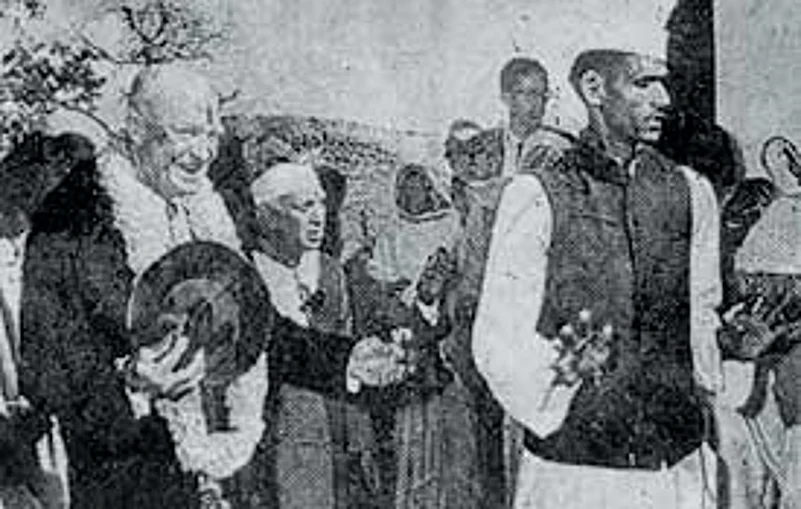

| Eisenhower and Nehru in Laramada, 1959 |


As we seek out Laramada, 51 years after Eisenhower visited, we can’t help wondering whether it even exists. A faded sign with the village’s name on it lays our doubts to rest. Meandering past that board is a brick lane, and as we’re soon going to be told, it is the very road Eisenhower walked on. Trivia flies fast and furious around Laramada as village elders, bound together by that peculiar glue of shared memory, rewind to that winter of 1959, when Eisenhower’s chopper noisily descended on their fields. “Eisenhower took the stage adjoining the panchayat ghar, all of which we constructed in eight days. Five bighas of crops were destroyed as people trampled on them, trying to get close to the president,” septuagenarian farmer Sahab Singh remembers. Mahavir Singh, a former pradhan who grew up hearing all about it, adds, “Our panchayat accepted the challenge of turning the village into a model one in two months. Villagers worked nights on end to create smooth pathways, running rollers over layer upon layer of mud. Our mud houses were caked with dung and whitewashed to make them look like pucca structures.” (Clearly, some things haven’t changed in 50 years.)
Laramada’s 90-year-old matriarch Barfi Devi’s cloudy eyes see further into the past than we think. As the wife of the village’s first headman, Karan Singh, she had hosted Eisenhower and then Prime Minister Jawaharlal Nehru, in her humble home. Now, surrounded by an expanding family of children and grandchildren, she peers at a laminated photograph of the visit that her son, Ramesh Chand, has brought down from a shelf. “Aisen-haavar!” she says, struggling with a failing memory and a breaking voice, and then produces an anecdote about how both the US president and Nehru encouraged her to remove her ghoonghat in their presence. “‘You are like our daughter’, they told me. I served them puris made of asli ghee. It was our custom to serve milk then—not tea—and they relished the meal.”
It’s not surprising that Laramada’s residents speak of the presidential visit as if it was only yesterday. Except for the occasional trill of mobile phones and a faint melody from Lafangey Parindey playing in a courtyard, there is little to remind them that five decades have passed since he came. Ramesh Chand underscores the point. “The only good that came out of the visit was that we got electricity soon after. From a hamlet of 1,500 people, Laramada is today a 5,500-strong village. But its progress has hardly kept pace,” he says standing on the stage that once hosted the village’s most famous visitor. The panchayat ghar too still stands, while the surrounding fields have been taken over by huts and cowsheds. The pond into which coloured water and ducks were released for Eisenhower’s visit is a cesspool today.

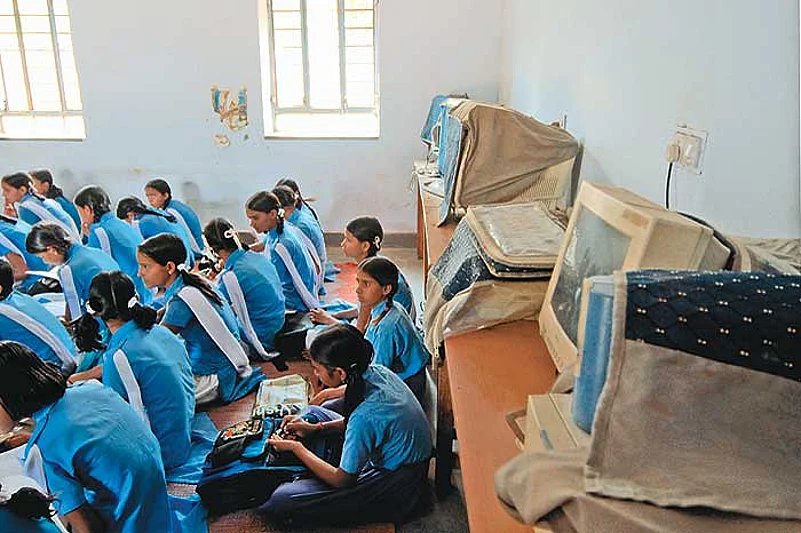
Nayla: Bill Clinton, above, dancing with the village women, Mar 2000; PCs gifted by him gather dust under their covers in the local girls’ school
In Nayla, too, the young sarpanch, Sankar Lal Sharma, seems struck by how brief that tantalising taste of fame was. The thriving milk cooperative, relocated here as the perfect showpiece for Clinton’s visit, moved away from the village four years ago; the new location was found to be logistically unsustainable. The computers Clinton gifted to the Rajakiya Balika Madhyamik Vidyalaya and the panchayat lie wrapped in dusty covers because instructors, tired of waiting for their salaries, stopped showing up. The school was upgraded to offer Classes IX and X as part of the Clinton facelift, but never went beyond. “Maybe it’ll take another vip visit for the plus-two course to begin,” quips a villager.

Carterpuri: Children rule the dusty lanes of Carterpuri. (Photograph by Tribhuvan Tiwari)

Jimmy Carter visiting Daulatpur-Nazirabad village in 1978
But one rural encounter with a US president, several hundred kilometres away in Haryana’s Daulatpur-Nasirabad village in 1978, did ensure a tiny piece of the country was never quite the same again. After Jimmy Carter dropped in to see where his mother, Lillian, had worked as a US Peace Corps volunteer, Daulatpur-Nasirabad got a new name—Carterpuri—and along with it a new identity: the “birthplace” of the peanut-farmer-turned-US-president. Three decades later, the quaint, if far-fetched, notion that Georgia-born Carter was a son of the Haryanvi soil has clearly taken root. “Hamare gaon ke aadmi America ke rashtrapati bane,” smiles 70-year-old Kartar Singh, retired branch postmaster of Carterpuri, fishing out a newspaper clipping from a small local paper which actually states this. His treasure-trove of Carter memorabilia also has three photographs of the visit and thank-you letters from the White House.
Adds Ram Kishore Yadav, who was all of six when First Lady Rosalynn Carter—fetchingly dressed in a salwar suit—lifted him up in her arms, “We have a familial connection with him. It’s not political.” With some authority, he informs us that his photograph with Mrs Carter still hangs in the White House. And no, he doesn’t have a copy.
Walking around the village, we learn that the jaildar’s haveli where Carter’s mother is believed to have stayed (and given birth to her son, so goes the lore) is no more, but the memories around it are alive and well. Fact and fiction merge as the stories pour out, just like in Laramada, where someone remembers a larger-than-life “7-and-a-half feet tall” Eisenhower hitting his head on a doorpost, while others remember how seven achkan sets, complete with artificial flowers in their buttonholes a la Nehru, arrived for the headman and his brother after the vips left.
Doubtless, in Nayla too, the Clinton stories will be burnished afresh with every decade. The vips may have come, namasted, conquered and zipped out in their superplanes, but for the overwhelmed villages they left behind, Elvis won’t ever leave the building. And, oh yes, Laramada is abuzz with rumours of a surprise visit from Obamaji.