- The Congress There have been strong demands from within the party to ban the Bajrang Dal after the violence in Orissa. But while the Union cabinet met on October 9 and discussed the issue, there has been no ban so far.
- UPA Allies Wants Centre to move against both Orissa government and the Sangh outfit. Laloo, Ram Vilas Paswan among chief advocates for action. They expected decisive cabinet action.
- The Church Leaders express disappointment with Centre's response; expected Sonia Gandhi-led Congress to be more proactive. Say Christians don't count as they're not a sizable votebank.
- The BJP Has dared the Centre to ban the Bajrang Dal and impose President's rule in Orissa. Some leaders in private admit that the Dal needs to be reined in.
***
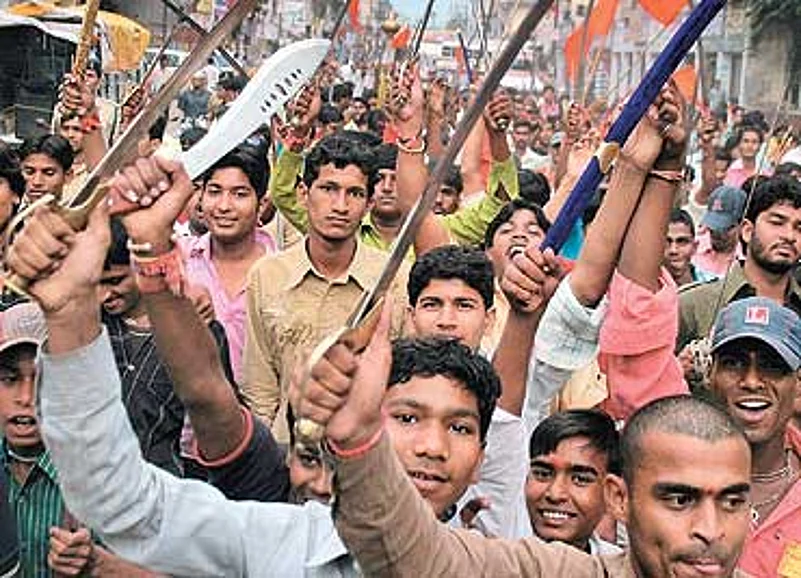

On Dussehra eve, the Union cabinet at a two-part meeting—the focus of which was the economy—appeared sharply divided over the imposition of President's rule in Orissa, even as it discussed a proposal to ban the Bajrang Dal and the VHP. The demand for central rule came from allies Ram Vilas Paswan and Laloo Prasad Yadav, and was endorsed by the Congress's A.R. Antulay and Jaipal Reddy. However, the DMK's T.R. Baalu, the PMK's Anbumani Ramadoss and the NCP's Praful Patel said they were, in principle, opposed to the use of Article 356 of the Constitution. It was also pointed out that it would be difficult to get a consensus on President's rule. It didn't matter, countered the proponents of central rule, if the government decision didn't get Parliament's approval (there's a lack of adequate majority in the Rajya Sabha), as a political point would have been made.
As far as the subject of the ban was concerned, Union home minister Shivraj Patil said "evidence" was still being collected against the Bajrang Dal. The cabinet was also constrained by the fact that senior members such as Pranab Mukherjee, Sharad Pawar, Kapil Sibal and Priyaranjan Das Munshi were all absent. All this, though, hasn't eased the pressure on the Congress to impose a ban on the Dal and VHP, say sources.
Which is why a meeting of the National Integration Council (NIC) has been called on October 13, in the hope that it might be able to build a political consensus on Orissa, as all state governments will be represented at the NIC. "We need to take everyone into confidence," says Congress general secretary Digvijay Singh. Clearly, the government has decided it cannot, on its own, deal with the question of attacks on Christians in Orissa, Karnataka and parts of Madhya Pradesh—states that are ruled either by the BJP or its allies.
So far, of course, the Congress had been divided on what action it should take in Orissa. The fact that the perpetrators of the atrocities are from the Bajrang Dal, a sister organisation of its principal political rival, the BJP, while the victims are Christians—a minority community to which Congress president Sonia Gandhi belongs—appears to be the overriding concern among a section in the Congress. This is even though senior party leaders including Digvijay Singh, cabinet minister Kapil Sibal and former UPCC chief Salman Khursheed have publicly expressed the need for strong action. They say all options—from an outright ban to the use of the Unlawful Activities Act—should be thought of with regard to the Bajrang Dal.
"This form of 'terrorism'," Sibal said, "should equally attract the provisions of the Unlawful Activities Act. It needs to be dealt with as effectively as other forms of terrorism. It is not surprising that the communal violence was unleashed in states ruled by the BJP and its allies only after we won the trust motion. I believe this is to polarise communities for electoral gains."
For four successive cabinet meetings, both inside and on the sidelines, members including Das Munshi, Sibal, Oscar Fernandes, Vayalar Ravi and Selja, apart from allies such as Laloo and Paswan, have expressed their "anguish" at what is happening in Orissa.
Within the party organisation, there are those who support a ban on the Bajrang Dal, as it would send out a strong message that no organisation—regardless of the denomination it represents—has the right to take the law into its own hands to terrorise members of another denomination. But there are also the conservatives in the Congress who feel that this would trigger a Hindu backlash, a view supported by the Union home ministry.




Standing guard: Security personnel at a relief camp at Tikabali in Distt Kandhamal
Simultaneously, as Kandhamal continued to burn, the Centre began to actively consider imposing President's rule in Orissa since the constitutional machinery there had clearly collapsed, with the Naveen Patnaik government watching as 5,000-odd homes of Christian tribals were destroyed, close to 200 churches vandalised and more than 25,000 people forced to flee to refugee camps. Of course, the use of Article 356 is an unpopular move that requires a two-thirds majority in Parliament.
On the other hand, after the state-sponsored carnage in Gujarat in 2002 (when the idea of using Article 365 was toyed with but not followed up as the BJP-led nda government did not wish to act against Narendra Modi), there has not been as serious a case as Orissa. After all, if the historic Bommai judgement of March 1994 put curbs on the Centre's right to impose President's rule, it also upheld its right to use Article 356 against any state government that either pursued unsecular policies or an unsecular course of action, as that was contrary to the constitutional mandate.
Meanwhile, the BJP too is beginning to feel the heat, and questions are being raised about its fitness to rule as it continues to—even if obliquely—endorse the actions of the Dal. On October 8, at the instance of Chidanand Saraswati of the Paramarth Niketan, Rishikesh, BJP president L.K. Advani and senior party leader Sushma Swaraj met the Archbishop of Bhubaneshwar-Cuttack, Raphael Cheenath, and the Archbishop of Delhi, Vincent Concessao. While the meeting was clearly an effort by the BJP to look conciliatory, Raphael Cheenath told Outlook, "Sushma Swaraj said the murder of Swami Laxmanananda Saraswati had made the people 'emotional'. But I want to ask, 'emotional' for 45 days?" He said he was also offended by the repeated charge of "forced conversions" made by the BJP and other Sangh affiliates: "There are laws in at least five states against forced conversions—but can you cite a single case of a conviction, leave alone a charge? It is a case of giving a dog a bad name and hanging it."