In the overwhelming context of Nelson Mandela’s persona and achievements, one aspect of the South African struggle for freedom is relatively unknown: that there were many other significant heroes and heroines walking the long walk to freedom with him and before him. These men and women of high principles continue to be worshipped for being the leaders who led the country out of the oppression of apartheid.
Oliver Thambo was perhaps the most important of them all and a guide to the others. Walter Sisulu, whose family still participates in government, was another. Govan Mbeki, the father of Thabo Mbeki, a former president of South Africa, was less visible but a great mentor. There were others, like Ahmed Kathrada, a strong, silent comrade who shared the prison cell at Robben Island with Mandela. Kathrada, as a non-African, was allowed to wear trousers and eat from normal plates, while Mandela, of African race, had to wear shorts and eat from aluminium plates. The intimacy and support for each other that the two maintained in the face of such stinging discrimination is unbelievable. That fellow feeling is evident even today. As Mandela lay unwell in hospital in these last few weeks, Kathrada was one of the few visitors whom Mandela recognised.
In Durban, there was Ismail Meer, Mandela’s lawyer, and Meer’s wife Fatima, an equally important champion. She was not only a close friend of Mandela’s wife Winnie, she looked after their family while Mandela and Winnie were engaged in the anti-apartheid struggle. One must also mention Mac Maharaj, who secreted Mandela’s manuscript out of Robben Island. He is now spokesperson for the South African presidency. And Helen Suzman, a white woman, played a critical role in conveying messages from the prison.
One of the most significant mobilisers during the struggle was Archbishop Desmond Tutu. The Regina Munde church in Soweto became a space from which mobilisation of the oppressed took place. Tutu’s sermons gave courage and brought peace. It may be recalled that one of the most heinous assaults by the apartheid regime was a massacre in Soweto.



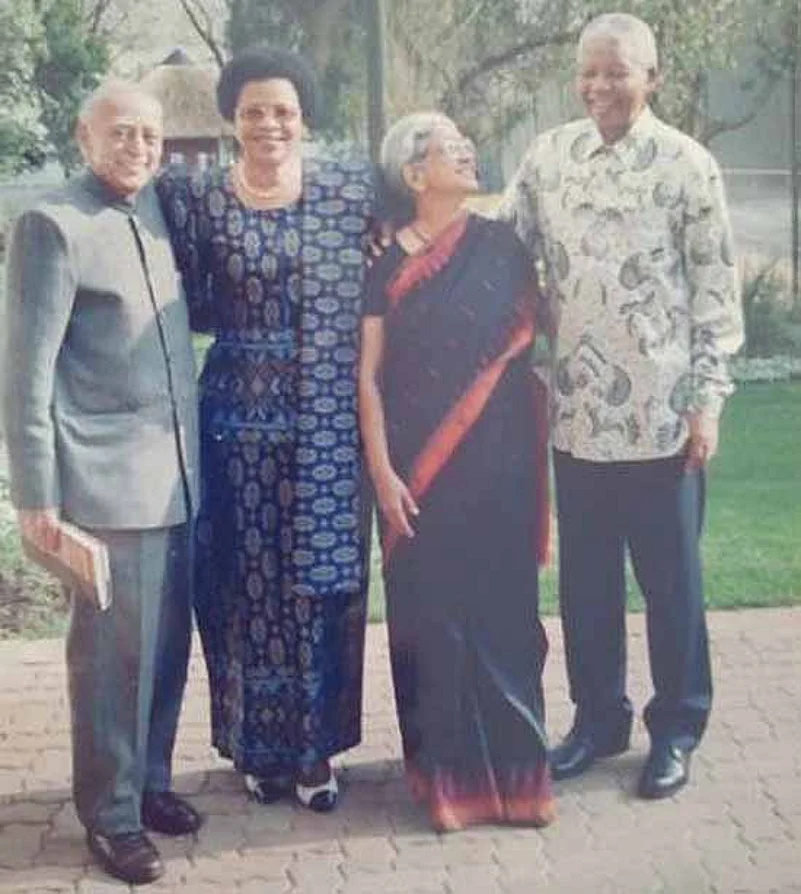
Across the spectrum of leaders, one could argue, Mandela was accepted as more suited to be the president. His ability to mastermind strategies, to negotiate and build solidarity among leaders, his clarity of mind—these made him the obvious choice. But except for Thambo, who had passed away, these men and women, leaders all, continued to be vivid and present when my husband Lakshmi Jain and I were in South Africa in 1997, the last year of Mandela’s presidency. My husband was India’s high commissioner to South Africa, and we had the joy and privilege of friendship and discussion with Mandela and these veterans of the anti-apartheid struggle. The conversations revealed not only the extraordinary viciousness of the regime, but also the stamina, the brilliance and the variety of the freedom fighters. It added to our respect for the people of a beautiful nation.
Our first exposure to the political process and the leaders was at the national conference of the African National Congress at Mafeking. This was the meeting at which the next ANC president was to be elected and confirmed, which, of course, would be the first step to bring in the next president of South Africa. Thabo Mbeki was to be christened the next president in Mafeking.
Mandela made a speech which is now famous for its quality in both describing the situation in South Africa as well as what the ANC should really aspire to achieve. In his stentorian voice, Mandela spoke more like an army commander than a politician. Every sentence was greeted with a huge response from the stadium, bustling with ANC cadres from across South Africa, dressed in colours representing the various provinces. “Amandla!” (meaning power), the slogan echoed across the stadium, and the response was an equally loud “Awethu!” (meaning “to us”).
One of the tense moments I’ll never forget is after Mandela finished his speech and handed over the office of the president of ANC to Thabo Mbeki. Thabo, different from Mandela in every way—short stature, clipped voice, no body language, severe looks—came to the mike and for a moment alarmed the audience by saying, “You can be sure I will not step into the shoes of Madiba (as Mandela is popularly known).” There was silence for a moment. Then he said, “Have you seen his shoes? They are the ugliest, dirtiest old shoes I’ve ever seen.” He got a big round of applause, and a huge smile from Mandela, who was standing next to him. Everyone has commented upon Mandela’s most famous feature—his smile, exuding warmth, the eyes crinkling at the corners as if he always wants to laugh and joke.
It is common knowledge that every leader loves his people. But one has to experience Mandela’s extraordinary warmth, his desire to include and embrace everyone. This is what makes him stand tall among leaders. And the love expressed by South Africans when his life was in danger in these few weeks is a response to that inclusive warmth.
Mandela has been often compared to Mahatma Gandhi. The real similarity between them lies in this extraordinary love they feel for their people. Mandela likes to mingle with his people, at ease shaking hands with them, embracing them, talking to them on the streets of Pretoria.
There is a site where people in South Africa gather after a funeral, especially for a leader. They are always held on Saturdays even if the person has died during the week or earlier. We often met Mandela and people like Walter Sisulu or Mrs Oliver Thambo, architects of South Africa’s freedom, at these funerals. If there was a large industrial exhibition as there was one in Johannesburg, Mandela would visit and walk through it with characteristic exuberance. The crowds would gather around him. Mandela is extremely informal. Here again comes the similarity with Gandhi—both totally at ease with common folk. Both are also different from their successors, not so much at ease with the aam aadmi.
At the ANC convention, we saw him from a distance. But our next meeting with him was at the presenting of credentials (as high commissioner). He welcomed us and could not resist saying straight to our face that he missed Gopal Gandhi, our predecessor. We took it in our stride because we could understand what it meant for him to have not only somebody as gentle and thoughtful as Gopal Gandhi but also Gandhiji’s grandson representing India in South Africa. But after the formal ceremony, in which he greatly appreciated Lakshmi’s speech, he said to me, “You are Graca’s only friend in South Africa.” Graca Machel and I had worked together in an eminent persons group of the UN dealing with children in armed conflict. We were invited to their wedding and into an inner room where the special guests and his family were present. Then came the time for us to leave South Africa. We were invited to have tea with Mandela and Graca in their home.
If we were to compare Gandhiji with Mandela, often a subject for discussion, I would say they both shared an ability to love and transmit that love to people. Great clarity of mind and the ability to reason out solutions to very complex challenges. It is the reasoning out of solutions and then carrying constituents with that solution that is another aspect of his similarity to Gandhi. Intuition, followed by intellectual strength, which is not exhibited but internalised in bringing out ideas and roadmaps.
Also the stamina to withstand assault and pain. The pain of conflict with Winnie Mandela, a true comrade, was something that would have crushed a less strong person. But he continued to stride across South Africa with his mission to rebuild her after decades of incarceration. Gandhi also put up with a great deal of personal pain—conflict with his son, loss of close friends, extraordinary differences with his freedom fighter colleagues—but had the grit to stick to the public agenda.
The contrast, of course, which could be more than a vein of humour, is that Gandhi was small in physical stature compared to Mandela whose stature reveals what he was —a chief and, as we all know, in the tribal system he was the headman of his tribe and therefore a chief even in that community. While he may be remembered for surviving 18 years in Robben Island, it may be recalled that there were others too, like his comrade Kathrada who also spent 18 years there.
So that was not really the major issue. The remarkableness lies in the years of incubation of thought and action, reflection which was then translated into the greatest freedom struggle in the world. Gandhiji incubated his ideas with fasts and then came out with strategies like collecting the fistful of salt on the beaches of Gujarat, an act like that electrified the nation with the Quit India Movement. India and South Africa are certainly destiny’s most favoured nations for giving birth to these two lovely men.
(Archbishop Desmond Tutu will deliver the first L.C. Jain memorial lecture on Nelson Mandela at the Nehru Memorial Auditorium in Delhi on November 5.)