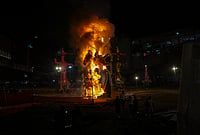
Taiwan’s military carried out coastal exercises across central Taiwan, using rockets, artillery and missile systems to simulate stopping a Chinese amphibious invasion under more realistic combat conditions.
The exercise comes amid continued tensions with China, with Taiwan reporting increased Chinese military and coast guard activity and reiterating that only the island’s people can decide its future.
Taiwan’s military on Tuesday conducted a coastal defence exercise simulating the destruction of an invading Chinese force, deploying rockets and artillery to repel an amphibious assault in what officials described as a more realistic combat scenario with shorter preparation windows.
China considers democratically governed Taiwan part of its territory and has never ruled out the use of force to bring the island under Beijing’s control. Chinese military aircraft and naval vessels operate around Taiwan almost daily.
Taiwan’s western coastline, which directly faces China across the Taiwan Strait, is widely considered the most likely landing point in the event of a Chinese invasion. The latest drill was held simultaneously at eight locations across a 20-km stretch of coastline around Taichung in central Taiwan.
The exercise forms part of Taiwan’s broader effort to modernise its armed forces by introducing newer, more mobile weapons systems while making military training less predictable and closer to actual battlefield conditions.
Artillery commander Ong Yih-ming said the military was moving away from scripted exercises and fixed deployment patterns.


"What is different about this training compared with the past is that we are no longer conducting heavy artillery firing in a fixed, routine formation as before," he said.
"The timing for entering positions this time was based on realistic combat conditions. So I believe this training posed a considerable level of difficulty for our troops."
The exercise involved domestically developed truck-mounted Thunderbolt-2000 rocket systems, U.S.-made Paladin howitzers, anti-tank missiles, artillery and mortars to create a "kill zone" aimed at stopping an amphibious assault.
According to Taiwan’s military, this marked the first operational-area live-fire deployment of the Thunderbolt-2000 in seven years. The system has been developed for long-range suppression and rapid mobility.
Rocket commander Liao Neng-cheng said the shortened preparation period reflected changing training priorities.
"What was different this time compared with the past is that previously, we would usually enter the position one week in advance and complete firing preparations," he said.
"This time, however, we arrived at the position only one day before and carried out the relevant position preparations. So our preparation time was relatively tight."
Taiwan continues to reject Beijing’s sovereignty claims, maintaining that only the island’s people have the right to determine their future.

Over the past month, Taiwan has also reported increased Chinese coast guard activity around the island, including near its eastern waters and around the Taiwan-controlled Pratas Islands in the northern South China Sea.
"The one trying to change the status quo is the Chinese Communist Party," Taiwan's top China policy maker Chiu Chui-cheng told Taiwan media outlet CNews on Tuesday in an interview.
"We will use strength and sufficient deterrent capability to prevent the Chinese communists from changing the status quo by force," said Chiu, who is head of the Mainland Affairs Council.
(Reuters reported)