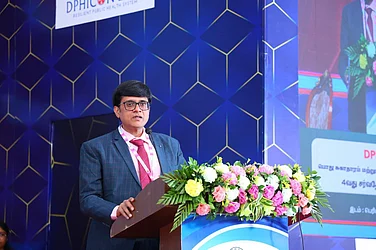
Recognition, at its most visible level, celebrates milestones. At its most meaningful level, it affirms sustained contribution.
The Southern Achievers recognition conferred upon Dr. Sushant Rajput is best understood not as an isolated accolade, but as the acknowledgement of a multidimensional body of work spanning corporate leadership, management education, authorship, and structured thought leadership. What distinguishes this journey is not scale alone, but integration is the deliberate convergence of domains that are often pursued independently.
In contemporary professional ecosystems, specialization is rewarded. Depth in a single vertical is considered efficiency. Yet the complexity of modern institutions increasingly demands integrative thinkers, leaders capable of navigating strategy, human development, and intellectual articulation simultaneously. Dr. Rajput’s career reflects precisely such integration.
As a Vice President in the corporate sector, he operates within environments defined by measurable consequence. Leadership here is not symbolic; it is operational accountability. Strategy must withstand financial scrutiny. Execution must align with governance frameworks. Digital transformation initiatives must translate into tangible performance metrics. His work across financial markets, business development, and operational strategy reflects disciplined reasoning, calibrated risk assessment, and long-term value orientation.
Corporate leadership, however, forms only one dimension of his influence.
Parallel to his industry responsibilities, Dr. Rajput has remained consistently engaged with higher education, particularly management institutions. As a visiting faculty member and mentor to MBA cohorts, he addresses a structural tension within contemporary education, which is the divergence between credential acquisition and decision-making maturity.




In academic discourse, professional formation is often reduced to skill acquisition. Dr. Rajput’s pedagogical philosophy challenges that reductionism. He advocates clarity before ambition, discipline before visibility, and character before designation. His sessions do not merely discuss employability; they examine ethical judgment, emotional steadiness, cognitive depth, and leadership under uncertainty. Students are encouraged to evaluate not only career trajectories, but identity formation to understand that longevity is sustained by internal architecture rather than external acceleration.
A defining moment in his academic engagement emerged during a session delivered after years of corporate leadership. While discussing risk frameworks and strategic accountability, a student asked, “How do we build the judgment to take such decisions?” The question extended beyond curriculum. It revealed that technical knowledge can be transmitted, but judgment must be cultivated. That realization deepened his commitment to mentoring, through transforming guest lectures into structured engagement aimed at building cognitive maturity alongside competence.
This philosophical orientation extends into his literary work. As an award-winning author, Dr. Rajput’s books, “I Wish Someone Told Me This Before My First Job” and “Mindful Momentum: Navigating Procrastination and Overthinking” explore the psychological architecture of performance. Rather than offering motivational rhetoric, his writing examines procrastination as behavioural resistance, overthinking as cognitive distortion, and consistency as a strategic differentiator. His work situates professional growth within disciplined self-leadership.
The global acknowledgement of his broader contribution is reflected in two honorary doctorates conferred upon him. Dunster Business School, Switzerland, awarded him an Honorary Doctorate in Social Impact, Thought Leadership, and Human Development, recognising his sustained contribution to mentoring ecosystems and professional capability building. Kennedy University, USA, conferred upon him an Honorary Doctorate in Literature, affirming the intellectual and literary depth of his written contributions. These distinctions signify institutional validation across domains of leadership, scholarship, and human development.
In addition to corporate and academic engagements, Dr. Rajput has addressed public audiences as a two-time TEDx speaker, articulating themes of disciplined ambition, reframing success, navigating uncertainty, and aligning growth with responsibility. His ideas resonate in an era defined by acceleration and disruption.
That era is now shaped by artificial intelligence, automation, and rapid digital transformation. The half-life of technical knowledge is shrinking. Functional skills are commoditized faster than ever before. Institutions face constant recalibration.
Yet amid technological upheaval, a structural truth persists, that technology can amplify intelligence, but it cannot manufacture integrity. Algorithms can optimise processes, but they cannot substitute for ethical reasoning. Systems can accelerate scale, but they cannot anchor character.
Dr. Rajput consistently emphasizes that future-ready professionals must integrate technical fluency with principled judgment. Skill without accountability creates volatility. Ambition without discipline produces fragility. Growth without conscience generates imbalance. His work across corporate, academic, and literary platforms reinforces this equilibrium.
The Southern Achievers recognition therefore aligns with a broader ecosystemic contribution. It acknowledges leadership that extends beyond individual career milestones toward institutional strengthening and human capital development.
For Dr. Rajput, the recognition is not culmination but reinforcement of a commitment to bridge industry and academia meaningfully, to cultivate professionals who combine competence with conscience, and to sustain influence through responsibility rather than visibility.
Titles may generate attention. But stewardship generates significance.
And significance, sustained over time, becomes legacy.